PDF version of this entire document
To augment GMDS with another discriminant that is more anatomically aware and can be invoked in cases of uncertainty, a rather Euclidean-esque measure was sought.
Fiducial points are assumed to be unavailable as in reality, for example, manual markup won't be provided because it is impractical for fast assessment/comparison. Texture makes it easy to identify areas like eye corners, whereas the nose is easy to accurately locate based on geometric distinction. So assuming absence of texture and fiducial points, in order to use Euclidean distances between different points on the planes (3D only, not 2D+3D) it might be required to decide on geometrically distinct properties, such as the point at which the area above the eye socket flatters and becomes part of the forehead. This is not robust to eyebrow movement however, which brings into play emotional or expression-imposed variation. One natural substitute for this would be the steepness of the nose, which is quite immune to variation by expression and can help discern individuals. However range of change there is minuscule.
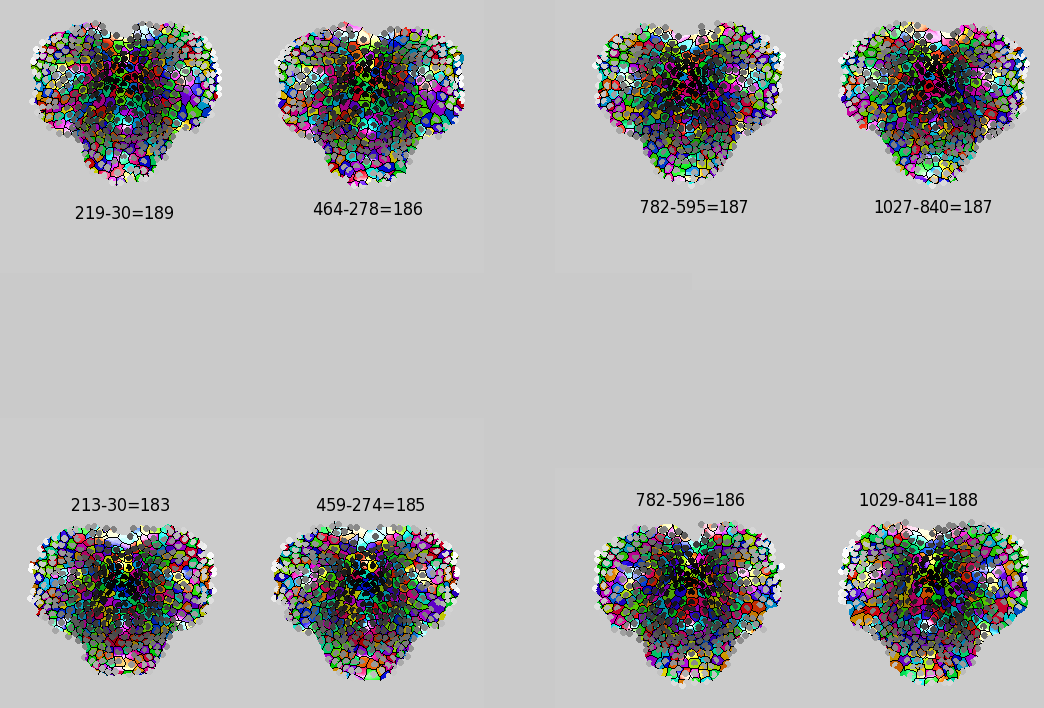
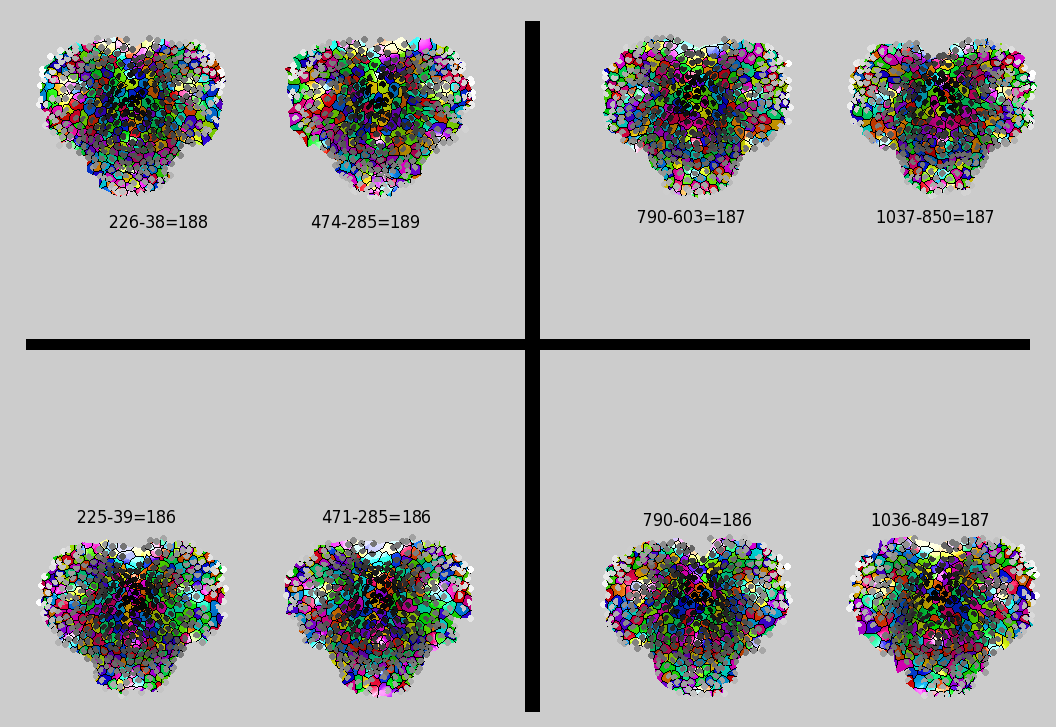
Another possibility is to explore alternative ways of measuring geodesic properties, for example placing a fixed point, carving around it a a geodesic circle and then measuring the Euclidean distance to the edge, based for example on the sum of absolute differences in 3 dimensions. A similar pair of surface should be carves at similar positions. Exploratory experiments were to take a look at the potential of this property, based on a case-by-case assessment.
This exploratory experiment should give a rough idea of the potential of Euclidean combined with geodesic means - a bit like measuring their volume in space along each dimension, at least when confined to lie inside a bounding box.
Having run some experiments manually (with somewhat encouraging results,
as shown in Figure ![[*]](/IMG/latex/crossref.png) and Figure
), it seemed reasonable
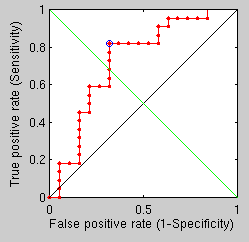
to carry on and implementing this in code, seeing what kind of ROC
curve would result from it (see Figure ).
By incorporating further refinements we might get a discriminant more
effective than the fallback currently in place.
and Figure
), it seemed reasonable
to carry on and implementing this in code, seeing what kind of ROC
curve would result from it (see Figure ).
By incorporating further refinements we might get a discriminant more
effective than the fallback currently in place.
|
Roy Schestowitz 2012-01-08