PDF version of this entire document
In existing (ongoing) experiments, rather than vary the geodesic boundaries, the locations of the points get altered, under the assumption that this can provide a greater source of variability, covering a greater extent of the surface being probed (in isolation for separability of regions). This is not stochastic yet, but it can be made so.
The results are interesting so far (no mis-detections), but more of them are required to draw some meaningful conclusions. GMDS might not be ideal for measuring FMM-dependent similarity, so composing a substitute or complement for this task might make sense, improving it one step of complexity at a time (assessing what improves it and what does not). Ultimately, perhaps a problem-specific or similarity-optimised method can be devised as a substitute rather than a fallback for GMDS and/or PCA (where scale and thus speed/memory are an issue). The sensitivity of GMDS was at times also a weakness, matching things that oughtn't be matched without a penalty large enough.
|
Various images that GMDS deals with just fine are not handled as easily
by this other method I gradually refine (a hybrid of FMM and a level
sets-inspired technique), so they can correct one another and make
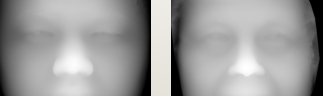
a better joint recogniser. One problematic pair, just for the sake
of an example, is shown in Figure ![[*]](/IMG/latex/crossref.png) , which
is basically detected as almost belonging to the same person (it is
actually on the margin of uncertainty), so the new method ought to
be made more sensitive and less permissive. Currently, the results
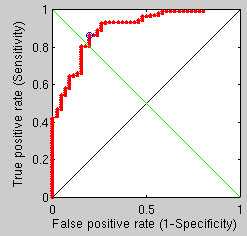
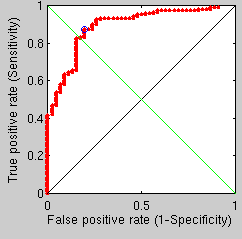
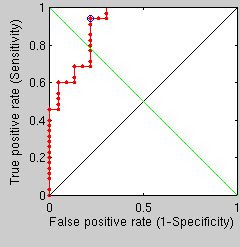
it yields can be seen in Figure
and Figure .
, which
is basically detected as almost belonging to the same person (it is
actually on the margin of uncertainty), so the new method ought to
be made more sensitive and less permissive. Currently, the results
it yields can be seen in Figure
and Figure .
|
Roy Schestowitz 2012-01-08