PDF version of this entire document
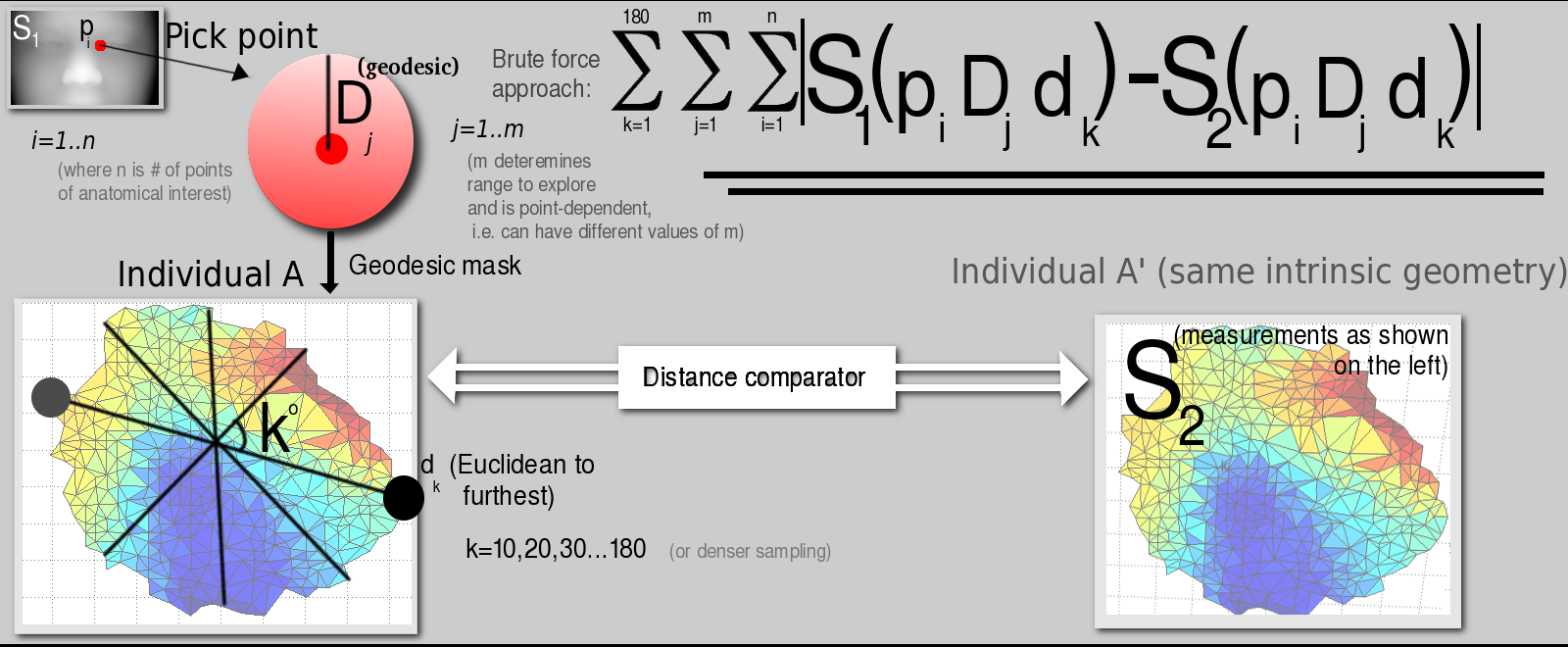
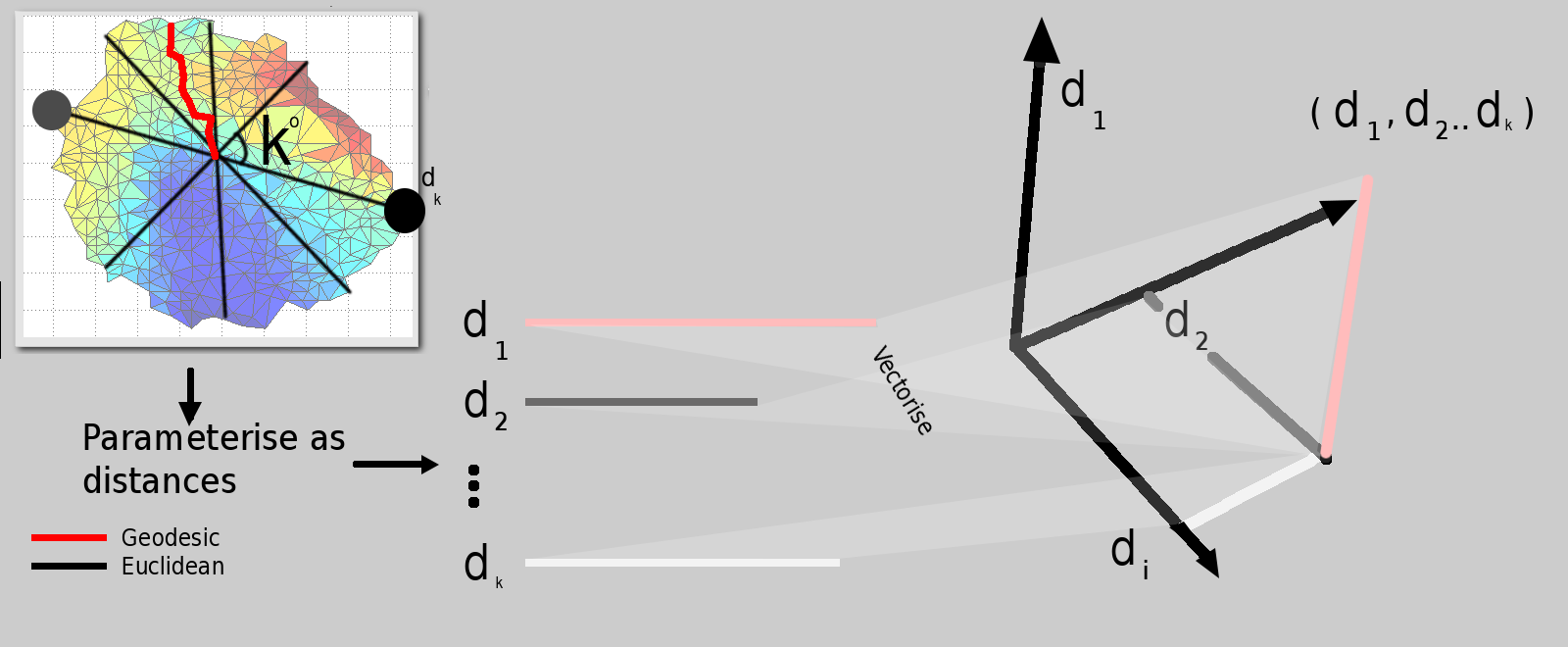
The currently-worked-on approach will try to measure distances between images in hyperspace based on their parameterised version, where these parameters are basically a small set of distances, each (hopefully) encompassing a sort of concise digital signature corresponding to a person's facial surface alone. Currently, 60 such parameters are planned for use, centered around points in the eye and nose regions (less prone to change due to expression).
The sketch shows the approach tested so far. It is a brute force implementation that measures many geodesic distances and then compares surfaces based on distance-to-distance subtractions. It is not particularly clever, but the results of recognition tests are not too bad, either. They help validate the premise that by measuring Euclidean distances in XY, YZ, and XZ (based upon geodesic operators like FMM) we are able to carve out the surfaces and extract meaningful measures from the sub-surfaces.
Another figure, Figure ![[*]](/IMG/latex/crossref.png) , shows the
next step.
, shows the
next step.
|
Roy Schestowitz 2012-01-08