PDF version of this entire document
The long term goal is to eventually replace the PCA with G-PCA, or more accurately, with GMDS. I.e. use the existing result for alignment and then measure the discrepancy between faces by embedding one extracted portion of the face to another and use distortion as a measure of similarity. Under the assumption that G-PCA is generalised PCA, yes, it's easier to see where this is going. Prior work on GMDS proved viability of distortion as similarity measure, but that cannot be compared on a like-with-like basis against the other group's results.
By applying shifts to the average shape (of either a person-specific or group-specific) corresponding to a residuals model they can show synthesis and by minimising an objective function it ought to be possible to do fitting, too. The parametric space is very high-dimensional though and it is hard to believe fitting is something which was done in this context before (Cootes et al. have methods for enabling it, even when texture is added to a combined model). One might wish to demonstrate GMDS-driven fitting algorithm.
We used the functions as they were given to us and leveraged them
to get video sequences loaded and sorted for the PCA experiments ![[*]](/IMG/latex/crossref.png) .
.
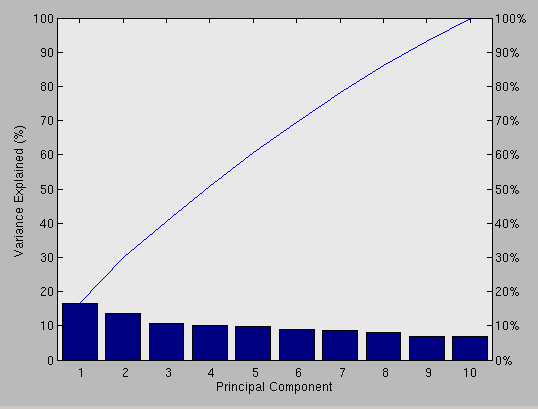
We eventually built and saved a relatively large EDM from GIP datasets.
It can be used later on. Figure
shows a decomposition of that.
|
Roy Schestowitz 2012-01-08