PDF version of this entire document
As template experiments with data that was collected from distinct subjects are needed (in order, for example, to perform recognition tests and use a classifier for ROC curves), experimental protocols from FRGC were sought, finding a suitable training set and target/query/matching sets.
This process varies from learning some of the metadata and experiment scripts/SGML/markup/data to looking at some sample data in 3-D, which is non-trivial to browse/navigate without some special/ised visualisation tools. For FRGC 2.0, the master file in
FRGC-2.0-dist/BEE_DIST/FRGC2.0/metadata/FRGC_2.0_Metadata.xml
contains a suitable index and experiments from previous years can also be run using the older protocols at
FRGC-2.0-dist/BEE_DIST/FRGC1.0
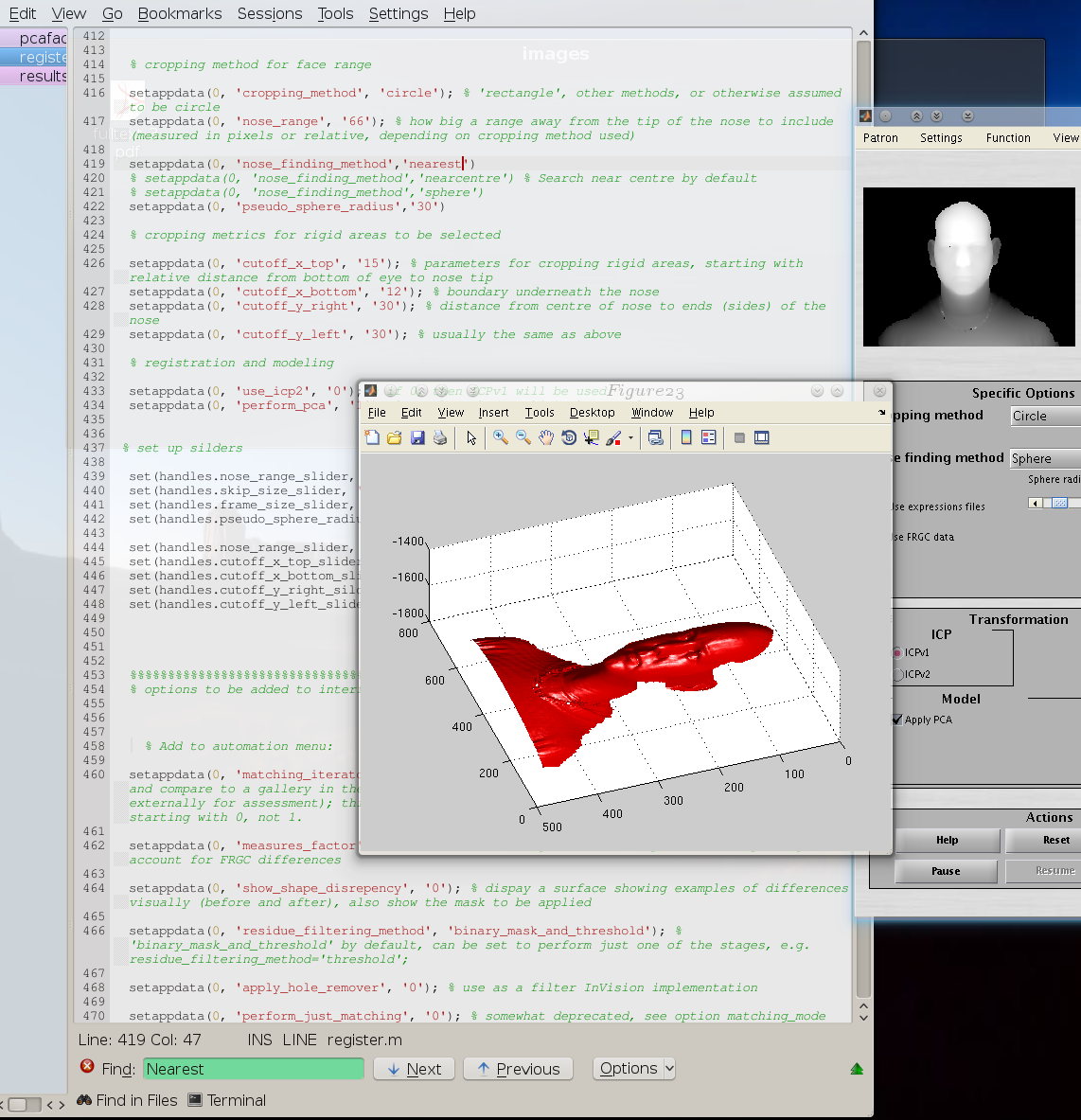
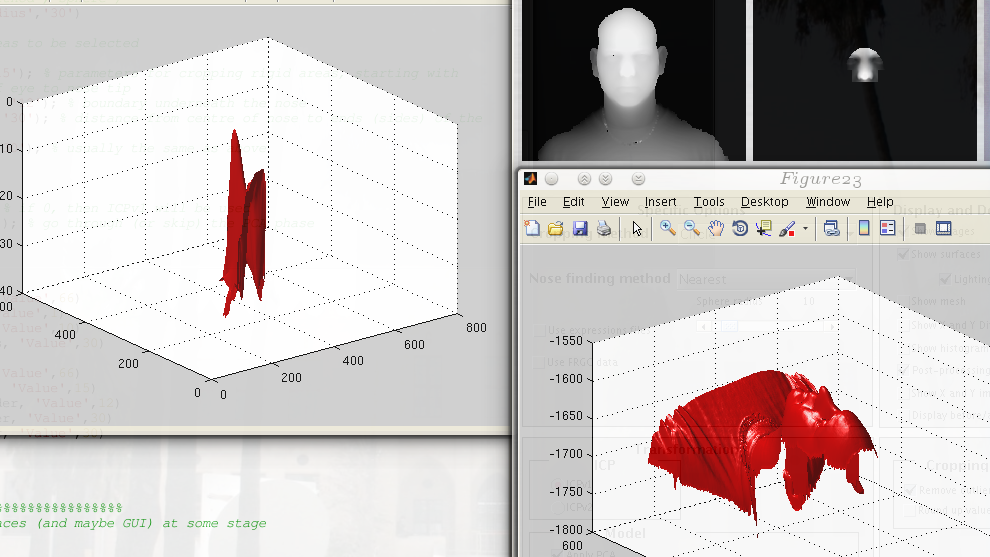
Early tests with the data (see screenshots of the development and
experimentation framework in Figure ![[*]](/IMG/latex/crossref.png) ,
as well as figures , ,
and ) suggest that we need to make some new
binary masks for residuals.
,
as well as figures , ,
and ) suggest that we need to make some new
binary masks for residuals.

|
|

|
Roy Schestowitz 2012-01-08