|
There are currently, 58 guest(s) and 0 member(s) that are online.
You are Anonymous user. You can register for free by clicking here |
|
Select Interface Language:
|
| |
Registration Benchmark
Posted on Friday, November 04 @ 09:56:29 GMT by admin
|
|
 E may soon start working in collaboration with the MIAS-Grid, as well as the IRC. MIAS-Grid, where MIAS stands for Medical Images and Signals, is a project which ultimately produces an e-Science workbench for medical image analysis. To demonstrate the utility of the system, a series of use-cases is required and our code might be among these.
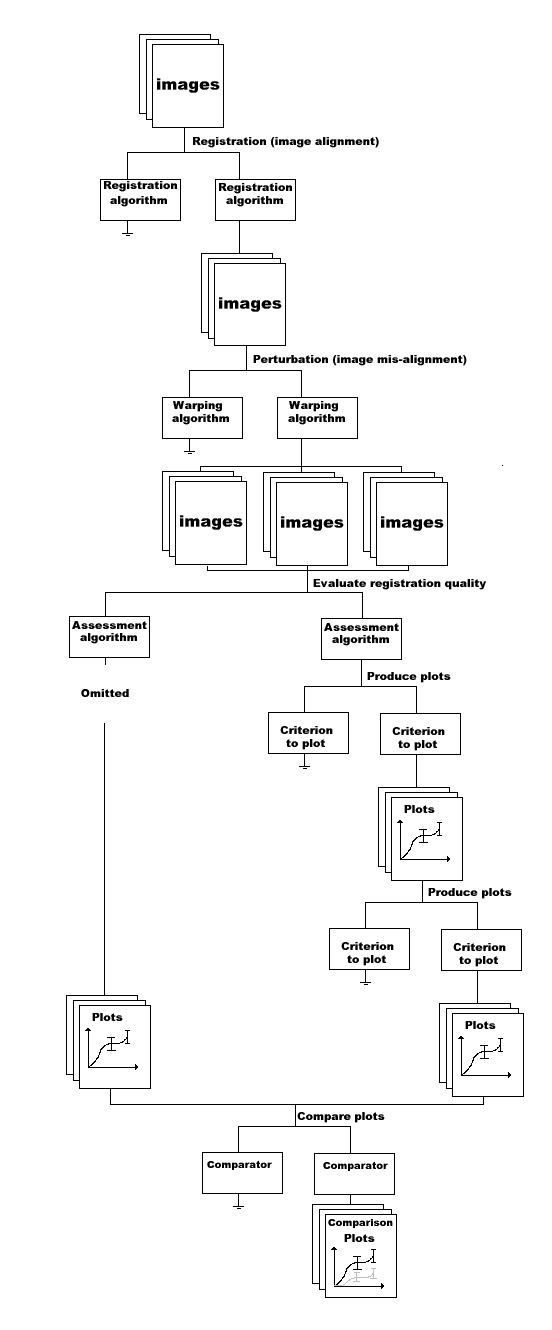
Essentially, the Grid might have our registration assessment algorithms re-created. It will then compartmentale the processes and carry out some analysis in a transparent way that has robust, well-understood interfaces (e.g. XML-RPC). Subsequently, these processes can be embedded as workflows within the workbench, which might involve autonomous and powerful computers. Algorithms can easily be exchanged, thus enabling benchmarks (comparisons) to be rapidly conducted. The idea is reminiscent of the principles and rationale behind the Strategy Patten in OO programming.
Image registration assessment: the benchmark architecture
Click image for full-sized version
We are not too certain about the future of this initiative and, in particular, some of the technicalities. Yet, we would feel privileged to have an opportunity to work on such modern computing architectures. Our particular set of binaries can directly benefit from parallel workflows. In short, here is the framework that can be envisioned already:
- We are given a set of N images
- We have M such image sets
- We need to build a model for each set among these M sets. That can definitely be done in parallel and there is no apparent dependency
- We now proceed to evaluating M models and again there are no dependencies among the evaluation processes
To add some context, registration is evaluated through the construction of appearance models. All in all, the process in question need not be serial and it can be handled merely (not entirely) in parallel. We can further refine speeds by treating sub-sets of data (chunks) and then aggregating the results, if needed.
This would be similar to things we have done in the past, such as deploying banaries in computer clusters, invoking them via SSH, and collecting the output later. At extremity we used 30 units overnight to produce some urgently needed results.
|
Associated Topics
 |
|
| "Registration Benchmark" | Login/Create an Account | 0 comments |
|
| | The comments are owned by the poster. We aren't responsible for their content. |
|
|
|
No Comments Allowed for Anonymous, please register |
|
| |
|
There isn't content right now for this block.
|
Don't have an account yet? You can create one. As a registered user you have some advantages like theme manager, comments configuration and post comments with your name. |
|
There isn't a Biggest Story for Today, yet.
|
| Wednesday, October 19 | | · | Registration Assessment Without Ground Truth Proven Most Sensitive |
| Thursday, September 15 | | · | Registration Without Ground-Truth Solution - Proof of Concept/Empirical Evidence |
| Friday, September 02 | | · | FTP Access or a ZIP Archive |
| Wednesday, August 24 | | · | Registration: Tanimoto Overlap and Model-based Evaluation |
| Thursday, August 18 | | · | Specificity, Generalisation and Registration |
| Monday, July 25 | | · | Placing Labels at Strong Edges |
| Tuesday, July 19 | | · | Model Construction and Registration in Medical Imaging |
| Thursday, July 14 | | · | Euclidean Image Distance |
| Thursday, July 07 | | · | Evaluation of Appearance Models |
| Tuesday, July 05 | | · | Parallel Work |
| Monday, July 04 | | · | Label Propagation |
| Sunday, July 03 | | · | Segmentation Propagation from Model |
| Friday, July 01 | | · | Segmentation in Relation to Models and NRR |
| · | Mean of Squared Differences (MSD) Unstable at Registration |
| Thursday, June 30 | | · | 3-D Surface Visualisation |
| · | Migration of Code |
| · | MIAS-IRC and MARS |
| Wednesday, June 29 | | · | Simultaneous Segmentation, Registration and Models |
| · | Migration from AART to MARS |
|
|
|