Introduction About Site Map

XML
RSS 2 Feed RSS 2 Feed
Navigation

Main Page | Blog Index

Archive for November, 2006

Digg Changes Algorithm

The Digg front page

DEMOCRACY has returned to Digg.com, all at the expense of arguably-deserved rewards (power and advantage) given to top site contributers. These latest algorithm changes affect me as well, though I have not been submitting any stories for a fortnight.

Will this prove to be a wise move by Digg’s administrators? Was it well overdue? History will tell. But here’s a sure bet: top users, whose labour contributed the most to Digg, are utterly dissatisfied by the large.

I noticed that fellow Diggers are unable to get front pagers. The frustration and loss or power is likely to discourage further participation. The problem is thus resolved not only by changing the rules, but also by demoralising regulars. It’s somewhat of a scare tactic, which is a bad idea no matter how you look at it. Good for newbies perhaps, but it drives away the “power Diggers”—those who care the most about the Web site, know it best, and submit the least duplicates. A shame really…

Putting Code in Perspective

I used to envision myself coding for the rest. Of. My. Life. many times I thought I had it all figured out. And nevertheless, experience suggests that preferences, trends and prospects always change. The industry nowadays is dynamic, volatile, and ever-changing. Thus, predictions that are long-term are utterly silly.
I have neither stopped coding, nor began to neglect purely technical things, but I refuse to ‘reinvent the wheel’ so to speak. Apart from packaged (often closed-source) applications that are out there mimicking each other and achieving virtually the same thing, one can turn to Sourceforge and see that not many project code is being re-used, let alone used (downloaded and run). There is a certain exhaustion in the market due to saturation, as well as the ability to duplicate good software for free. That’s why I advocate Free software, albeit not at the same level of capacity that equates to activism per se.

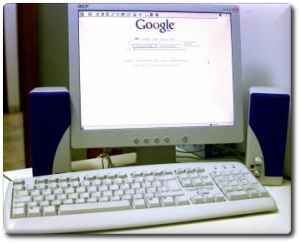
Google on a computer screen

I content that companies which ignore Open Source will not survice. Let’s take Opera for example. Opera needs to open up in order to attract enthusiastic volunteers (for plugins & testing, among other contributions). Only then will it match Firefox. Internet Explorer is all about monopoly abuse, so the same rules don’t apply. It does, however, come to show that proprietary software evolves slowly and often plays catch-up.

Maintenance and support will soon exceed programming and development in terms of capacity. Systems administration and architecture are the next big wave. “Open Source” becomes more of a vernacular term whilst hordes of programmers will stampede toward that development paradigm. Wither your right to survive in your career? Why? Better evolve; sooner rather than later.

Maemo Joins the ‘Candy Store’

Tiger in KDE
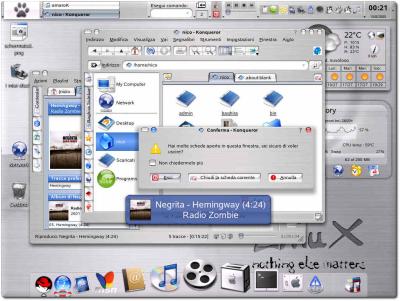
Linux with KDE in its Baghira glory

WHENEVER I approach kde-look.org (site), I feel like a kid at the candy store. So many themes and customisations are available there—to accumulate and use for free. Surely, there are also sites such as gnome-look.org and kde-files.org (among other other sister domains), but they are not quite as relevant to me.

Recently I spotted an applications site for the Linux-based Internet tablet from Nokia. Free goodness; community-driven. It may be just another sister sites of that large network that’s a candy store to those who love to shop for applications and themes (FreshMeat and SourceForge are less properly integrated). To those interested, here are some links:

KDE-Look.org
KDE-Apps.org
KDE-Apps.de
KDE-Files.org
GNOME-Look.org
Xfce-Look.org
Maemo-Apps.org

Assorted Search Engines Observations

WHILE Ask transforms itself into a search engine with technical merits (rather than many ads), Internet leviathan Google continues its climb. It appears as though this duo comprises the only prominent players that still gain market share. I have become rather fond of the Linux/Open Source news feed that Ask is offering.

Also while on the issue of search engines, various sites build content from RSS feeds in a supposedly legal fashion. This transforms the way search engines operate. Have a look at this discussion that is a good roundup. Google has already been sued in Europe over its news aggregator

Lastly (yes, more on the subject of search engines): Politicians beware – Internet prolongs blunders

Longevity — a Hot & Cool Topic

Season of the playful penguins
Season of the playful penguins from Oyonale

I finally found justification and backing for my long-time temperatural preferences.

Cool down – you may live longer

11:20 03 November 2006
NewScientist.com news service
Roxanne Khamsi

The refrigerator is used to lengthen the life of your food, and a new study suggests a similar principle could prolong your life, too.

Apple Pulls Another Fast One

Macs cluster

APPLE’S moves seem slightly worrisome. They have just incorporated encryption into their kernel.

Apple’s so-called ‘DRM‘ of the kernel does not only mean an adoption of dodgy technology for the benefit of the company rather than the customer. Binaries (without accompanying source code and compilation details) are bad enough as they are. They hide the intention of a program. DRM‘ing them makes them not even runnable, regardless of what they are set to do.

Apple is being hypocritical here. It boasts virtualisation of Linux and Windows (even full installation of Linux), but it doesn’t permit OS X to run on anything other than Apple’s pricey hardware. It’s a one-way relationship.

Bill of Rights for the Web?

This one is an eye-catcher in case you have been following the progression of the Web. This relates to the tiered Web, the divisive (isolated) Web, and censorship.

A bill of rights for the internet age has been proposed at a United Nations’ conference in Athens.

The bill would update and restate rights that have been enshrined for centuries, said Robin Gross of civil liberties group IP Justice.

As an aside, one of the greater threats to the Web are Windows zombies which pollute the Internet with SPAM and DDOS attacks.

Also see: Web developer (Berners-Lee) fears for the internet, Berners-Lee calls for Web 2.0 calm

Retrieval statistics: 18 queries taking a total of 0.074 seconds • Please report low bandwidth using the feedback form
Original styles created by Ian Main (all acknowledgements) • PHP scripts and styles later modified by Roy Schestowitz • Help yourself to a GPL'd copy
|— Proudly powered by W o r d P r e s s — based on a heavily-hacked version 1.2.1 (Mingus) installation —|