Introduction About Site Map

XML
RSS 2 Feed RSS 2 Feed
Navigation

Main Page | Blog Index

Archive for the ‘Windows’ Category

Microsoft is in Serious Trouble, Even Microsoft Staff Knows It

This morning I wrote about “voluntary” (NOT!) layoffs at Microsoft.

I said: “They can’t catch a break, can they?”

I was using wordplay because it is summer’s break.

A friend asked, “why should shoddy, subpar, proprietary software be given any preferential treatment by groups which don’t have access to the backdoors / bugdoors built into the product(s)?”

He said that “can’t catch a break” looks too much like sympathising with Microsoft.

“It’s good news that the world is giving Microsoft,” the friend said, as well as “its products, and services the
heave ho. What remains, especially in Europe, is how to deal with the leftover microsofters which have displaced as good as all IT departments.”

“Even the idea of a team to support workers to use ICT to their advantage has become foreign due to the persistent pervasiveness of microsoftianism over the IT departments it has displaced.”

Another friend said “it will take a lot of time and effort to get rid of them and to properly train IT people on real technologies again you could talk about a lost generation or two. I’m just glad I started using GNU/Linux in 1997 and abandoned Microsoft in 2002, long before the current move towards GNU/Linux and free software…”

For Microsoft, When It Rains It Pours

Crossposted from Techrights

10 hours ago:

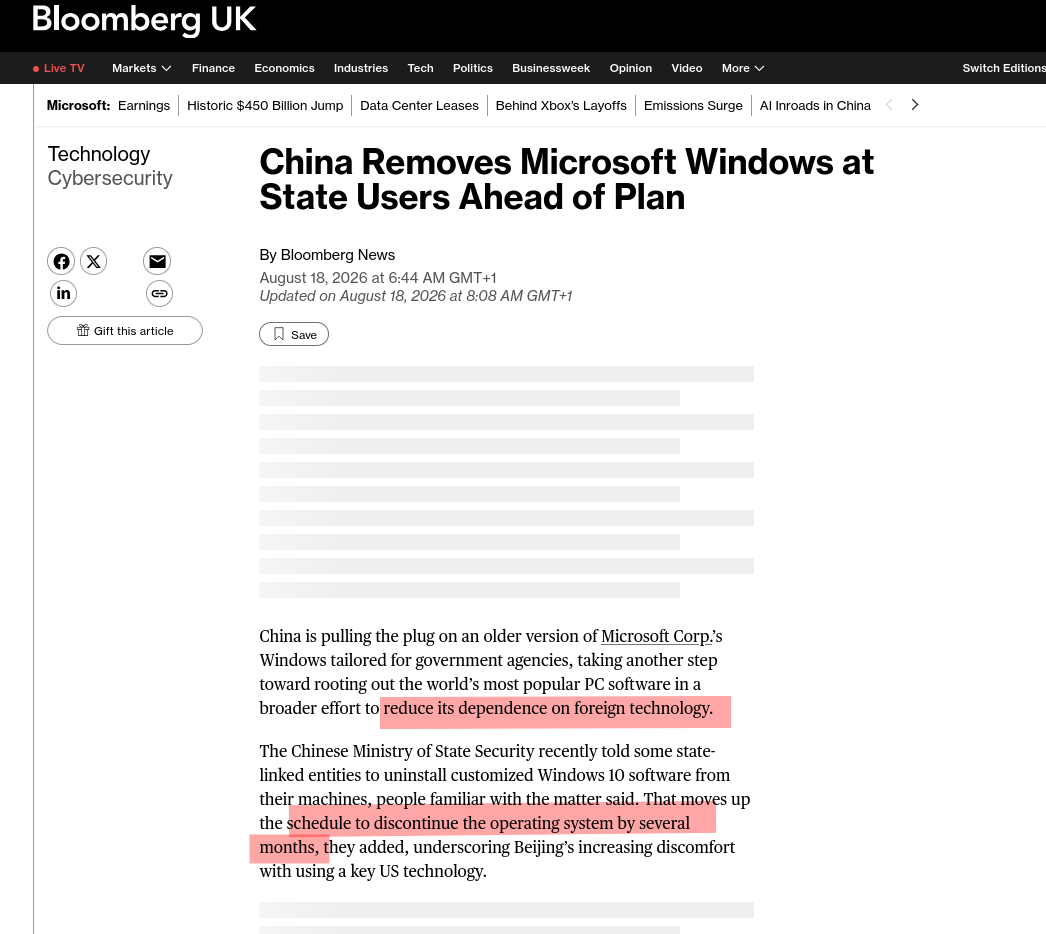
China Removes Microsoft Windows at State Users Ahead of Plan

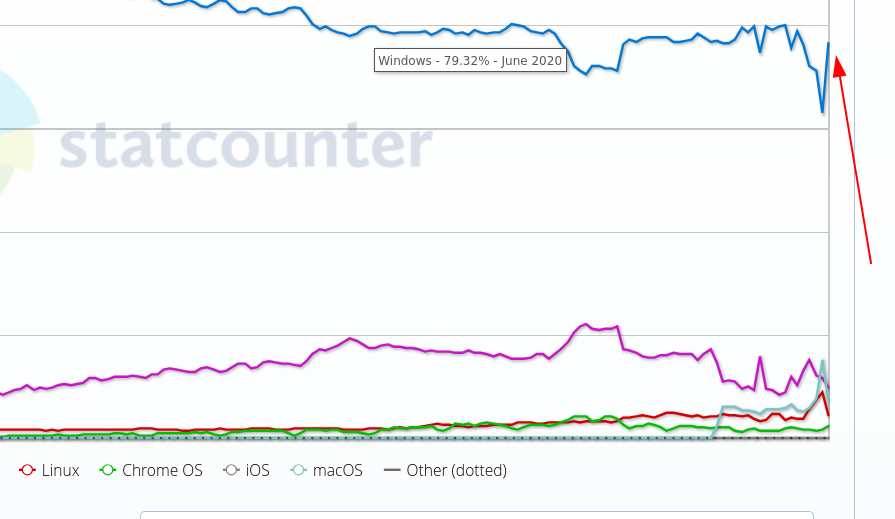
Last week: Clownflare Sees a Lot of GNU/Linux in China, Unlike statCounter

In the US, the home of Google, Apple, Facebook, Amazon and Microsoft (GAFAM), GNU/Linux is said to have exceeded 10% “market share” on “the desktop” (desktops/laptops). Even Clownflare (US) sees that.

What about the world’s second-largest economy (by GDP)?

China said it would reduce its reliance on GAFAM several times over the years, but now there is a timeline and perhaps also a directive/order like in France.

It is hardly surprising that Windows is shedding off userbase all around the world and Microsoft has mass layoffs even during the summer break.

They can’t catch a break, can they?

In India, whose population is estimated to be bigger than China’s (based on the official figures at least; some authorities dispute these because of undocumented residents and distant/detached settlements, nonconfomist societies that reject any census), things are even worse for Microsoft and much better for GNU/Linux.

Windows Needs to Disappear

I recently wrote about security crises associated with Windows deployments. “On the topic of Windows,” a friend told me (citing this one article): “The writers there (and elsewhere) conflate spending with results. Security is part of the design and not an aftermarket add-on. The latter is a pointless and futile waste of time and money, but one which keeps Microsoft market share from bottoming out. [...] the Microsoft way of thinking permeates their design *and* implementation *and* especially their deployment.”

I still firmly believe that removing most Windows installations out there (ultimately all of them) would considerably improve computer security worldwide. Microsoft designs things not for security but the very opposite (remote access by the state). ?

Microsoft and Windows Need to be Eliminated for Computer Security to be Possible

I‘ve just published another post about why Microsoft needs to be eradicated as a matter of national security. If Finland still uses anything from Microsoft, as I generally argue that it sadly does, then it remains widely open to any Russian cracker all the time.

“Only the physical border is being limited,” a friend told me. “The digital border has been cracked wide open and the visit by Microsoft’s Brad Smith and the subsequent failure of authorities to detail and charge him indicate that the crack is widening.”

“Lots of Windows TCO announcements are likely during the long weekend, especially from the assholes at shit organizations and companies which have decided to sponsor more malware via payment to ransomware operators. First and foremost Microsoft is to blame. Second, however, are those who have chosen to intentionally underwrite more breaches by paying the ransom, instead of having had proper data hygiene and backup practices.”

“Dissent” at databreaches, i.e. the main author of a site that tracks major security incidents (cracks/compromise), had an interesting message for Thanksgiving and then covered many new incidents about this topic over the weekend (which has only just started). Are companies revealing severe failings while journalists are away on holiday?

Citing this new article, the friend said they’re “underwriting further attacks against inherently vulnerable Windows useds” [sic].

The world won’t be without breaches after Microsoft is gone, but there will be vastly fewer such breaches. Also, the Microsoft way of teaching “security” is part of the problem..

2 Decades Without Windows

“Windows 98 should have been released for free on Jan. 1, 1996 and titled Windows 95.1. If this were Hollywood, then Windows 98 would be the equivalent of ‘Heaven’s Gate’, ‘Waterworld’ and ‘Godzilla’ rolled into one. A huge, overhyped, bloated, embarrassment.”

Jesse Berst, ZDNet editor

MY GENERATION (I’m 37) grew up on DOS. Not necessarily Microsoft DOS, either. Just DOS. As a kid I used to work from the command line. We, as kids, taught one another new tricks; sometimes an adult would visit to teach us things and copy some programs for us (floppy disks with compressed archives). Various utilities like RAR were useful. Sometimes an infection (malicious program) needed to be removed. That was before the days of Windows 3.x — the days we used ncurses-type interfaces to type documents and send these to printers. Later on I did some programming with batch files and at around age 15 I started with Pascal (quite popular at the time owing to simplicity and relative elegance).

I mostly missed the BBS generation (some friends of mine used it; they’d copy for us files they got from there). When bulletin board systems were still popular many computers did not even have modems (few of my classmates had them, usually because of lack of a technical parent, and only one of them was a GNU/Linux user in the mid/late nineties). I think I got my first modem when I was 14 and IRC was probably the first thing I used “on-line”. After Windows 95, which many people used at that time, I bought my last Windows laptop. Actually, my father bought it. He used it and then passed it to me. It had only 32 MB of RAM and Windows 98. I carried it around and used it in university as an undergraduate student (at the faculty I used GNU/Linux at the time). It retired years later and I’ve not bothered with Windows since then. I wrote a great deal about it in USENET at the time. Memories from these days are mostly gone by now; I barely ever touch Windows and when I do it’s over Remote Desktop, typically to access a client’s network, e.g. to run PuTTY from a remote system. That happens about once a month (patching Debian GNU/Linux servers).

Was Windows 98 a decent operating system? No, it was unreliable, but at least it ran on modest hardware without much RAM. I ran Firefox on it, with a total system capacity of something from the mid-nineties (~400MegaHertZ CPU, 32 MB of RAM). That was before Microsoft added back doors to Windows (this was reportedly done in 1999), before the bloat of NT and before DRM (Vista).

With 3 weeks left before the end of this year (and this decade) I remember not so fondly the 90s, back when I used Windows. In 2000 I moved to GNU/Linux, helped by a Finnish friend, an exchange student at the university. In a sense, next year I become a 20-year GNU/Linux user.

Letter From Anonymous on Windows Going ‘Open Source’

The other day I was sent an anonymised E-mail from someone who entertained the possibility of an “open” Windows/Microsoft — a notion that I reject for realistic reasons. Here is the full discussion.


Defining the Cause

Friday October 25, 2013

Hi Roy,

A like to share with you a thought and hear what you think.

By some twist of faith, how many Linux users are pushing for Linux over Microsoft? That would be a lot, right? But, as long as Linux users are pushing for Linux, you know they forget that Linux was “proprietary” too. So doesn’t it make a whole lot more sense, to do the SAME to Windows and make it “open source” too, just like GNU did for Linux?

This is not an accurate account of history. Linux Torvalds chose the GPL for his kernel, which was only briefly licensed as proprietary (it was obscure at the time). This is similar to MySQL. Windows cannot be compared in an apple-to-apple fashion by warping suppositions.

Here are some reasons for it, although not in much order or cohesion. I’m just rushing this to get it out. Please don’t be offended, just consider the possibilities of where this leads for the cause, okay?

If Windows become “open source”, shouldn’t that be a good thing? Don’t we want to see more corporations becoming “open source” free providers?

We want to maximise freedom, for freedom’s sake. If Windows was able to use deceiving labels to perpetuate control over users, that would not be a good thing.

Is the battle of Linux overshadowing GNU? Which isn’t about a kernel, as so much for being “open source code” to be a lot more important, right?

Maybe that SCARES Linux developers? Why would anyone want to use Linux if Windows was made “honest” by releasing ALL of the “open source” code?

It’s not just a problem of honesty and the “battle of Linux” can be viewed as a battle for GNU/Linux, however “battle” may be defined. Advocacy perhaps, given the context.

Haven’t Linux enthusiasts pointed out that Gnu/Linux is trusted more for being “open source”? But the same could be true if Windows did the same!

It’s not just about trust. There is more to it than that.

Are we fighting for “open source” code or against proprietary code? Or is that we just loath and hate anything about Microsoft? Hopefully, we will realize, the main real reason why Microsoft become hated, for using “proprietary code”.

Microsoft is not hated for this. Based on my experience talking to people, ethics are the problem, business ethics in particular. The framing of advocacy as a “fight”, or the choise of pro- or con- (for or against) is quite arbitrary; if you are for something, one can always portray you as being against something, or vice versa. Bias guides language.

Proprietary code is locking in vendors, people and society.

And it is not just about lock-in.

Of course, Linux is designed a bit differently than say Windows. Windows has made it easy for novice, no need to learn “terminal”. But, it always had a clumsy dependency to backup plenty of DLLS versions for instance. Which is just ridiculous! It takes a Chinese hackers to offer the only unofficial tool to actually trim and reduce the WinSxS bloatware.

Windows had and still has competition which makes it easier for novice users to embrace computing. There are suppositions above that I cannot accept, so I cannot reply to them.

You know, “open source code” would be the BEST thing for Windows and Microsoft. That’s not as scary as it seems, because the real reason Linux despises Windows and Microsoft, is for the lack of interoperability, vendor lock-ins, and shoddy development, that has comes to be known as mostly vaporware branding in the world!

Microsoft has already tried openwashing. It also created some proxies that try to make Microsoft look “open”. I don’t think these have been effective as people very much distrust those proxies and many detest Microsoft even more for trying to infiltrate the philosophical rivals. sometimes derailing it from the inside.

But, all of this could be eliminated, if Microsoft adapted “honesty” as their policy by supporting and releasing “open source” code under GPL3 or GPL4 (coming soon).

Honesty, tenets, etc. have been tried by Microsoft marketing already (microsoft.com still has some Web pages to that effect). The same goes for “transparency” (for example reports on surveillance requests compliance). If everything Microsoft ever released was re-licensed GPLv3+ (unlikely as they incorporate bits of code from other parties), that would not mean honesty. Malicious features like DRM (for Hollywood) and perhaps back doors would still be in there.

I am beginning to think, it was NOT Linux that matters at all for whom without having “open source” code, Linux would had remain proprietary. The only reason Microsoft is proprietary, is related to it’s CEO, “Bill Gates”, who pushed the business into a market monopolizer for profiteering, right?

Gates is no longer the CEO and Linux would not have become popular if it remained proprietary (BSD was already ahead). There were other forces in industry pushing for proprietary, even predating Gates.

Didn’t he advocated and pushed that software freedom by taken away for the sake of profits? This works against an open free society, it is evil, it is immoral and that’s the pain, misery and suffering we are having to cope and deal with here from the very beginning.

The same practice is embraced by the medicine ‘industry’ (oligopoly), where generics are being kept away for the sake of profit (more people die, but large corporations make more money). India seems to be the only country that is eager to fight against this, at least sometimes.

What is to prevent the same thing from happening with Linux now? Won’t some rich corporation take it over, once it matures into a rich profitable market? We (creators and developers) do all the work and they (proprietary owners) take over, right?

The GPL does not quite allow this. Linux can be forked if this happens and all the developers then work on the fork.

So what is important here, is the push for “open source code” more than anything else. But tell that to Linux users who bash Windows a lot, instead of realizing there will always be another proprietary around the corner to replace Microsoft. Maybe that would be Apple OSX. Maybe, it might even come from China or Taiwan!

Windows is being replaced by Android to a large degree. Android is a free/libre system for the most part. Taiwanese companies and Chinese companies (RPC) use Android a lot. The notion of ownership is different when licensing is copyleft-leaning.

How much longer will it be before Ubuntu or Linux gets bought by proprietary rich corporation like Microsoft? But, if we got Microsoft to use GPL3, maybe a GPL4 is required, to become “open source” this would INSURE GNU life of living!

These are unlikely — if not impossible — scenarios. There are other risks — urgent issues like software patents. Using these, for example, Microsoft is believed to be already making billions of dollars from Android sales.

The open source community is no less human like the rest of us. There will be temptation to swing back to proprietary. So it is just better to get all public businesses to ditch proprietary code all together, once and for all.

Swinging back to proprietary or “semi” proprietary (like “half” pregnant) is a real issue these days.

The same can be said for freedom, as a democracy cannot be both ignorant and free at the same time! When you fail to demonstrate adequate concern for the freedom of others, you embolden and empower those who want to take yours away.

The same applies to “open source” code. If we don’t insure it for everyone, there will be others who will want to push “proprietary” code.

Now, imagine how the world would had been improved differently had Microsoft not been proprietarized. All the best ideas and software code could had been shared freely with everyone and a more open free society.

Microsoft was proprietary from the start, not proprietarized, except when Bill Gates fished other people’s code from the dumpster, as he himself admitted.

Which is greater to have, your freedom or wealth? What good is wealth if you have no freedom? In comparison, if you have freedom, you can do anything.

Which is greater to have, your health or wealth? If you have wealth, you need it to afford healthcare, but you still may not obtain health. However, if you have your health, you can always earn wealth.

Now you diverge.

Which is greater to adapt in society, proprietary code or open source code? If you use proprietary code, nobody else can build upon it. If you use open source code, and it’s kept free for all, then everyone can contribute and build upon it.

The same can be said for society, as an open free society who strives with self-determination will thrive as a people. As compared to a tyrannical totalitarian society that is reduced down to a few possibilities.

That’s why Linux isn’t or shouldn’t be the focus. GNU must be the spotlight by insuring Windows is made “honest” to release the source code. It may even help fund GNU to discover all the infringing code used in Windows. What is it, 70 million lines of code there?

GNU/Linux is not the sole area to focus on. Ethics and justice are important, Free software is the means to reach the higher goals.

The only people who have something to hide, are those using proprietary code! What is Windows hiding? We should have the legal right to know, if there are backdoors built in. We should have the right to correct the source code, for mistakes, design flaws, to let everyone improve it.

Someday sooner, we will realize by releasing our freedoms, so that profits can be given away to a few will be viewed as both illegal and immoral. It puts the rich and wealthy first, and makes the society hindered, handicapped, crippled and censored.

Secrecy in code — as in anything in life — harbours misbehaviour. Richard Stallman foresaw the applicability to computer programs.

Feedback? Feel free to interject. I especially enjoy a rebuttal.

When is the new TechRights site going to be up and running?

Did you like any of the ideas for the documentary video?

Waiting to hear!

The scope of Techrights expands because GNU/Linux has outgrown the “advocacy” stage and our enemies are no longer just tech companies. A documentary video needs to be short in order to be viewed by many, or split into chunks because people have become too lazy (of overburdened by information overload) to sit through a full-length film.

If you want to write a guest post for Techrights (highlighting some of the above points), please go ahead.


For those who are not aware, I have been redesigning Techrights with Drupal.

GNU/Linux on the Server Side Helps ‘Desktop Linux’

The Network Effect in action

Network spheres

The myths about “desktop Linux” are mostly associated and tied to “easy of use”. Many people, mostly ones with next to zero experience when it comes to GNU/Linux, have blindly decided that the slow growth of GNOME and KDE is due to an inherent problem other than marketing. But perceptions are changing when people discover that they are surrounded by GNU/Linux, even if their own client machine does not run a Free/libre operating system.

Whenever I perform scientific experiments, I entirely separate my work machine from the computational machines, which are dedicated to a particular task and are optimised for uptime, resilience, and good memory management. These machines exclusively run GNU/Linux, for technical reasons of course. In addition, soon enough one of the Windows clusters will be converted into dual-boot, permitting even more computational power to be amassed from remote nodes, provided one is not a Windows drone. In this modern age when just about any large cluster or computational server runs GNU/Linux, what can a Windows or Mac OS X user do to justify a choice of non-homogeneous platforms, wherein there is basically disharmony and inconsistency between the back end (server) and the desktop/workstation? There is a time penalty associated with moving a program from a proprietary desktop environment to GNU/Linux at the back room. It is not surprising that more and more people in my field are moving to UNIX or Linux on their desktop.

To what extent might the rise of Android impact people’s feelings towards GNU/Linux on the desktop? It does seem like iPhone has already managed to persuade some users to replace a Windows desktop with an OS X desktop. I see examples of this all the time, although as proof it’s merely anecdotal, not statistical.

Retrieval statistics: 21 queries taking a total of 0.109 seconds • Please report low bandwidth using the feedback form
Original styles created by Ian Main (all acknowledgements) • PHP scripts and styles later modified by Roy Schestowitz • Help yourself to a GPL'd copy
|— Proudly powered by W o r d P r e s s — based on a heavily-hacked version 1.2.1 (Mingus) installation —|