


Archive for December, 2022
 Filed under:

England and Wales Deaths in December 11.2% Higher in 2022 Than Pre-COVID-19 Levels
Week 48 deaths:
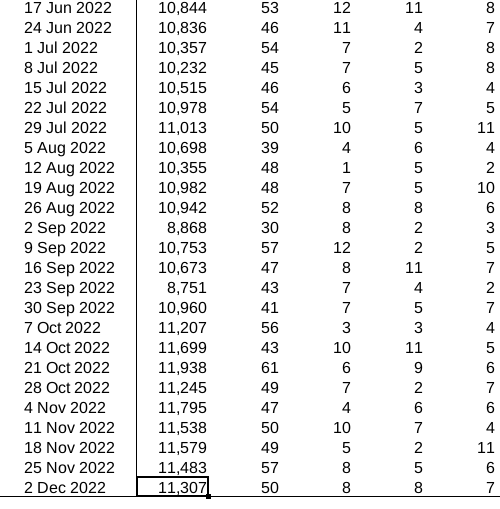
Data: 2022 deaths as OpenDocument Format
New figures released today. 11,307 deaths in England and Wales for the last week — far above the usual. For perspective, 10,164 were registered for the same week prior to COVID-19 (2015-2019 average).
That’s an increase of 1,143 in about half a decade, representing 11.2% (relative) increase.
The new cluster in the low-risk percentile are younger people. In other words, more young people die.
‘Long COVID’ Impacting Several Millions of Brits
Published hours ago:
Description:
Self reported long covid
2.2 million (3.4% of the population)
Of those, as of 6 November 2022
87% more than 12 weeks
55% at least one year
27% at least two years
Symptoms
Fatigue 70%
Difficulty concentrating 48%
Shortness of breath 46%
Muscle ache 45%
Adversely affected the day-to-day activities, 1.6 million (75% of self-reported long COVIDs)
Self-reported long COVID more common
https://www.ons.gov.uk/peoplepopulationandcommunity/healthandsocialcare/conditionsanddiseases/articles/coronaviruscovid19latestinsights/infections
Aged 35 to 69 years
Females
Living in more deprived areas
Working in social care
Another activity-limiting condition or disability?
People not working and not looking for work
i.e.
If you are working or actively looking for work you are less likely to report long covid
Proportions of LC
Vaccination status not given
Cumulative change in number of people aged 16 to 64 years inactive because of long-term sickness
Long COVID is not the main factor
Working-age adults
(Economically inactive because of long-term sickness)
Has been rising since 2019
363,000 more since start of pandemic
ONS reasons
NHS waiting times
Long-term sick
other health problems or disabilities
(may include LC)
April to June 2022
97,000 higher than the same period in 2019
(a 41% increase)
Excess deaths, (ending 2 December 2022)
372 deaths involving COVID-19 registered in the UK
2.9% of all deaths
(400 in the previous week)
A total of 12,866 UK deaths
5.1% above the five-year average
Zoe symptoms as of this week (13th December)
Sore throat, 64%
Runny nose, 57%
Blocked nose, 57%
Headache, 54%
Sneezing, 53%
Cough, no phlegm 53%
Cough with phlegm, 44%
Hoarse, 40%
Muscle pains / aches 24%
Altered smell, 20%
Swollen neck glands, 19%
Dizzy, light headed, 19%
Fatigue, 17%
Loss of smell, 17%
Sore eyes, 17%
Shortness of breath, 15%
Chest pain / tightness, 15%
Earache, 15%
Chills or shivers, 13%
Wheezing, 11%
Full Zoe report
http://email.mg.joinzoe.com/c/eJwdjs1uwyAQhJ_G3IKWHxs4cOil70HYNSbC3gicVurT14k0h5Fm5tNQVIuDoGY_g8DoCcijqFGD1korA045HWTOblnX1ZBWzqClycJe5IPr8cckM-9iixnQAZpFeWcskrfg9WpCoNnONlglWtzO8zkm8zXp70uZj8Htmjd-oSzMpX1YVzRO7qnQ5e6dfwf1T_2n4u35ureab5jOJEWPD96OeuTUWx3tfavsqbY35R-jWUPB
Sirius Open Source and Its Money Problem
Video download link | md5sum 998661b08883fcceda48a018ad44c466
Sirius Treats Some Tech Staff Like Peasants
Creative Commons Attribution-No Derivative Works 4.0
Summary: Shortchanging technical staff seems like common practice, but some companies push that very far; As noted last night in this meme, Sirius ‘Open Source’ really does not like this series; but it was forewarned for years already about several issues (before trying to witch-hunt the messenger), including the rights of staff and the standards of pay
THE early parts of this series explained how things were in 2011 and prior to that year. Sirius had generously (or for self-promotional purposes) given money to KDE and to the FSF. It also recruited high-calibre staff which certainly received a decent salary.
When it comes to the NOC, things were different. As we shall see and show later, NOC staff was treated as disposable; no wonder staff turnover was very high there (for a position occupied by 4 or 5 people we’ve had about 20 members of staff already). When recruitment went on the official (but internal) wiki of the company compared NOC staff to “monkeys”. For the same number of hours covered I could easily earn 5 times as much in another company, so surely I’m no “monkey”… my solace was, once upon a time we did in fact support Free/libre software. It felt like an ethical job.
The salary I received in 2011 was higher (per hour) than at the time I left, in spite of being more than 11.5 years apart. How did this happen? How many employers fail or refuse to keep up with inflation (at the very least)? Set aside promotion ladders that typically come with increments in base pay.
Either way, the company really does not want me to talk about this. Last night it sent me a letter after more than 10 days of complete silence. What did the letter say? It is described in the video above, but the impression one gets is that it’s a low-grade censorship attempt. It almost looks like the company “Sirius Open Source” is trying to ‘bribe’ us, basically saying something like (not actual quote), remove all those articles and we’ll pay you for some holidays (that we never took). Well, we’re not sellouts, we won’t stop, and the Sirius ‘UK’ CEO (pretending to be based in two continents) does not seem to grasp what he’s dealing with. Paying (shall we say ‘bribing’?) while making veiled threats is legally bad and makes the company look even worse. Better to just say nothing than send frivolous letters. For sure we’ll return to this at the end of the series, probably some time next month.

Network Operations Center by Alan Levine the from United States. This file is licensed under the Creative Commons Attribution 2.0 Generic license.
The Time Sirius Didn’t Cover Expenses for Journeys
Summary: The company Sirius ‘Open Source’ paid way below the market standards even back in 2011; incredibly enough, payment increments were discarded in spite of inflation and even travel expenses weren’t always reimbursed
THE signs that a company isn’t functioning are probably universal; one can find many stories about startups that never pay staff or always make verbal promises with delays… until they become insolent (then, recovering the stolen salary is impossible). “Wage theft” as it’s sometimes called it very common in small companies, but Sirius was never that bad. Having said that, as we shall show next month, the financial situation was dire and staff was expected to adapt accordingly. It was hard to compel people to work extra hours; some of them had already worked very strange hours under unusual conditions.
Funds of the company were increasingly redirected to wasteful things, clients were occasionally undercharged, and sometimes even the staff took the brunt of the waste. Today, as well as in tomorrow’s part, we shall revisit some examples of that, citing a report we left this month, just before leaving the company.
Financial Aspects Revisited
As noted above, the current AWS fees are extraordinary and as shall be shown later, an ordinary staff salary is almost laughable. For technical people working at hours like these, including weekends and holidays, the salary would typically be double or treble the “market standard” (which for technical people is rather high). To observe that ordinary employees of Walmart (the world’s largest employer) get paid more than someone who works around the clock, even on holidays, doing technical work, is just unbelievable. In many US states a starter salary for Walmart staff is around $30,000 and some Support Team staff at Sirius receives 21,000 British pound, i.e. only a little above minimum wage. It’s important to stress that in Sirius the management never experiences those erratic sorts of rotas, including mid-week rotations (moving between 5:30PM-1:30AM to 1:00AM-9:00AM and then back again). People at Walmart don’t work overtime or in weekends (if they do, they get paid double or more) and don’t have the same skillset. Some don’t have college/university degrees (or student debt to pay). How can Sirius justify this, especially the lack of increase in salaries, not just adjusted for level of seniority (or length of service) but also inflation? This impedes recruitment prospects. As noted earlier, it is essential to attract “new blood” for the company to remain operational, and later on it will be noted that basic equipment is not being provided either. Employees need to pay for their work equipment and more. This makes Sirius like a low-cost supplier of cheap labour. At Walmart, there is at least a chance of career progression, e.g. supervisor roles and above. Walmart employees don’t receive urgent calls when they’re out for family time away from town, asking for immediate help with some technical matters due to an incident. In Sirius, even low-paid staff was subjected to that. Even getting a holiday approved has become quite hard and sometimes approval is received only a day prior (with a substitute unsuitable to actually fulfil the job). That’s not enough time to make meaningful travel plans.
From clear recollection, the company has a track record of not paying full travel expenses to some colleagues and one may have sued the company over it, based on another colleague. In Roy’s case too, several trips to Leicester (to meet a potential client) around 2014 were never covered (train expenses totaling about 140 pounds). Despite repeated reminders from Roy and repeated assurances from the management (or no reply), Roy never received his expenses reimbursed for either of those trips. At some point Roy simply gave up pursuing that as Roy felt like it required a lot of nagging. Again, where is the accountability for it? That was 8 years ago and still overdue. If not a matter of stinginess, this is a case of gross incompetence and injustice. After about a year it became embarrassing to even bring up the subject again. It’s akin to what’s known as “wage theft” but applicable to travel (long-distance journey) expenses rather than remuneration. This was still several years before vindictive managers started manufacturing fake ‘cases’ against particular members of staff in a rather psychopathic fashion (never bothering to even apologise later, as any truly mature person would do). Habitually the company would distort what employees actually said, either on the record or off the record, to manipulate or trick people into saying things, hinged upon loaded statements or distortion thereof. This will be discussed in this document’s final section.
Almost Nothing Left of Sirius ‘Open Source’
Video download link | md5sum 9615f8b17fcd94145474e78b9654c947
Sirius as Just an Account
Creative Commons Attribution-No Derivative Works 4.0
Summary: Sirius ‘Open Source’ has turned into a virtual company; it’s just some AWS account with a bunch of people working on their personal computers (not company computers) from home; even accounting is missing in action (MIA), failing to correctly pay a salary for about a quarter and sometimes missing pension contributions — an indication of extreme negligence or gross mismanagement
THE potentially frustrating vision of “clown computing” is that all computing is centralised, even more so than in the mainframe era. Back in the golden age of mainframes the companies at least got their own mainframes, which could be maintained by locally-sourced and privately-employed staff.
Sadly, the company I left this month is almost entirely centralised — albeit not within itself but rather the opposite. There are virtually no assets left in the company, not even a server or a chair.
Births in England and Wales Down 5.2% Since Pre-Pandemic Years, Baby Deaths Down by a Similar Level
Data for this article: Baby deaths [Open Document Format]
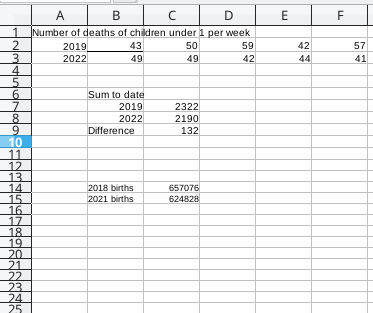
Hypothesis: babies born into the pandemic are equally likely to survive (but caveats exist, e.g. maybe only more affluent families still have kids and medical treatments continue to improve)
So I’ve decided to check how the pandemic affects babies, specifically people under the age of 1 in England and Wales, for which we have complete data from ONS.
Based on the available data, 2,190 children under the age of 1 died so far this year, compared to 2,322 (132 more) in 2019. Those kids might be born a year earlier, i.e. in 2021 and in 2018.
Births in 2018 were 5.2% higher than in 2021, based on the official figures. 657,076 – 624,828 = 32,248 (fewer births in 2021 than in 2018), representing a big decrease.
Old data can be found here (births in England and Wales). It says: “There were 679,106 live births in England and Wales in 2017, a decrease of 2.5% from 2016 and the lowest number of live births since 2006.”
In 2018 there was a decrease. To quote: “There were 657,076 live births in England and Wales in 2018, a decrease of 3.2% since 2017 and a 9.9% decrease since the most recent peak in 2012.”
More recent data comes from this page (also see “Births by parents’ country of birth, England and Wales: 2021″). To quote: “There were 624,828 live births in England and Wales in 2021, an increase of 1.8% from 613,936 in 2020, but still below the 2019 figure (640,370); 2021 remains in line with the long-term trend of decreasing live births seen before the coronavirus (COVID-19) pandemic.”
It also says: “There were 2,597 stillbirths in 2021, an increase of 226 from 2020; this is similar to the 2,522 stillbirths in 2019. [..]. The stillbirth rate in 2021 increased to 4.1 stillbirths per 1,000 total births compared with 3.8 in 2020; this is also higher than the rate seen before the coronavirus pandemic in 2019 (3.9).”
Based on the available data, the number of babies dying in their first year was similar in the past year to what it was before the COVID-19 outbreak. If adjusted to the total number of births, compensating for disparity and assessing the ratio.
It may be safe to conclude that babies’ mortality rate (at least here) did not worsen in recent years, unlike all the other age groups.