Introduction About Site Map

XML
RSS 2 Feed RSS 2 Feed
Navigation

Main Page | Blog Index

Archive for the ‘Open Source’ Category

A Lifetime Without Commericial Software

Money on keyboard

IT was only a few days ago that I came to ponder an interesting fact: I have never,ever in my life paid for a piece of software. I have never paid for a Web service either. I had some computer games bought for me as a gift while I was a teenager, or even younger than that. I was primary using freeware as a child and I do not think it ended up quite so miserably, despite my habit of relying on free and/or Open Source solutions.

The are a few exceptions to the above statement. Admittedly, I may have bought computers that had Windows pre-installed and thus a licence paid for. Anything commercial that I ever use nowadays, the University pays for (MATLAB which runs on Linux, for example). My Web host pays for cPanel too, I presume. Palm handhelds which I have owned have some programs bundled, but I never purchased any softwere for this platform where so much is already free.

Is it all something to take pride in? I do not believe so, but the observation is an interesting one nonetheless. Frankly, I can never recall pulling out a credit card for software purchase or a paid service on Web. On the Internet, if I ever pull out the CC numbers, it is for groceries, various items (primarily gadgets) and Web hosting bills. Never have I paid for a licence key or a binary file.

Bottom line: expensive proprietary software is not a necessity. That, however, is not what commercial software vendors would have you believe. Freeware and Open Source software are their greatest enemies and, given experience and orientation, they can achieve anything. They also have the merit of being transferable and readily available in abundant numbers.

The Road from Windows to Linux

If you are switching from Windows to Linux, be warned. An independent, small-scale study concludes that migrating from Linux (back) to Windows is hard. As Windows lacks the power and user-friendliness that Linux offers, frustration should be anticipated.

PenguinsA similar and older article uses sarcasm and outlines reasons not to use Linux. In practice, both articles which are cynical serve as primers to the advantages of using Linux.

If you choose to upgrade to Linux, be aware that rather than reading surveys, you can use a questionnaire-type utility to determine which Linux distribution suits you best.

Also see: 25 Reasons to Convert to Linux

Patent May Prevent Outside Access to Windows

Bill Gates
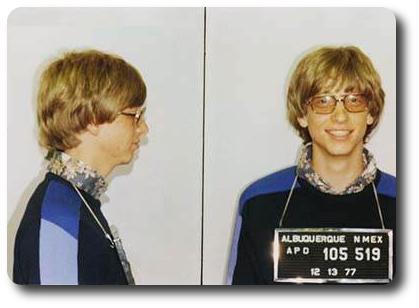
Bill Gates arrested in his younger days (photo in public domain)

This one particular story comes from CNET and it speaks of a patent which has just been upheld. This patent has apparently suffered from some court battles and rejections in the past as it is very controversial. Judge for yourself:

[...]

The FAT file system, a common means of storing files, was originally developed for Windows but is also employed on removable flash memory cards used in digital cameras and other devices. Some Linux- and Unix-related products also use the system to exchange data with Windows.

[...]

To many this means that files will be ‘locked’ not only by proprietary formats, but also by the underlying filesystem. The filesystem in itself becomes proprietary and very restrictive. I wonder not only how this affects Linux, but merely any device that attempts to communicate with the closed-source ogre. The European Commision is less than pleased about aggressive attempts to lock out the competition.

The European Commission has threatened to fine Microsoft up to 2m euros (£1.36m; $2.4m) a day until it gives rivals more access to its systems.

OpenOffice and Microsoft Office Comparison

Microsoft Word
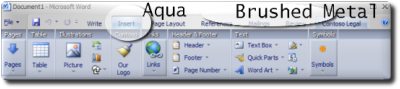
A screenshot of Word (Office 12) with copied graphical themes highlighted

OPENOFFICE 2 was officially released a few months ago. Microsoft Office 12 will probably be out in the near future and it imitates much of the Mac OS X look, for which it has been criticised. See the above image if persuasion is needed that the contention is true.

Around the release time of OpenOffice, a particular controversial article made the rounds. It described OpenOffice as slow and inferior. Comparisons involving Microsoft Office and OpenOffice were only conducted under Windows, for it seems the only possible platform for benchmarks of this nature. However, it is a ‘home and away’ situation.

Windows is optimised to run Microsoft Office. It keeps many common objects in memory, for which there is a noticeable cost. On the other hand, OpenOffice ‘feels’ most comfortable in its origins: Open Source environments. The Windows OpenOffice version could be treated as merely a secondary port. Moreover, someone claimed that the OpenOffice build which was used in this comparison had been compiled with debugging ‘bits’ which accommodated for bug reports. It was not the final product, but merely a candidate with a practical purpose that entailed improvements.

Judging and comparing office productivity tools on Windows is unfair and grossly biased. It is like assessing the performance of a football team based only on its home games. This is not the first time that biased studies are conducted. Web servers, legacy hardware, and security are a few more examples. There was recently a big controversy over a study which counted security flaws, but compared Windows against many dozens of different Open Source platforms and applications like Apache and Firefox. The miserably-delivered figures were very deceiving, almost intentionally so. Flaws count was aggregated from just about any distribution or derivative of UNIX and then compared against the corresponding number from Windows.

Free Software – What Does it Truly Mean?

Season of the playful penguins
Season of the playful penguins from Oyonale

I decided to explore and assemble a few favourite essays that explain what “free software” actually means. It does not mean what people tend to believe. I can assure you that, so please read on.

Essay #1: What software freedom means to me

Some seem to view software as a closed sphere; meaning that one person or group’s success must come at the expense of another’s. For those that have this rather selfish and narrow view of a closed world of zero sum games, I guess it makes sense to be able to take software and ideas that others have created, and offer them back with some modifications as proprietary solutions under the exclusive control of one individual or group.

Essay #2: Debunking common GNU/Linux myths

(Fallacy:) Free software is Communism. Free software promotes a gift economy and is anti-capitalist. Free software will kill the software industry and hurt the economy. First let’s examine free software. Basically it is software that you are allowed to use, sell, distribute and modify in any way you see fit. Compare that with proprietary software, which most often only allows you to use the software on a limited basis — no redistribution, sale, or modification of the software is allowed. Actually it goes further than that; criminal and civil penalties can be imposed on you for doing any of those things. It would be more accurate to say that proprietary software is fascist rather than suggest that free software is communist.

The “free” in free software does not mean “free of charge;” it means “free of restriction.” That’s free as in rights, not price. This is a point often misunderstood or misrepresented by proprietary software CEOs and others who have a proprietary software agenda to push.

That being said, free software is often also free of charge.

[...]

So, as the GNU slogan clearly says, it is “free as in freedom“.

Retrieval statistics: 21 queries taking a total of 0.090 seconds • Please report low bandwidth using the feedback form
Original styles created by Ian Main (all acknowledgements) • PHP scripts and styles later modified by Roy Schestowitz • Help yourself to a GPL'd copy
|— Proudly powered by W o r d P r e s s — based on a heavily-hacked version 1.2.1 (Mingus) installation —|