Introduction About Site Map

XML
RSS 2 Feed RSS 2 Feed
Navigation

Main Page | Blog Index

Archive for the ‘Research’ Category

Cross-Platform Remote Access

Multiple SSH sessions
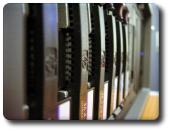
Dozens of remote sessions occupying a cluster. Terminals shaded on the left monitor (click to enlarge)

WHATEVER operating system we use, the idea of using remote terminals should not be foreign to us. These days, it is rather common to log on to a computer remotely and manage it from afar as if we were actually there.

Inter-Platform Connections

Windows users frequently stick to VNC, which requires a high-bandwidth connection and grabs the entire desktop/workspace metaphorically ‘across the wire’. Nonetheless, there are some smart algorithms (c/f Citrix clients), which only re-draw elements once they change, so speed/bandwidth might not be the utmost concerns.

Linux users, on the other hand, are capable of establishing transparent connections with Windows machines via VNC, for which there are many applications in existence (Remote Desktop or rdesktop among several more variants). Linux also takes a different approach in its most natural method for remote access. Take, for example, SSH connections wherein individual windows get ‘grabbed’ and communicated over the network, only upon demand. Everything else should be managed from the command-line interface (CLI), e.g. bash and xterm. This might be less natural to the majority of users nowadays, especially to those unfamiliar with CLI’s.

Windows connectivity to *nix protocols can be established using the renowned PuTTY. In the case of Telnet or RLogin, applicability might be slightly different, but merely all protocols seem to have been covered. In fact, Windows typically supports telnet at its core (Start » Run... » telnet » ENTER). This establishes a somewhat mutual relationship. Windows users can remotely log in to Linux machine (might need a commercial X-session if not CygWin) and Linux users can connect to Windows hosts. In modern Linux distribution, all necessary toolsets are already pre-installed from what I can gather.

Extreme Use of Remote Access

When carrying out some computer vision experiments, I was at times using over 30 Pentium 4′s. These were used for quite a considerable overnight resource hogs. The communication barrier was merely inexistent; I an fortunate enough to work upon a 100Mbit Ethernet backbone. To give some indication of how fast the connection actually is, I can transfer an entire CD (~650 MB) across campus in less than a minute. That unbelievable speed is at times truly needed. I estimate that I use up bandwidth of over 100 GB per month, mainly due to backup necessities.

As regards extreme use of remote login, this is one of the most exciting experiences, to me at least. Rather than conducting large-scale experiments over the period of one month on a single CPU, they can be distributed, thus completed within a day. Nothing can beat that in terms of productivity. AI is known to be resources-greedy. Our computer vision methodology falls under that branch too. I will soon write about the use of supercomputers to run my experiments, albeit this is still under negotiation.

Traffic Chain

I could no longer resist my geek spirit so I decided to experiment with the idea of SSH chaining. The dependency of one machine upon another is something that intrigues me, so often I log in remotely to one machine, which in turn connects to another.

I decided to set up a larger SSH chain wherein I connect to my own computer via an entire ‘ring’ of machines, using SSH. I wanted to see how this affects speed and responsiveness in applications that ‘travel’. Needless to mention, this also cripples all computers in that ring. This observation has some interesting implications on its own. These intermediatory machines can be perceived as purposeless routers. If one computer in the chain is reset, the whole chain collapses and the connection is lost. It may also take a while to re-build, which to me at least, is amusing.

Cluster Control

On to some more extreme uses of SSH, some time ago I read about use of SSH to control entire computer clusters in parallel. In essence, the user will be sending any given command to an ‘army’ of computers (clients or computational hosts). The tool is not very flexible, but can be valuable under particular circumstances.

TV First, Then Science

I quite liked the critical spin that a Slashdot contributer put to an article on the move to digital TV.

After budgets cuts led to the layoff of engineers and scientists at NASA Jet Propulsion Laboratory, a US Senate committee has approved a $3 billion dollar subsidy to assist Americans in their difficult transition to digital television in 2009.

TV X-FilesWhile we should all know that it is science that drives innovation, money gets spent where the long-term future is uncertain. Television and advertisements that accompany its existence shape up a tremendous industry. However, it is a well-established fact that economy cannot safely propagate to the future (Wall street and the ‘bubble effect’) whereas exploration and new discoveries are capable of putting the States at the forefront. This all comes at a very sensitive time when the whitehouse issues budgetary cuts on science and research while creationism and defence (or contrariwise armament) are better catered for. I am truly concerned.

Research Demonstrations

AT this moment I am delivering a series of 4 one-to-one demos to prospective Ph.D. students. This occupies my morning and afternoon and I must admit that I quite enjoy it. I still remember the day when it was me whose ‘role’ was a student awaiting interviews and seeing some astounding demos. Once you grow to fit the very same shoes that you admired, it all seems somewhat worthless nonetheless. That, I suppose, is simply the way of life as the nature of progression. Below is a presentation that I primarily use to reflect on work that I do at present. I re-use this internal talk from earlier this year:

Early 2005 Presentation – Ph.D. Students Talks

MIAS IRC presentation
Presentation from April this year
UCL, London

Second Year Completed

TODAY marks a milestone as I submitted my 2nd Year Progress Report (PDF, HTML). My 1st year report was enormous in comparison, totalling at 202 pages which went under the heading Continuation Report (PDF, HTML). Last month I started to work on my thesis and distributed my LyX (front-end to LATEX) template among the LyX users community. This template appears to have become quite popular, which entails a rewarding feeling.

I am expecting to complete my Ph.D. next year, at the age of 24. As for future paths: academia is appealing, industry is appalling and otherwise all is confusing. The next stage remains undecided. I will have to ponder and come up with a decision within the next couple of months. I would like to sincerely thank all my readers, who have unknowingly motivated me to carry on with some heavy burdens. I have recently come under great pressure due to involvement in many (technical) support-related groups, as well as my jobs and the degree program at the University. I am glad to say that I have regained full control and can now cope with all my commitments and obligations.

Roy as a baby
Photo taken in 1984 or thereabouts

Machine Learning and Grammar

Quotes

The Science Blog outlines a method for teaching the computer various languages without any human involvement, i.e. in a data-driven manner.

[computers can learn languages] “…autonomously and without previous information infer the underlying rules of grammar. The rules can then be used to generate new and meaningful sentences. The method also works for such data as sheet music or protein sequences.”

Having quotes the above, I believe there is nothing truly novel to find in the study. The blog item does not have any mentioning of Markov models. That, in my blunt opinion, is proof that the author fails to grasp the real merits of the method. It also appears as if the author has limited knowledge in the field which is technically discussed. The ability to look at sequences of words up to a certain depth (as much as brute-force permits) presently produces nice textures in graphics and get good flow of coherent text (a paper-generating tool from MIT comes to mind).

The method can indeed perform more admirably than by making use of probabilistic models solely. It can extract grammatical content, but so can logical inference and theorem prover programs like Vampire (Voronkov and his students from Manchester University). As a matter fact, a few years ago, as part of a course on languages and semantics, we wrote programs in ML that translated English sentences into first-order logic. This technology has been out in the wild for many, many years.

Condolences to Internet Explorer

Firefox in the dock
Internet Explorer remains aside for the time being

For quite some time I have been kind to Internet Explorer (IE) despite its obnoxious limitations. Those who follow this blog may have noticed that its layout is IE-friendly. It comes with a cost though, in terms of flexibility in particular.

One of the prominent IE deficiencies, which constantly puts me aback, is its lack of support for high-depth colour blending — something for which I have great affinity. Earlier this week I decided to give up on Internet Explorer visual compatibility as far as my Ph.D. progress reports are concerned. I did likewise when assembling the talk that I prepare for an audience of surgeons at the Royal Eye Hospital. I went along with what should work in any modern browser like Mozilla, Opera, Firefox and Safari, to name just the major ones. I incorporated 32-bit PNG transparencies in Web pages — or put differently — I have included 32-bit alpha blending effects in my reports. I used to reluctantly stick to JPEG‘s, but I wanted some nicer effects that resemble shadows.

If you are curious, the result is in my latest progress report 1. See the slides which contain figures to get an example of blending with the background 2. I am assuming that they will appear with white background in Internet Explorer, which is not aesthetic and seems like a complete misfit. All I can say is that Internet Explorer 7 will render this properly, having surveyed some and reviews on the topic. Either way, my supervisor and I use Firefox. I even urge him to use it more often and sometimes set it as his default browser (it will be our little secret).

To those anticipating the arrival of Internet Explorer 7, it is worth mentioning that, on the face of it, it will still be adverse to Web standards. As an intersting statistical side note, Firefox and IE usage is more or less in state of equality on this domain as a whole.

1 The report is yet to be delivered at 11 this morning

2 There is a nice story behind the background image. It depicts the Maths Tower which is being demolished the moment. The reports might commemorate its existence.

Einstein Manuscript Archives

Einstein's manuscriptYou can now take a peek at one of Einstein’s last great breakthroughs. Be aware that the manuscript is written in German and Einstein’s handwriting is not very legible.

If it took the University 80 years to find his manuscript, one wonders about his privacy, which was in great jeopardy. This is yet another manuscript to be added to the pool of similar scans. It has been several years 1 since Einstein’s manuscripts were put in alberteinstein.info.

1 I can still remember the announcement from Reuters at the time.

Retrieval statistics: 21 queries taking a total of 0.172 seconds • Please report low bandwidth using the feedback form
Original styles created by Ian Main (all acknowledgements) • PHP scripts and styles later modified by Roy Schestowitz • Help yourself to a GPL'd copy
|— Proudly powered by W o r d P r e s s — based on a heavily-hacked version 1.2.1 (Mingus) installation —|