Introduction About Site Map

XML
RSS 2 Feed RSS 2 Feed
Navigation

Main Page | Blog Index

Archive for the ‘Research’ Category

Government Covering Up Excess Deaths (Mortality) in the UK After Poor Response to COVID-19 and Profiteering

I am glad some people talk about this.

This is worrying. They changed it from Tuesdays to Wednesdays for updates and they try to hide just how badly the COVID-19 response was and still is. Loads of people are dying; answers are not being sought.

Here is what the video covers:

Direct link to parliament TV, parliamentlive.tv/Event/Index/5e1f14d2-72b3-488f-a…

Link to Hansard full transcript, hansard.parliament.uk/Commons/2024-01-16/debates/1…

Neale Hanvey
(Kirkcaldy and Cowdenbeath) (Alba)

Time is tight, so I will cut to the chase. I pay tribute to the hon. Member for North West Leicestershire (Andrew Bridgen) for his courage and determination on this important matter. I also challenge the right hon. Member for Knowsley (Sir George Howarth) on his assertion that these were so-called experts at that meeting. They are world-renowned experts in their field; that is just a matter of observable fact.

I want to focus on the safe use of novel mRNA agents and on concerns over their alleged role in driving excess deaths. I repeat a point that I have made previously in this place and directly with the Minister: any agent has the potential to cause harm or injury to the subject. For the avoidance of doubt, the position I have taken is based on decades of involvement in the management and delivery of clinical trials. Politicians who dismiss the data and emerging clinical evidence are acting in a wholly irresponsible manner, and posing a real threat to the duties of honesty and candour at the heart of good clinical practice. If substantiated, the concerns surfacing around falsified or concealed data are the most serious that I can imagine.

I have worked in the same institution as Professor Dalgleish, and his credentials are impeccable.

Addressing this matter is necessary because we are talking about the standards on which good clinical practice, or GCP, is based. GCP is not about a nice bedside manner or knowing what treatment to prescribe; it is a set of internationally recognised ethical and scientific requirements, which must be followed when designing, conducting, recording and reporting on clinical trials that involve people, and have their origin in the declaration of Helsinki.

The rights, safety and wellbeing of trial subjects are the most important consideration, which should prevail over interests of science and society, including commercial or political interests, and I will conclude with a reflection on that important principle. The foundation of good clinical practice is under threat. In their December 2023 pathology research and practice paper on gene-based covid-19 vaccines, Rhodes and Parry gave the following warning:

“Pandemic management requires societal coordination, global orchestration, respect for human rights and defence of ethical principles. Yet some approaches to the COVID-19 pandemic, driven by socioeconomic, corporate, and political interests, have undermined key pillars of ethical medical science.”

None of these clinical experts are quacks or conspiracy theorists. As the Government said so often during the pandemic, we must follow the science

2024: A Year of COVID-19 Cover-up (Massive Mortality Levels Persist, Even Now)

I AM deeply disappointed but not shocked. There’s no actual plan to look after people’s health, let alone properly inform them. This is societal or systemic breakdown.

Consider mortality data.

ONS changed staff assigned to the task. Now it is: “David Tabor, Merilynn Pratt and Patrycja Delong-Smith”.

What happened to the person who used to do it? Gone?

At the end of last year they admitted an error or two, which is otherwise rare:

ONS mistakes

“See correction,” it says. “Time series of deaths occurrences for 2022 in Experimental occurrences model table (Sheet 11) had not been correctly updated. This was because of a processing error and has now been corrected.”

This happened more than once. People reported based on false data.

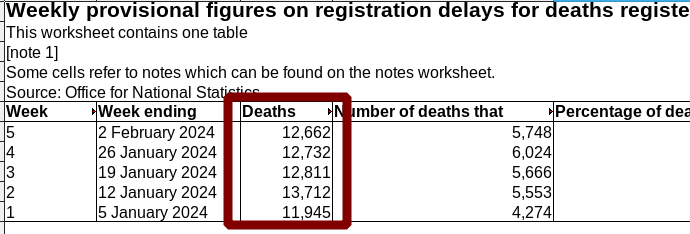
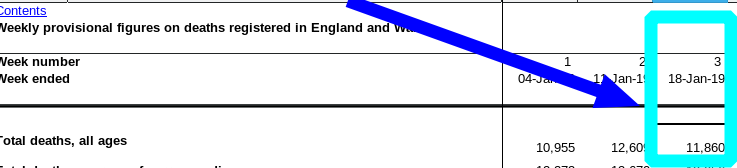
So the staff changed, they admitted errors, and they have also changed how ONS presents this data. It makes it harder to compare current mortality to past years.

This is the old format:

England and Wales deaths 2023

And the new:

England and Wales 2024 deaths

Notice they are counting 5 years of pandemic to make it seem like those numbers are finally down. They omit lots of other stuff.

In prior years it was possible to isolate pandemic years from “the real normal”.

Perhaps the “new normal” is “let’s pretend COVID is solved”.

“Ignore all the dead people and very unhealthy people, even children…”

Check out this new Finnish spin. The headline says THL: Disabled people died at greater rate during Covid pandemic. Not untrue. Disabled people, however, are distraction. All people died at a greater rate even “AFTER” (as if it ended) it. In some countries they now report that infection rates are soaring. In some it is at a record high.

The media hides the dead. So typical. Belittling the issue, downplaying the scale or the magnitude of several scandals, for which both the national media (broadcasters like Yle) and politicians can be held belatedly accountable.

This indicates a failure of the political system, the media, and health agencies. Health isn’t their priority.

Still High Excess Deaths, Even in Children

New video

Description:

Direct link to parliament TV, https://parliamentlive.tv/Event/Index/5e1f14d2-72b3-488f-a53c-fc94fee92dac

Link to Hansard full transcript, https://hansard.parliament.uk/Commons/2024-01-16/debates/152B485D-812D-43CC-9D25-C2B651564810/ExcessDeathTrends?highlight=westminster%20hall#contribution-46059AFE-9A03-472B-9364-0BF972E2E7D8

Full speech from Dr. Johnson
This is a very important debate and I will try to make my speech as short as possible. I congratulate the hon. Member for North West Leicestershire on raising this issue and on his determination to highlight the challenges that we are facing. On the one hand, we might have expected that the pandemic would shorten the lives of a number of our more frail citizens and thus have expected a fall in deaths post-pandemic, and we saw that. The ONS reported roughly 608,000 deaths in England and Wales in 2020, 586,000 in 2021, and 577,000 in 2022—that was higher than 2019 when there were about 531,000 deaths, so that does warrant further inspection. We expect a fluctuation year on year, and we also expect

Toggle showing location of Column 221WH
the total number of deaths to increase year on year as the population increases and ages. We therefore look at the five-year average, and currently we are using 2017, 2018, 2019, 2021 and 2022 because of the outliers in 2020. Even then, it is unlikely that we will be exactly at the average, and we would expect some years to be higher or lower.

The ONS monthly mortality analysis shows that, in 2022, there were 32,000 more deaths than the five-year average, and in January to July 2023, there were 21,809 more. That equates to an annualised figure of around 37,000, but the figures appear to stop in July 2023. Would the Minister advise as to why the data series has been discontinued? It would be helpful if it were not. However, those are raw numbers and we must be cautious because, as the population ages and increases, so will the number of deaths. The ONS therefore uses the age-standard mortality rate, which has fluctuated month on month but is actually down for both 2022 and 2023 when compared with the five-year average. Overall, when adjusted for age and population size, the number of deaths is not excessive, given what we would expect.

We need to look further at the trends on age and the causes of death to see a fuller picture. Others will no doubt speak of rising cardiovascular disease in men, the late presentation of cancers or the rise in liver disease, but as a consultant paediatrician, I would like to focus on children. The National Child Mortality Database collates data on children’s deaths from nought to 18. Its latest bulletin from March 2023 shows that there were sadly 3,743 deaths to the end of that month, which is an increase of 8% on the previous year. Would the Minister comment on what investigation she is doing into the cause of that increased mortality and what is being done to prevent further deaths? The purpose of the child death overview panel is to investigate those deaths, but the average investigation is taking 392 days, with less than half completed in 12 months and a significant fall in the number being completed in 12 months. What is the Minister doing to improve that process?

One particularly distressing feature of child death data is that suicide or deliberate self-harm was a primary cause of death of children between 10 and 17 years, and looking at the data, it is getting much worse with children between 10 and 14. I understand that the Government are aware of those figures and are investing in mental health for children and improving online safety. I would be grateful if the Minister elaborated further on the steps they are taking to support children and prevent further tragedies.”

[Paper] Excess mortality in England post Covid-19 pandemic: implications for secondary prevention

Description replicated in case Google censors him again:

Excess mortality in England post Covid-19 pandemic: implications for secondary prevention

https://www.sciencedirect.com/science/article/pii/S2666776223002211?via%3Dihub

Many countries, including the UK, have continued to experience an apparent excess of deaths long after the peaks associated with the COVID-19 pandemic in 2020 and 2021.

Numbers of excess deaths estimated in this period are considerable.

The UK Office for National Statistics (ONS) has calculated that there were 7.2% or 44,255 more deaths registered in the UK in 2022

OECD, UK

https://stats.oecd.org/index.aspx?queryid=104676

Excess deaths in 2022, 52,514 (9.26%)

This persisted into 2023 with 8.6% or 28,024 more deaths registered in the first six months of the year than expected.

OECD, UK, weeks 1 – 44, 2023

Excess deaths, 49,389 (9.44%)

The causes of these excess deaths are likely to be multiple and could include the direct effects of Covid-19 infection,

acute pressures on NHS acute services resulting in poorer outcomes from episodes of acute illness,

and disruption to chronic disease detection and management.

Further analysis by cause and by age- and sex-group may help quantify the relative contributions of these causes.

Office for Health Improvement and Disparities

3rd June 2022 to 30th June 2023

Excess deaths for all causes were relatively greatest for 50–64 year olds (15% higher than expected)

11% higher for 25–49 and under 25 year olds,

and about 9% higher for over 65s

Several causes

3rd June 2022–30th June 2023

All cardiovascular diseases, 12%

Heart failure, 20%

Ischaemic heart disease, 15

Liver diseases, 19%

Acute respiratory infections, 14%

Diabetes, 13%

For middle-aged adults (50–64)

Cardiovascular diseases, 33% higher than expected

Ischaemic heart disease, 44%

Cerebrovascular disease, 40%

Heart failure 39% higher

Deaths involving acute respiratory infections, 43% higher

Diabetes, deaths were 35% higher

The pattern now is one of persisting excess deaths which are most prominent in relative terms in middle-aged and younger adults

Timely and granular analyses are needed to describe such trends and so to inform prevention and disease management efforts.

JP-S is Partner at Lane Clark & Peacock LLP, Chair of the Royal Society for Public Health and reports personal fees from Novo Nordisk and Pfizer Ltd outside of this submitted work.

Christmastime England and Wales Deaths: From 11.2k to 13.2k (Before and ‘After’ Pandemic)

Pandemic not over, this is not normal:

England and Wales week 51 deaths

Week 51 noted.

It was 11.5k in 2014-2019 or about 11.2k in 2014-2018 (before COVID-19).

Peer Reviewed Papers Disputing the Efficacy of Existing COVID-19 Vaccine Booster

Open access using this link:

https://onlinelibrary.wiley.com/doi/10.1111/eci.14136

Effectiveness of a fourth SARS-CoV-2 vaccine dose in previously infected individuals from Austria

Evidence is limited on the effectiveness of a fourth vaccine dose against coronavirus disease 2019,

in populations with prior SARS-CoV-2 infections.

We estimated the risk of COVID-19 deaths (primary outcome)

We estimated the risk of SARS-CoV-2 infections (secondary outcome)

Methods

Austria nationwide retrospective observational study.

1 November to 31 December 2022

Primarily comparing individuals with four versus three vaccine doses.

Whole population data.

Results

3,986,312 previously infected individuals

281,291 (7,1%) had four vaccinations at baseline

1,545,242 (38.8%) had three vaccinations at baseline

We recorded

69 COVID-19 deaths

89,056 SARS-CoV-2 infections
The majority of COVID-19 deaths and a significant proportion of all-cause deaths occurred in nursing home residents

Relative vaccine effectiveness (rVE) for four versus three vaccine doses

-24% against COVID-19 deaths

17% against SARS-CoV-2 infections.

Protection against infection rapidly diminished over time,

and infection risk with four vaccinations was higher during extended follow-up until June 2023.

Adjusted HR for all-cause mortality for four versus three vaccinations was 0.79.

That is people with a 4th dose were only 79% as likely to die
(Suggesting healthy vaccinee bias, i.e. healthier persons received more vaccine doses)

Discussion

In previously infected individuals, a fourth vaccination did not reduce COVID-19 death risk,

but with transiently reduced risk of SARS-CoV-2 infections,

and reversal of this effect in longer follow-up.

All-cause mortality data suggest healthy vaccinee bias.

More details

Mostly Pfizer vaccine, some Moderna

In this study, overall case fatality rate, 0.08%.

(IFR, ? 0.008% if 10% of infections picked up)

Individuals with repeated previous infections had reduced re-infection risk

Natural immunity may be a main determinant of immunological protection in a population

By end 2022, the vast majority of the global population had already acquired some immune protection

Compared to three vaccine doses, those with fewer or no vaccinations did not differ with regard to COVID-19 mortality,

but had reduced risk of SARS-CoV-2 infections.

In 2022, infection fatality rates due to SARS-CoV-2 significantly declined suggesting transitioning into endemicity.

In general, our study results question whether recommendations for repeated vaccine boosters against SARS-CoV-2 are currently justified for large parts of the general population with a history of previous infections.

Measures against SARS-CoV-2 including vaccine policy should be critically re-assessed for their risk-to-benefit ratio.

As most SARS-CoV-2 infections are asymptomatic or mild in an endemic phase,

effectiveness of vaccinations should be primarily evaluated according to hard clinical outcomes (e.g. COVID-19 deaths)

Extended follow-up

From 1 January to 30 June 2023

Omicron XBB.1.5. was the predominant variant

225 COVID-19 deaths

174,174 SARS-CoV-2 infections.

Analyses in 2023 confirm no relative vaccine effectiveness (rVE) for four versus three vaccine doses for COVID-19 mortality,

but show higher risk of SARS-CoV-2 infections with a rVE of ?17%

As 2024 Starts Millions of People (More Than in Prior Years) Die While They Tell Us Pandemic is ‘Over’

They would never hold corporations (with secret deals) accountable for anything.

Excess deaths by week, 2023

https://data-explorer.oecd.org

https://stats.oecd.org/index.aspx?queryid=104676

Australia, weeks 1 – 34, 2023

14,710 (16.8%)

Covid deaths, 4,977

Australia, 2022, weeks 1 – 52

29,738 (18.7%)

Australia, excess deaths
2022 + 2023 = 44,448

Austria, week 1 – 44, 2023

4,444 (6.5%)

Canada, weeks 1 – 33, 2023

28,400 (16.7%)

Covid deaths, 4,613

Canada, 2022

61,468 (22.3%)

Canada, excess deaths
2022 + 2023 = 89,868

Denmark, weeks 1 – 44, 2023

3,052 (6.9%)

Covid deaths, 347

Denmark, 2022

5,871 (11%)

Denmark, excess deaths
2022 + 2023 = 8,923

Finland, weeks 1 – 44, 2023

4,627 (10.5%)

France, weeks 1 – 44, 2023

22,268 (4.9%)

Covid deaths, 5,565

France, 2022

71,751 (11.9%)

Germany, weeks 1 – 44, 2023

59,039 (7.7%)

Germany, 2022

134, 578 (14.9%)

Greece, weeks 1 – 44, 2023

5,132 (5.2%)

Iceland, weeks 1 – 44, 2023

209 (11.5%)

Covid deaths, 0

Iceland, 2022

446 (20.2%)

Israel, weeks 1 – 44, 2023

4,303 (11.8%)

Covid deaths, 640

Israel, 2022

7,050 (15.4%)

Italy, weeks 1 – 44, 2023

938 (0.28%)

Netherlands, weeks 1 – 44, 2023

14,209 (11.3%)

Netherlands, 2022

19,326 (13.2%)

New Zealand, weeks, 1 – 44, 2023

3,960 (14.5%)

New Zealand, 2022

5,787 (17.6%)

Norway, weeks 1 – 44, 2023

1,885 (5.7%)

Norway, 2022

4,980 (12.5%)

Portugal, weeks 1 – 44, 2023

5,184 (6.3%)

Spain, weeks 1 – 44, 2023

11,948 (3.7%)

Switzerland, 1 – 44, 2023

2,063 (3.9%)

UK, weeks 1 – 44, 2023

49,389 (9.44%)

Covid deaths, 18,591

UK, 2022

52,514 (9.26%)

UK excess deaths
2022 + 2023 = 101,903

Height of the Blitz, September 1940 to May 1941

UK civilian deaths, 40,000

Total civilian deaths for WW2, 70,000

US, weeks 1 – 37, 2023

155,763 (7.8%)

Covid deaths, 76,187

US, 2022

495,749 (17.53)

US excess deaths
2022 + 2023 = 651,512

Total US deaths in Vietnam war

The U.S. National Archives shows that 58,220 U.S. soldiers perished.

https://www.worldatlas.com/articles/how-many-americans-were-killed-in-the-vietnam-war.html

Hungary, weeks 1 – 44, 2023

-3,785 (-3.2%)

Poland, weeks 1 – 43, 2023

104 (0.13%)

Slovak republic, weeks 1 – 43, 2023

-774 (-1.54%)

Sweden, weeks 1 – 44, 2023

-529 (0.6%)

COVID, the untold story. So much more makes sense after this book and my first illuminating discussion with Dr. Craig. Get your copy in the UK here:

https://www.amazon.co.uk/Expired-untold-Dr-Clare-Craig/dp/1739344707

For friends in the US get your copy here, https://www.amazon.com/Expired-untold-Dr-Clare-Craig/dp/1739344707

This dataset presents the latest data on All-cause death statistics

Excess mortality and COVID-19 deaths, by week, for all OECD countries for which data are available.

The expected number of deaths is based on the average number of deaths for the same week, (2015-19)

This baseline could be considered a lower estimate of the expected number of deaths since both population growth and an ageing population would be expected to push up the number of deaths observed each year.

For example, New Zealand saw its population grow by around 9% since 2015, with the number of people aged 65 and over increasing by 18%.

Retrieval statistics: 21 queries taking a total of 0.346 seconds • Please report low bandwidth using the feedback form
Original styles created by Ian Main (all acknowledgements) • PHP scripts and styles later modified by Roy Schestowitz • Help yourself to a GPL'd copy
|— Proudly powered by W o r d P r e s s — based on a heavily-hacked version 1.2.1 (Mingus) installation —|