
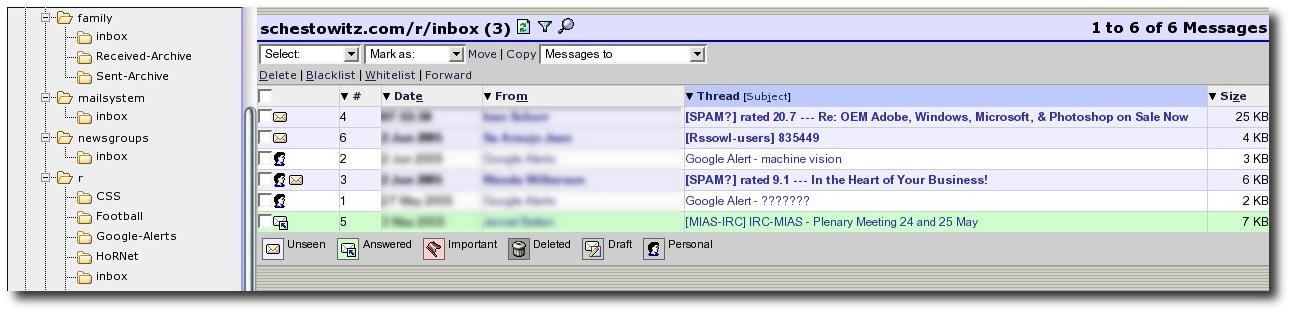
My Web-based mail access (primarily Horde)
click image to view in full size
 HIS is going to be the type of post that potentially leads to friction, but I simply cannot hold off. I even created a new category due to this item and aptly named it “Rants”. I will stick to anonymity in order to prevent sensitive criticism from having context.
15 minutes we spent in the weekly meeting. 15 minutes discussing the mail problems that have plagued this department for the past week. You’ve guessed it. The Department has got an Exchange mail server. People are unable to send mail at times, Web access is flaky, and popups keep coming up to inform the user about error in the local mail client, which to most is Outlook. Fortunately, I metaphorically took my toys and left this mail system 2 years ago. It seemed unreliable when I first joined the Division.
In the interim, people still suffer from mail issue. I do not take pleasure in the misery of others, but I could not feel better about my foresight. I did the right thing by ditching this mail system very early on. This is only the pinnacle of something that has culminated after months of recurring issues. More interesting is the following observation: At no point throughout the meeting was the mail system criticised. Not Exchange, not Outlook, not even the support staff. The IT department suggests that there is a single Outlook user which is the catalyst for this issue, probably without any awareness. They can’t identify who it is (not me of course, just for clarification!).
The staff would defend the only thing that they know and consider to be trustworthy: pricy Microsoft products. This loveaffair is by all means expensive. Linux to them would seem as though it serves only be a step back. It may be the effect of age and earsay. Regardless, the most amazing thing is that the entire meeting revolved around blaming an anonymous user who had the system crippled due to its deficient nature. Exchange cannot cope with something as simple as manageing 100 mail accounts. A single user can have it grind to a halt for very long periods of time, burning the valuable time of both support staff and research staff. There is no solution on the horizon either, other than speak to each individual user which is bound to the mail system. The staff might also need to verify that the system is properly configured on each individual workstation.
I find entire the scenario rather pathetic. This is probably why I was never fond of the Microsoft-friendly attitude among academic IT departments. Due to issues of liability and large available budgets, brand names are often picked at the expense of quality.
Needless to mention, these mail issues are irrelevant to me. I could not be happlier with my mail system. I had my mail hosted in my Linux-based domain for over year without any downtime or quirks. It never ceased to work, just like the positive Linux myth. Need it be mentioned that my server is responsible for mail accounts of just a single individual and not an entire Department? This is not the first time that I mention Exchange server disasters.


 Filed under:
 BOUT a year ago, I agreed upon a rule for myself: Read more of the technology sections in Web sites; feeds likewise. Front pages and doorway pages tend to concentrate on celebrities (sports included), sex, and death.

 N the last 8 days of February, I may have set a new personal record. I composed nearly 400 posts, which had been sent to various newsgroups, especially technical ones. I am admittedly somewhat addicted at this stage. I merely try to catch up and keep up appearances as a regular reader and participant.



 Y habit of playing computer games has slowly faded over the years. There was a ‘hiccup’, however, last year: A particular game that I played very heavily, almost for entire days at a time. The game to blame: Enemy Territory (