Praising the past rather than criticizing the present
 IGG, at least as a technology site, seems to be dying. It’s ironic because it actually started as a technology site — the very same part which is being sidelined. Very few technology stories make the front page and those which do can sometimes be described as ‘fluff’, not news. This was pointed out by some other people before. The observation made the front page, too.
The days of my Digg raves remain far behind. Here is one such rave. These were the golden days, or “a honeymoon” as my online friend Derek once called it (he was the number 3 Digger at one stage, if I recall correctly). I seem to recall having 4 or 5 (!!) of my stories appearing in the front page of Digg at the very same time back in 2006. These were news items. They were about GNU/Linux mostly.
I have noticed a decline in Digg’s population, based on active participation. In fact, Alexa rank — as silly as it may be — has dropped for Digg. Jumping the shark? I don’t know. I carry on submitting to Digg, but for the first time in almost 2 years I no longer read Digg. Too much noise, too little signal. I have better feeds to read.
Unless Digg changes and stops being (already becoming?) a link farm to bloggers/submitters, then it’s “so long, Digg.” It was a nice ride though.
Interestingly enough, it’s not the stalkers/shills that drove me away. It’s Digg’s inherent problems. It becomes a dumpster of content. In a a way, I’m happy that Digg had itself ruined because it makes my departure Digg’s fault, so to speak.
At the moment, since Digg as a technology site is dying (and to me it’s a fact), I gradually leave it and I asked for advice on finding rare stories (i.e. those that LinuxToday, FSDaily and Lxer tend to miss). I used to be using search feeds, syndicating hundreds of blogs, and a combination thereof. I’m experimenting with new information pipes.
Speaking of Digg, take with a grain of salt whatever you see in Digg. 4+ people there mod down all my comments systematically and post slanderous remarks about me. They do the same thing in USENET and Slashdot where they exist as “anonymous coward”. It’s the same old tricks from OS/2 days and some of the very same people.
Will Digg ever take care of shills in their site? Will they? They never did. Not even a response from them on the particular subject. 4 people systematically mod down all my comment (example from arbitrary few hours alone). If people do this for months and within a few hours, it’s no hobby or obsession. It’s hard to believe these people aren’t paid to do this. Then it become easy to watch them attacking the messenger. Classic!
Digg has become a junkyard for corporations and users should be rightly concerned.
Digg contains and gives room to notorious characters like “flatfish” (a Microsoft shill better known as Gary Stewart). That’s the guy who is part of the group (in Digg and elsewhere) which spreads false rumours about me, including the lie that I’m transsexual, that I have a criminal record, that I molest children and whatever… you name it, they did it. It’s a smear campaign. One just needs to add these shills to the blocklist and tell the Microsoft buddies at Digg (they are business partners now, having signed an advertising deal) to address this problem which they continue to ignore.


 Filed under:
  ike most people*, over the years my online posting habits change and sites I was once active in I no longer access (some no longer exist at all). This differs from person to person. I used to be very active in newsgroups and in mailing lists (that was about a decade ago), but I no longer use these much. I try to use self-hosted blogs where possible, but sometimes, due to social dynamics, I also reluctantly send copies to larger networks with more people in them. It makes my messages more widely accessible to a broader audience.

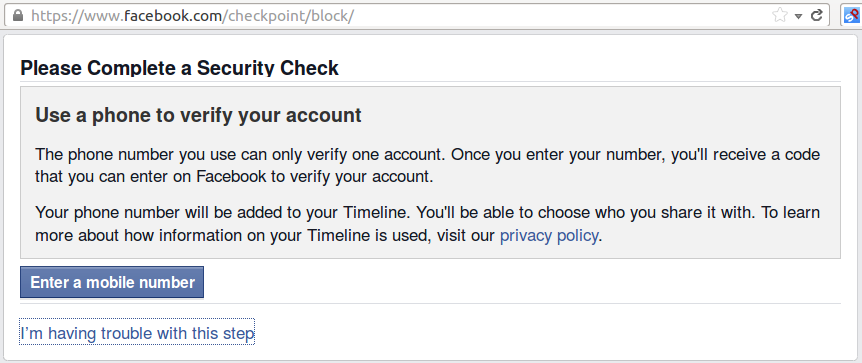
 ACEBOOK, the surveillance giant, is reaching new levels of creepiness. A friend of mine, who was apparently conformist enough to have ‘joined’ Facebook, sent me the screenshot above, translating it as follows:
 Y wife used to be using Facebook quite a lot. It’s a site that, in practice, probably violates people’s privacy more than all other sites combined, but only if one assumed loss of privacy to peers (as opposed to government spies and marketers, who also get data from Microsoft, Google, and countless other companies). Just over a year ago I suggested to my wife that she oughtn’t upload photos to Facebook (with some applications Facebook just uploads all taken pictures automatically) and that I can set up an album that would preserve some of her privacy (no tags, no face recognition, no covert tracking of viewers, etc.). Days ago I
  ulian Assange engages with John Pilger in conversation regarding Wikileaks. The privatisation of censorship is one of the first subjects to be addressed. It’s how the West and capitalist societies suppress speech. (
 ack in the days, people created Geocities-hosted Web sites. Well, Yahoo! has axed it, shortly after getting abducted by Microsoft in fact, so Geocities is no more (although many sites similar to it still exist). I created my site there in 1997/1998 and a few years later I got interested in Open Diary, which in some sense resembles Live Journal. Further down the line there was the phenomenon of blogging, which started in particular sites like Blogspot and Blogger, among many more (some of them are not surviving well). Free software like B2 and WordPress soon filled a gap and enabled more and more people to take control of their blogging platform and also register their own sites for the purpose. Around the same time, sites like MySpace grew, but they soon perished mostly because of competition which included an extension to ‘people-indexing’ services (resembling classmates reunion sites). Facebook was prominent among those. For news and discussion people had Digg, Reddit, and several more large sites, Many experiments emulating the above failed miserably for reasons that would require a separate long post. Later on, in recent years, celebrities joined Twitter and helped it grow very quickly, along with Free software clones such as Identi.ca. What joins together many of those services and pieces of Free software one can download to substitute the hosted prison is that they provide people with a place to express themselves and also find out what others are thinking. The thoughts of others are sometimes expressed by citation (news) or multimedia. It all helps weaken the cetralisation of so-called ‘mass media’ and it empowers people. This is one of the better achievements of the Web — that alongside wikis such as Wikipedia, but that’s another category of sites and a subject for another day.
 ell, well, well…