Red Hat Videos (Fake)
 Filed under:
 These are, needless to say, not real ads.


|
|


Navigation |
These are, needless to say, not real ads.
Over at Blogspot, a list is being assembled which points to mirrors of Novell pages that have miraculously vanished.
- Important Quotes about Linux
- Why Linux is a Better Choice than Windows…
- Things Microsoft Failed to Mention…
- We’ve Reached the Linux Tipping Point…
- It’s all about Choice. Users want choice…
- Why Choose Novell for Linux?…
The removal of these pages cannot be misinterpreted. It’s an implication and sign of Novell’s changing mind, or perhaps consent to censorship applied to truthful facts.
Head over to that blog in order to see all the pages for yourselves (in full, and including hyperlinks which are deliberately omitted above).
Correction: I have just been told that all pages have returned (albeit a few may have been edited), apart from one which includes a comparison with Windows (“Why Linux is a Better Choice than Windows…”).
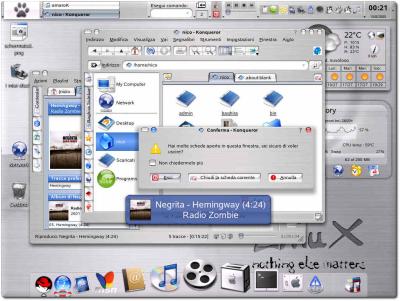
Linux with KDE in its Baghira glory
 HENEVER I approach kde-look.org (site), I feel like a kid at the candy store. So many themes and customisations are available there—to accumulate and use for free. Surely, there are also sites such as gnome-look.org and kde-files.org (among other other sister domains), but they are not quite as relevant to me.
Recently I spotted an applications site for the Linux-based Internet tablet from Nokia. Free goodness; community-driven. It may be just another sister sites of that large network that’s a candy store to those who love to shop for applications and themes (FreshMeat and SourceForge are less properly integrated). To those interested, here are some links:
KDE-Look.org
KDE-Apps.org
KDE-Apps.de
KDE-Files.org
GNOME-Look.org
Xfce-Look.org
Maemo-Apps.org
Knowledge is power. More is better. Everything is
recorded, so do not be fooled.
 HERE was a great deal of opposition, particularly from Windows users/advocates, in response to a controversial blog item which I had posted yesterday. Some would consider it nothing but a conspiracy theory, but many signs seem to support my hypothesis. I ought to have elaborated. I discussed the possibility that the American government has a strong relationship with Microsoft and that it may be using this bond for its own benefit in one way or another.
Since a bookmark-type submission got knocked off the front page of Digg very quickly, it is clear that too people read what they did not want to believe and reported this as “lame”. In defence of my points, I will address two issues here. Firstly, why do Windows users refuse to accept the idea that their government wants globally-avaliable information to be stored locally, i.e. in the datacentres of American companies? Is it fear that repels the reader? The government has already pulled such data, enlisting the legal power of the Department of Justice to make all companies just give up the fight. Secondly, let me explain why Windows is already the perfect eavesdropping tool, at least when put in the hands of its vendors (and their affiliates).
Some time ago I attempted to explain what it is that makes some Windows users loathe Open Source (including Linux) so vehemently. There are many reasons to use Linux rather than commercially-controlled platforms. Linux is by all means ready for prime time, but that’s not what those who resists it would like you to believe. Even some Linux users might reluctantly show resistance because they fancy the idea of being unique (the ‘RTFM/inferiority complex’ is a possibility too).
Yesterday, in a slightly different context, I received an insightful response from Ian Hilliard, who explained why Linux is being pushed away by so many.
When electricity was first offered to households there was also a great deal of resistance. There was resistance from the gas companies, who saw their market being erroded. There was also a great deal of resistance to ordinary people, who were used to gas. There was the general feeling that gas had done all right up until now, why change.
The gas companies produced FUD about electricity, indicating that if you have electricity it will kill you. Electricity is lethal to touch and it might cause a gas explosion. The whole time, people ignored the number of people who died every year of gas poisoning and all the gas explosions that were already occurring.
When automobiles came out, there was massive resistance to the automobile by the whole industry that had been set up around horses and horse drawn vehicles. Many people were very skilled at riding horses and saw no need to change. The resistance got to the point that it was necessary to have someone walk in front of automobiles with a red flag to warn the public. What the people refused to see is the number of people who died every year in riding accidents or because of horses running amuck.
Like electricity and cars, Linux is a disruptive technology. As such, there will be winners and losers. What has to be expected is that there will continue to be resistance by the losers for some time to come. But, like every other disruptive technology, the as yet unseen technologies that result from Linux will bring massive improvements to our lives.
There is an important point to be taken from the above article. At the moment, many look at Linux as being an alternative to Windows. Just like electricity is not an alternative to gas and the car is not an alternative to the horse, Linux is not an alternative to Windows. It is a replacement for Windows. It is the next generation. It is the future.
Since then (this morning), it has occurred to me that:
I will close with a grim statement: it is no surprise that the US government turns a blind eye to Microsoft’s fraudulent activities. It even supports Microsoft at national and international level. The government may argue that it needs Windows to be prevalent not only as means of pulling money from all over the world. It could argue that it needs Windows to prevail in order to fight terrorism. That’s the perfect, unbreakable policy to harbour any move that involves jeopardising one’s privacy.
In an age where supervision by governments becomes important, one might wonder if people up above will attempt to altogether ban Open Source or make it penetrable using mandatory ‘binary blobs’. The same flavour of laws already make it a legal offence to backward-engineer proprietary modules like DRM.
I also notice that, contrary to the warnings, there is no massive worm attack, yet. This makes one even more suspicious about overhyped reports that percolated through media sources, from Microsoft.
Correction/update: an exploit is now out. Windows zombie armies are being accumulated as I write this.
In-the-wild attacks against a Windows Server Service vulnerability have started, using malware that hijacks unpatched Windows machines for use in IRC-controlled botnets.
Brace yourself for even more SPAM and distributed denial-of-service attacks.
Update: A new comment on my previous item suggests that France and Germany already sued for NSA spying in Windows.

Stereotypical images in people’s prejudiced minds
 N elaborate and lateral analysis of a potentially-offensive advertisement has gotten my attention. It perpetuates the myths and confusion over hacker/cracker fallacies and scapegoating. Check out the original post in its full context or get an idea from the snippet below.
Am I nuts, or is this ad really offensive? First of all, the implication that geeks are somehow a threat. The whole tone of the ad is that you need their excellent insurance because the world is swarming with nerds and geeks who are going to break into your business systems and steal from you. So buy our insurance.
Second. What is this, high school? With the bullies who fail all their classes have such an inferiority complex they have to make fun of the geeks? If this is high school, Travelers is the neanderthal jock beating up geeks for their lunch money. “Protection” money.
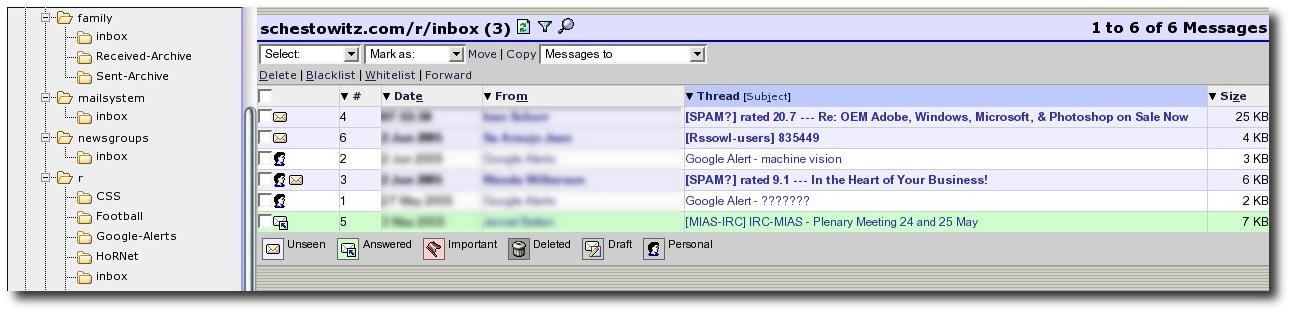
Managing SPAM with the Horde
Web-based E-mail client (click image to view in full size)
 N many contexts, no proprietary application can beat Open Source software where development is cumulative — that which stands on the shoulders of giants. I quite like using SpamAssassin as an example.
Spamassassin has captured and isolated tens of thousands of messages for me and never once flagged any genuine message as SPAM. On the contrary, off-the-ground commercial software performs far more poorly, despite its price and its shrink-wrapped package. Many times in the past, messages from myself actually reached the recipients’ SPAM boxes. They actually expected and welcomed that mail, which at time was important. This led to serious inconveniences and communication gaps.
So ask yourself today: in this industry of software, where production costs are inexistent or negligible, should price be indicative of quality? Co-founder of Apple seems to concur with the opinion that some of the worst software comes from large commercial companies.
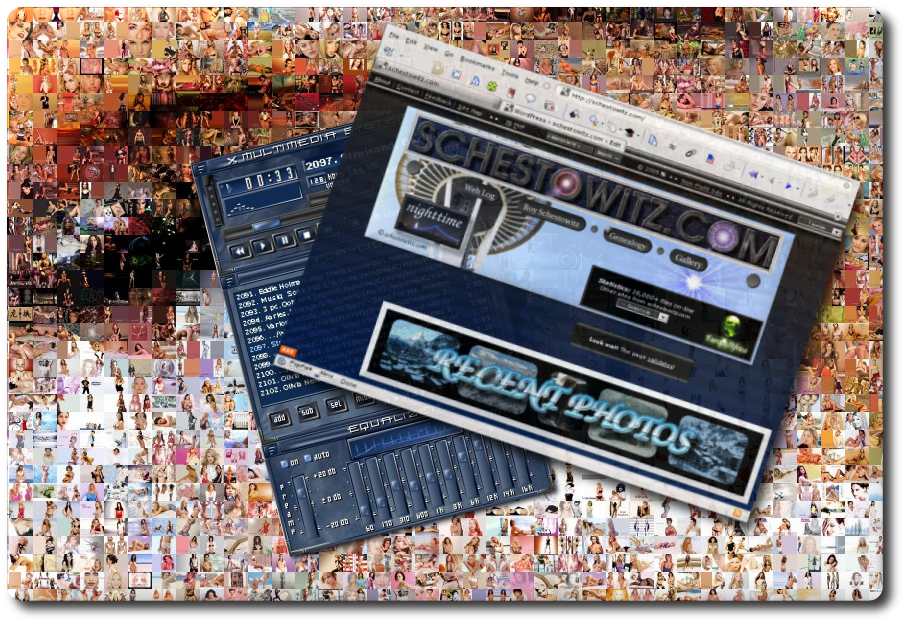
Wallpaper from Houghi (click image above
to enlarge; non-lossy PNG version)
 HECK out some three-dimensional Web browsers. None of the three is said to obviate the need for Opera, Safari, Mozilla Firefox, or even rusty Internet Explorer. The pages that are filled with screenshots, however, leave plenty of place for imagination. Technologies like XGL/Compiz, as well as DirectX support in Vista, will make it all possible. The contribution of the third dimension is very mere though, which is where proper yet pseudo 3-D displays come into play.
Retrieval statistics: 21 queries taking a total of 0.082 seconds • Please report low bandwidth using the feedback form
Original styles created by Ian Main (all acknowledgements) • PHP scripts and styles later modified by Roy Schestowitz • Help yourself to a GPL'd copy
|— Proudly powered by W o r d P r e s s — based on a heavily-hacked version 1.2.1 (Mingus) installation —|

