


Official NHS Numbers: COVID-19 Vaccination Uptake Lowest Since Records Began
 Filed under:
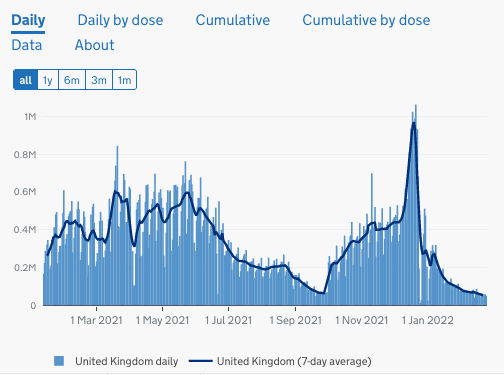
  his past week, across the UK at large, the number of COVID-19 vaccines administered (including “boosters”) was lowest since the tallies began back in January 2021 (source)
Maybe this is what happens when the government gaslights victims and wants people to go “back to the office”. Yesterday I was irked if not irritated by a COVID-19 denier (COVIDiots like to pretend either that it’s “old news” or “fake news”). My mom did what the government said — she went “back to normal” so to speak — and got COVID-19 (she told me yesterday). A pandemic isn’t something you can wish away (in the US they still have ~2,000 deaths in weekdays), as my mom can attest. She took not only one booster but two. And yet, she is taking the real thing very hard. This time it’s an actual potent virus. It’s a real problem and it has already killed many people. It is still killing people. You can see these mortality graphs. “In week 6 2022,” said this latest report (from Thursday), “an estimated 11,558 all-cause deaths were registered in England and Wales (source: Office for National Statistics (ONS)). This is a decrease compared to the 11,862 deaths registered in week 5 2022.” Over 15,000 were dying at the same time last year. So the vaccines did work. They did reduce mortality, overall (all causes combined).
Is this problem over? Hardly!
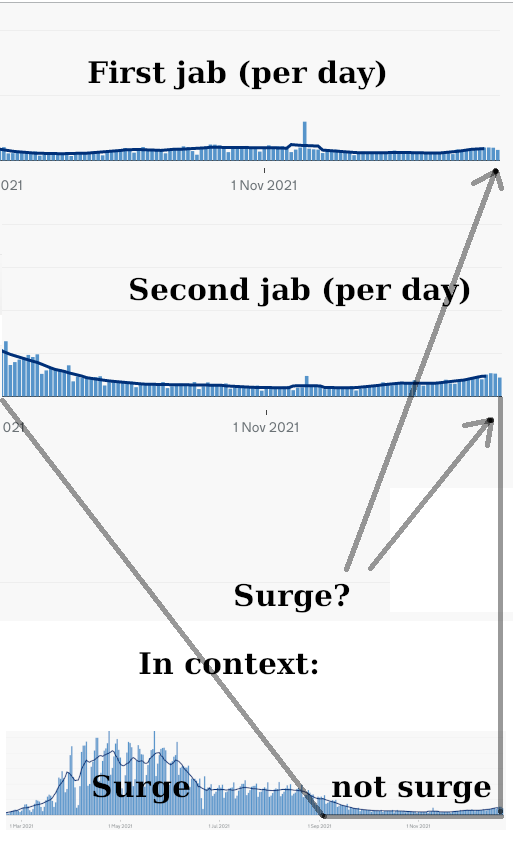
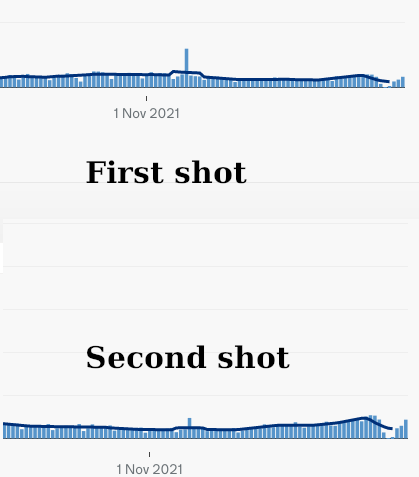
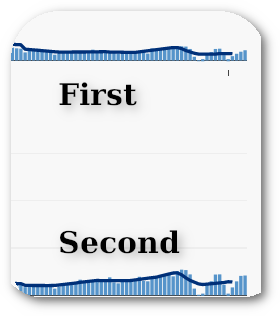
“From the week of 21 February 2022, the UK Health Security Agency will stop publishing dashboard updates at weekends,” says the official COVID portal of our government. So the regime is trying to sort of ‘wish’ COVID-19 away… because of “the economy”, the precious businessman’s wealth! Notice how few get newly vaccinated for COVID now (it’s like 7k a day). The graphs are flattened almost:

Keep the mask on, keep distance too. Don’t get this virus if you haven’t already. And even if it infected you before, remember it can infect you again. And again… and again.


 ITTLE, CONCISE, but completely new presentation about work that I did in 2010-2011.
 T IS the end of an era as another project comes to an important milestone. I was preparing a lot of code for upload last week. I wanted to wait a while, at the very least until I had also uploaded the accompanying papers. A 2011-2012 Technical Report [
 ed and green hues represent the matching from dual-scale classifiers of the rear of cars. Some more bugs were removed in this latest iteration of the implementation.
 ASED on further experiments, at the expense of performance in terms of framerate we can easily improve accuracy to the point of perfect tracking for particular cars. This is done by increasing the sample (window) size on which the tree is trained.