Introduction About Site Map

XML
RSS 2 Feed RSS 2 Feed
Navigation

Main Page | Blog Index

Archive for the ‘Science’ Category

The Decline of COVID-19 Severity and Lethality Over Two Years of Pandemic (Center for Health Emergencies, Bruno Kessler Foundation, Trento, Italy)

Description: (research paper here)

Clear graphics from Italy, The decline of COVID-19 severity and lethality over two years of pandemic

www.medrxiv.org/content/10.1101/2022.07.01.2227713…

20 to 40-fold reductions during the period of dominance of Omicron compared to the initial acute phase.

Phase 1, Ancestral

Probability of hospitalization per infection of 5.4%

Probability of ICU admission of 0.65%

Probability of death of 2.2%

Phase 5, Omicron

Probability of hospitalization, 95.1% reduction in risk

Probability of ICU admission, 97.3% reduction in risk

Probability of death, 97.5% reduction in risk

Using epidemiological and genomic surveillance data

To estimate the number of daily infections in Italy in the first two years of pandemic.

Attack rate

Ascertainment of SARS-CoV-2 infections

Phase 1 (ancestral)

NPIs

Attack rate 2.8%

Phase 2 (ancestral)

Less stringent NPIs

Attack rate 11.4%

Phase 3 Alpha variant

Mid -February 2021 to early July 2021

Alpha infected about 10.1% of the Italian population

Phase 4, Delta

Second half of 2021

Progressive relaxation of NPIs

Attack rate 17.3%

Phase 5, Omicron

End of December 2021

Attack rate, 51.1% of the Italian population became infected with Omicron

Evolution of population susceptibility

Percentage of the population susceptible to SARS-CoV-2

End of first phase, 97.5%

February 20, 2022, 13%

By February 20th, 2022

a marked proportion of individuals unprotected against SARS-CoV-2 infection can be found among vaccinated subjects,

due to the waning of vaccine protection

Evolution of COVID-19 severity and lethality

Probability of hospitalisation

Probability of ICU admission

Probability of death

Evolution of population susceptibility

Natural, post infection immunity is now the main factor reducing population sensitivity

Vaccination protection is seen to be declining

Omicron natural infection had the largest protective effect

Repeat exposure to omicron (and sub variants) is likely to have the same effect going forward.

NPIs will reduce repeat exposures

NPIs will reduce exposure to other respiratory viruses such as RSV

No Clinical Trials

Description:

This covid winter should be better than last

Dr. Anthony S. Fauci, President Biden’s chief medical adviser

www.nytimes.com/2022/11/22/us/politics/fauci-covid…

www.washingtonpost.com/health/2022/11/22/covid-biv…

Combination of infections and vaccinations,

enough community protection that we’re not going to see a repeat of what we saw last year at this time

Re bivalent effectiveness

It is clear now, despite an initial bit of confusion

United States

Nearly $5 billion to buy 171 million bivalent boosters

(Pfizer BioNTech, Moderna)

Hobson’s choice

Dr. Ashish K. Jha, White House’s Covid-19 response coordinator

Still heavily promoting vaccination

Nothing I have seen in the subvariants makes me believe that we can’t manage our way through it effectively, especially if people step up and get their vaccine

So far, 35 million people, (11% of over 5s) one bivalent shot

www.cdc.gov/mmwr/volumes/71/wr/mm7148e1.htm?s_cid=…

Effectiveness of Bivalent mRNA Vaccines in Preventing Symptomatic SARS-CoV-2 Infection — Increasing Community Access to Testing Program, United States, September–November 2022

This is the clinical trial, previous work had only been based on antibodies

Benefits are mentioned, adverse reactions are not

Any adverse reactions not reported

v-safe

www.cdc.gov/mmwr/volumes/71/wr/mm7144a3.htm?s_cid=…

Systemic symptoms

Fatigue (30.0%–53.1%)

Headache (19.7%–42.8%)

Myalgia (20.3%–41.3%)

Fever (10.2%–26.3%)

Reported inability to complete normal daily activities

10.6% among aged over 65 years

19.8% among aged 18–49 years

Bivalent boosters provided significant additional protection against symptomatic SARS-CoV-2 infection

Relative vaccine effectiveness (rVE) of a bivalent booster dose,

compared with that of more than 2 monovalent vaccine doses,

30% and 56% aged 18–49

with relative benefits increasing with time since receipt of the most recent monovalent vaccine dose.

Staying up to date with COVID-19 vaccination, including getting a bivalent booster dose when eligible, is critical to maximizing protection against COVID-19

350,000 tests at almost 10,000 retail pharmacies between Sept. 14 and Nov. 11

Relative risk given

Absolute risk not given

What about protection from severe disease?

Paul Offit, director of the vaccine education center, professor of pediatrics, Children’s Hospital of Philadelphia

The only reasonable goal is to prevent serious illness,

We are still waiting for one shred of evidence that this bivalent vaccine or any bivalent is better than what we had

Virus continues to evolve

This should be a cautionary tale for what happens when you try to chase these variants

Celine Gounder, infectious-disease specialist, Kaiser Family Foundation

It doesn’t show the bivalents are better than the original boosters

(but still advocated the bivalent shot)

Pei-Yong Shi, virologist, University of Texas Medical Branch

difficult to measure how well the updated boosters were working because so many people now had some immunity from earlier infections,

including people who were never vaccinated or boosted.

John P. Moore, virologist, Weill Cornell Medicine

Are the boosters working better than the original shots?

Personally, I doubt there would have been much, if any, difference, but we may never know

Dr. Roby Bhattacharyya, infectious disease physician, Massachusetts General Hospital

This winter should be better than last

we’re a more immune population

China

www.reuters.com/world/china/chinas-daily-covid-cas…

www.telegraph.co.uk/world-news/2022/11/24/iphone-f…

Record high COVID-19 infections

Rigid zero-COVID policy

Cities nationwide imposing localised lockdowns

Mass testing, masks

No furlough scheme

Statistics About COVID-19 Vaccines in the United States

Description:

58% of covid US deaths now in the vaccinated

Kaiser Family Foundation vice president Cynthia Cox

www.cdc.gov/vaccines/covid-19/effectiveness-resear…

covid.cdc.gov/covid-data-tracker/#rates-by-vaccine…

www.cdc.gov/coronavirus/2019-ncov/vaccines/effecti…

data.cdc.gov/Public-Health-Surveillance/Rates-of-C…

www.washingtonpost.com/politics/2022/11/23/vaccina…

58% of coronavirus deaths in August were people who were vaccinated or boosted

(people who had completed at least their primary series of vaccines)

Therefore 42% coronavirus deaths in August were people who were unvaccinated

First time there were more deaths covid deaths in the vaccinated versus the unvaccinated

covid.cdc.gov/covid-data-tracker/#vaccinations_vac…

In September 2021
Vaccinated people, 23% of coronavirus fatalities

In January and February 2022

Vaccinated people, 42% of coronavirus fatalities

We can no longer say this is a pandemic of the unvaccinated

(who conducted the analysis on behalf of the Post)

www.cdc.gov/mmwr/volumes/71/wr/mm7144a3.htm?s_cid=…

Safety Monitoring of Bivalent COVID-19 mRNA Vaccine Booster Doses Among Persons Aged ?12 Years — United States, August 31–October 23, 2022

On August 31, 2022

FDA authorized bivalent, Pfizer-BioNTech and Moderna

mRNA encoding the spike protein from original strain of SARS-CoV-2,

and from Omicron BA.4 and BA.5

Advisory Committee on Immunization Practices (ACIP) recommended,

all persons ?12 years receive an age-appropriate bivalent mRNA booster dose

v-safe

a voluntary smartphone-based U.S. safety surveillance system,

established by CDC to monitor adverse events after COVID-19 vaccination

As of 3rd October, 10 million users

icandecide.org/press-release/breaking-news-ican-ob…

Vaccine Adverse Event Reporting System (VAERS)

Total data, August 31–October 23, 2022

14.4 million received a bivalent Pfizer-BioNTech

8.2 million adults (?18 years) a bivalent Moderna booster dose

v-safe, among the 211,959 registrants (aged ?12 years)

August 31–October 23, 2022

Reported in the week after vaccination

Injection site reactions, 60.8%

Systemic reactions, 54.8%

Fewer than 1% of v-safe registrants reported receiving medical care

Vaccine Adverse Event Reporting System (VAERS)

5,542 reports of adverse events after bivalent booster vaccination (?12 years)

95.5% of reports were nonserious

4.5% were serious events

Health care providers and patients can be reassured that adverse events reported after a bivalent booster dose are consistent with those reported after monovalent doses.

Relative risk

Absolute risk not given

Health impacts after COVID-19 vaccination are less frequent and less severe than those associated with COVID-19 illness (2).

Relative risk

Absolute risk not given

This is their Reference 2

Block JP, Boehmer TK, Forrest CB, et al. Cardiac complications after SARS-CoV-2 infection and mRNA COVID-19 vaccination—PCORnet, United States, January 2021–January 2022. MMWR Morb Mortal Wkly Rep 2022;71:517–23. doi.org/10.15585/mmwr.mm7114e1 PMID:35389977

myocarditis; myocarditis or pericarditis; and myocarditis, pericarditis, or MIS,

within 7-day or 21-day risk windows after the index date

Comparisons between after vaccine and after infection

Relative risk

Absolute risk not given

Review of v-safe Data

During August 31–October 23, 2022

211,959 v-safe registrants had a bivalent booster

1,464 (0.7%) were aged 12–17 years

68,592 (32.4%) were aged 18–49 years

59,209 (27.9%) were aged 50–64 years

82.694 (39.0%) were aged ?65 years

Fourth dose

96,241; 45.4%

Fifth dose

106,423; 50.2%

In the week after receipt of the bivalent booster dose

Local injection site reactions

49.7% among aged ?65

72.9% among aged 18–49

Systemic reactions

43.5% among aged ?65

67.9% among aged 18–49

Systemic symptoms

Fatigue (30.0%–53.1%)

Headache (19.7%–42.8%)

Myalgia (20.3%–41.3%)

Fever (10.2%–26.3%)

Reported inability to complete normal daily activities

10.6% among aged ?65 years

19.8% among aged 18–49 years

Receipt of medical care

Reported by 0.8% of registrants

Origins of COVID-19

Description

I feel let down and apologise if I have misled anyone

https://www.thelancet.com/journals/lancet/article/PIIS0140-6736(20)30418-9/fulltext

We are public health scientists who have closely followed the emergence of 2019 novel coronavirus disease (COVID-19)

and are deeply concerned about its impact on global health and wellbeing.

We stand together to strongly condemn conspiracy theories suggesting that COVID-19 does not have a natural origin.

https://www.nature.com/articles/S41591-020-0820-9

Our analyses clearly show that SARS-CoV-2 is not a laboratory construct or a purposefully manipulated virus.

Conclusion

Obtaining related viral sequences from animal sources would be the most definitive way of revealing viral origins.

(Fully formed or evolutionary intermediate)

UK experts helped shut down Covid lab leak theory

- weeks after being told it might be true

Sir Patrick Vallance among scientists behind paper that stifled debate into the origins of the virus

https://www.telegraph.co.uk/news/2022/11/23/uk-experts-helped-shut-covid-lab-leak-theory-weeks-told-might/

https://www.youtube.com/watch?v=lpZz9rCz3Co

Top scientists including Sir Patrick Vallance,

Were warned that virus could have evolved in lab animals

Collaborated in above paper

Debate therefore stifled

To date

Proximal origins paper

Accessed more than 5.7 million times and cited in 2,627 subsequent papers.

Emails from early 2020

FoI request, James Tobias, freelance journalist

Authors held lengthy discussions with experts, Sir Patrick and Sir Jeremy Farrar, head of the Wellcome Trust

Warned WIV had been carrying out research on bat-coronaviruses,

at worrying levels of biosecurity.

Research to alter Sars-like bat coronaviruses had been taking place for many years in Wuhan

(not mentioned in paper)

Sir Jeremy Farrar, (Wellcome)

Wuhan was like the “Wild West”.

Prof Kristian Andersen, Scripps Research Institute La Jolla, California (lead author)

had earlier told colleagues that features of the virus looked as if they’d been engineered in a lab.

(No mention of this was made in the paper)

Dr Jeremy Farrar, (Wellcome)

It is important that we understand how all pathogens emerge so that we can prevent future pandemics

as the efforts to gather evidence continue, it is important to stay open-minded

Serial passaging

Would cause the virus to contain o-glycans

The second notable feature of SARS-CoV-2 is a polybasic cleavage site (RRAR) at the junction of S1 and S2

Prof Ron Fouchier, Dutch virologist

(from another e mail chain)

It is good that this possibility was discussed in detail with a team of experts.

However, further debate about such accusations would unnecessarily distract top researchers from active duties,

and do unnecessary harm to science in general and science in China in particular

February 8th e mail Prof Edward Holmes

(one of the authors)

Ever since this outbreak started there have been suggestions that the virus escaped from the Wuhan lab,

if only because of the coincidence of where the outbreak occurred and the location of the lab.

I do a lot of work in China and I can tell you a lot of people there believe this and believe they are being lied to

Prof Kristian Andersen, February 8th

(Lead author)

Passage of Sars-live coronaviruses have been going on for several years and more specifically in Wuhan under BSL-2 conditions

BSL-2 laboratories are used to study moderate-risk infectious agents or toxins such as salmonella.

Serious diseases should be handled in BSL-3 or 4 labs.

Wuhan Institute of Virology (WIV)

Importing bat coronaviruses from areas of China which hold the closest viruses to Covid-19

Had also applied for funding to manipulate viruses by inserting a furin cleavage site (FCS)

The email chain

Involved Anthony Fauci, the director of the National Institute of Allergy and Infectious Diseases (NIAID),

an organisation which was funding research at the Wuhan lab.

Senate report on viral origins

the emergence of SARS-CoV-2 that resulted in the COVID-19 pandemic was most likely the result of a research-related incident

https://www.help.senate.gov/imo/media/doc/report_an_analysis_of_the_origins_of_covid-19_102722.pdf

https://asiatimes.com/2022/10/new-evidence-firmly-revives-wuhan-lab-origin-theory/

https://www.researchgate.net/publication/364599030_Endonuclease_fingerprint_indicates_a_synthetic_origin_of_SARS-CoV-2

Dec. 20, 2019 to Jan. 18, 2020

Searches for flu-like symptoms

Differs from Previous Natural Zoonotic Spill overs

Severe Acute Respiratory Syndrome (SARS)

Middle East Respiratory Syndrome (MERS)

Lack of intermediate bats to humans

Influenza

H7N9 (2019) multiple independent introductions across multiple locations

Geographically disparate, independent spill overs of H7N9

Treating People Like Lepers

Just released:

Description: (in case the video is removed in the future; the author has been cautioned by Google already)

G20 Bali Leaders’ Declaration

Argentina, Australia, Brazil, Canada, China, France, Germany, Japan, India, Indonesia, Italy, Mexico, Russia, South Africa, Saudi Arabia, South Korea, Turkey, United Kingdom, United States, and European Union.

https://www.consilium.europa.eu/en/press/press-releases/2022/11/16/g20-bali-leaders-declaration/

https://www.whitehouse.gov/briefing-room/statements-releases/2022/11/16/g20-bali-leaders-declaration/

Part 22

We recognize that the extensive COVID-19 immunization is a global public good

Section 23

We recognize the need for strengthening local and regional health product manufacturing capacities

We support the WHO mRNA Vaccine Technology Transfer hub

We acknowledge the importance of shared technical standards and verification methods,
to facilitate seamless international travel,

interoperability, and recognizing digital solutions and non-digital solutions,

including proof of vaccinations.

Establishment of trusted global digital health networks,

that should capitalize and build on the success of the existing standards and digital COVID-19 certificates.

Part 24

The COVID-19 pandemic has accelerated the transformation of the digital ecosystem and digital economy.

We recognize the importance of digital transformation in reaching the SDGs.

We also reaffirm the role of data for development, economic growth and social well-being.

G20 update

https://www.g20.org/wp-content/uploads/2022/11/2022-G20-Bali-Update.pdf

“Endeavour to move towards interoperability of systems including mechanisms that validate proof of vaccination,

whilst respecting the sovereignty of national health policies,

and relevant national regulations such as personal data protection and data-sharing.”

Indonesia’s Minister of Health Budi Gunadi Sadikin

G20 countries should adopt digital health certificate using WHO standards

Let’s have a digital health certificate acknowledged by WHO — if you have been vaccinated or tested properly — then you can move around

(next World Health Assembly in Geneva)

WHO seem to be on it already

https://www.who.int/publications/i/item/WHO-2019-nCoV-Digital_certificates-vaccination-2021.1

Digital documentation of COVID-19 certificates: vaccination status: technical specifications and implementation guidance, 27 August 2021

Use of scan codes

Klaus Schwab, World Economic Forum (WEF) Chair

Attended

From a doctor in Austria

It is currently a very emotional situation in my hospital

(and in general in hospitals in Austria)

because many of us in the health care sector are more or less forced to get a fourth vaccine dose.

Even in my case as a physician who has received three doses and one infection just 6 months ago.

The rule is that if the last vaccination is more than one year and/or the last infection is more than 6 months ago you either have to test all 72 hours or to get an additional vaccine dose;

if not you are at risk of having to pay 500 to 3600 Euros and may even get fired.

Vaccine passports

https://lc.org/newsroom/details/111722-world-leaders-agree-to-implement-vaccine-passports-1

New Study on Vitamin D and COVID-19

Description:

Association between vitamin D supplementation and COVID-19 infection and mortality

https://www.nature.com/articles/s41598-022-24053-4

(12th November 2022)

Johns Hopkins
University of Michigan
National Bureau of Economic Research
Department of Medicine, University of Chicago
Department of Veterans Health Affairs
Department of Medicine, University of Chicago, Chicago

Vitamin D deficiency, associated with reduced immune function,

can lead to viral infection

Vitamin D deficiency, associated, increases the risk of COVID-19

But is it a treatment / prognosis improver?

Population of US veterans, we show that Vitamin D2 and D3 fills

Associated with reductions in COVID-19 infection

After applying all restrictions

220,265 supplemented with vitamin D3

34,710 supplemented with vitamin D2

407,860 untreated patients.

Study design

Retrospective cohort

Supplemented (before and during the pandemic),

versus untreated controls

One to one matches

D2, D3, or calcifediol

Veterans Administration Corporate Data Warehouse (CDW) electronic health records.

Vitamin D levels typically respond to treatment following two months of exposure

D3 cohort

COVID-19 rates for the treated = 2.66%

COVID-19 rates for the untreated = 3.30%

D3 20%, reduction

D2 28% reduction

Mortality within 30-days of COVID-19 infection

Infection ending in mortality within 30 days

D3 group

Treated group death rate after infection = 0.23%

Untreated group death rate after infection = 0.35%

Vitamin D3 33% mortality lower (HR, 67%)

P? less than ?0.001

Vitamin D2 25% lower (HR, 75%) (but not significant)

Veterans receiving higher dosages of Vitamin D obtained greater benefits from supplementation than veterans receiving lower dosages.

Vitamin D blood levels between 0 and 19 ng/ml,

exhibited the largest decrease in COVID-19 infection and mortality following supplementation

(0–19 ng/ml, 20–39 ng/ml, and 40?+?ng/ml)

Dosage options, 20 IU, 40 IU, 100 IU, 125 IU, 200 IU, 250 IU, 400 IU, 500 IU, 800 IU, 1000 IU, 2000 IU, 5000 IU, 8000 IU, and 50,000 IU

Black veterans received greater associated COVID-19 risk reductions, with supplementation than White veterans

As a safe, widely available, and affordable treatment, Vitamin D may help to reduce the severity of the COVID-19 pandemic.

More background

Vitamin D insufficiency and deficiency affect approximately half of the US population,

with increased rates in people with darker skin,

reduced sun exposure,

people living in higher latitudes in the winter,

nursing home residents,

and healthcare workers

Populations with low levels of Vitamin D have also experienced higher rates of COVID-19

New mechanism

Vitamin D is needed to allow T helper cells to control and reduce Interferon gamma (IFN-?) production

Conclusions

These associated reductions in risk are substantial and justify more significant exploration and confirmation using RCTs.

This is particularly important given the high rates of vitamin D deficiency in the US population and COVID-19.

Extrapolate, D3 supplementation to the entire US population in 2020

4 million fewer COVID-19 cases (19,860,000 actual cases)

116,000 deaths avoided (351,999 actual deaths)

Given our findings,

the absence of severe side effects,

the widespread availability of vitamin D3 at low cost,

vitamin D3 presents a unique opportunity to reduce the spread and severity of the COVID-19 pandemic.

K2, MK-7

Supplement, probably 100 micrograms per day

Nato, 1,000 micrograms per 100 g

Cheese, typically 50 micrograms per 100 g

Safe and effective

UK, GP incentives to vaccinate

Home, £30

Standard reimbursement to Primary Care Networks (which then gets passed to GPs) £15

New contract, £12.58 each

Lawrence

I have heard that Dr. John Campbell is in the pocket of Big Overhead Projector Lobby.

Rumour is that he has accepted tens of dollars of under the table expenses.

Anyone else notice that he always seems to have an endless supply of A4 paper and fountain pens?

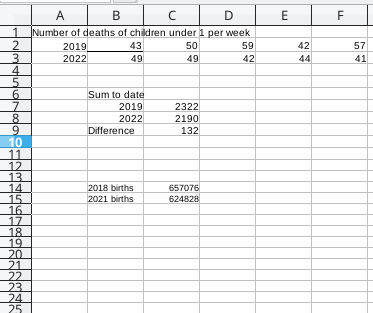
ONS Official Data: Deaths Rose in All Age Groups

Data for week 44 (2022): England and Wales: Deaths Up 21% Compared to Pre-COVID-19 Levels, Based on Data Released Only Moments Ago

Comparing this year to 2019 (total number of deaths):

Age under 1: 47 this year, 45 in 2019
Ages 1 to 14: 16 this year, 19 in 2019
Ages 15 to 44: 333 this year, 289 in 2019 (15.2% increase)
Ages 45 to 64: 1395 this year, 1196 in 2019 (16.1% increase)
Ages 65 to 74: 1816 this year, 1663 in 2019 (9.2% increase)
Ages 75 to 84: 3448 this year, 2938 in 2019 (17.4% increase)
85 up: 4740 this year, 4014 in 2019 (18.1% increase)

Conclusion: it seems like all adults (15 or over) are affected almost equally. Deaths rose by about 15%. This isn’t based on some subsample or random sample; it’s the complete data, which us very large.

Retrieval statistics: 21 queries taking a total of 0.085 seconds • Please report low bandwidth using the feedback form
Original styles created by Ian Main (all acknowledgements) • PHP scripts and styles later modified by Roy Schestowitz • Help yourself to a GPL'd copy
|— Proudly powered by W o r d P r e s s — based on a heavily-hacked version 1.2.1 (Mingus) installation —|