Introduction About Site Map

XML
RSS 2 Feed RSS 2 Feed
Navigation

Main Page | Blog Index

Archive for the ‘Science’ Category

Longevity — a Hot & Cool Topic

Season of the playful penguins
Season of the playful penguins from Oyonale

I finally found justification and backing for my long-time temperatural preferences.

Cool down – you may live longer

11:20 03 November 2006
NewScientist.com news service
Roxanne Khamsi

The refrigerator is used to lengthen the life of your food, and a new study suggests a similar principle could prolong your life, too.

IT Brains Dem/Geography

Map of Europe

COMPUTER skills and competence with them is a subjective thing. It very much depends on the area of expertise which is judged, as well as the way it is judged (e.g. average level of skill versus number of gurus). Regardless, I have found the following study rather interesting.

In some areas, such as security and Windows desktop administration, the United States remained dominant, the study showed; in others, such as LAN/WAN communications, we’re facing stiff competition from newcomers Romania and Ukraine. India continued to dominate database development and most programming-language categories — except C#. Latin American countries didn’t crack the top 10 but showed strong growth in new certifications, with Cuba up 125 percent, Chile up 163 percent, and Mexico up 73 percent…

In a survey conducted last year, Holland was shown to be the most tech-savvy country in the world. Whether that holds under the conditions imposed above, who knows…?

Wikipedia and Research Papers

WIKIS and research are a funny dou. As I recently pointed out, Wikis are an excellent tools for improving researched-on, peer-reviewed content. On the other hand, as this new article with some general background and criticism suggests, a Wiki is susceptible to abuse if it’s too open to a wide audience.
Brent Freccia, a social studies teacher at Newark High School in Delaware and a self-proclaimed “avid wiki-person,” created an entry for his school on Wikipedia, the oft-visited online encyclopedia and go-to source for students writing research papers.

An example where things can go terribly wrong:

When Cardinal Joseph Ratzinger was elected as pope last year, some Internet users who logged onto Wikipedia to see what he looked like found a rather different image: that of the evil emperor from “Star Wars.”

Wikis Finally Embraced by Academics

Wiki
The Public Wiki section on this domain

Some good news with regards to collaboration with tomorrow’s technology (pardon the pun).

“The collaborative editorial process of wikis often results in a stunning degree of accuracy. A study by the science journal Nature found Wikipedia nearly as accurate as Encyclopedia Britannica. In fact, for summaries on niche issues and emerging interests, the biggest wiki of them all — Wikipedia — is often the best available source of information.”

It’s about time. I have been doing this for over a year, but people whom I work with refuse to embrace the concept of collaborative editing. They just toss 2 MB E-mail attachments back and fourth, bloating/clogging each other’s inboxes, still unable to spot the actual changes made.

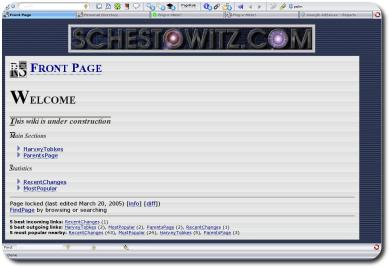
Here is one example . The page is currently locked for editing because it’s a year and a half old, which expires its ‘shelf life’ and justifies guarading against Wiki SPAM.

Accepting Evolution and Rejecting Theism

Rabbit

To many in the west, bunnies will
be perceived the creation of God

Slashdot looks at two perspectives on a new poll-based study which raises many questions.

“In a 2005 poll covering 33 countries, Americans are the least likely (except for Turkish respondents) to assert that ‘humans developed … from earlier species of animals.’

Here is my personal opinion on the matter.

Old related news:

Spreading Civilisation, or Shrinking it

Teleport

The almighty Stephen Hawking has made a bold and inspiring statement:

“The survival of the human race depends on its ability to find new homes elsewhere in the universe because there’s an increasing risk that a disaster will destroy the Earth, world-renowned scientist Stephen Hawking said Tuesday.”

In my humble opinion, many of the problems envisioned (sudden global warming, nuclear war, or a genetically engineered virus) can be addressed by controlling the size of the population, using birth control. The planet’s overcongestion leads to larger industries that are too morbid for a healthy, long-term existence.

Will society ultimately implode? Or will things escalate into a worst case scenario, as in this apocalyptic prediction? We shall live and find out.

Mathematicians in Support of Cloaking

Teleport

AN intersting article over at the BBC speaks about the idea of cloaking. To be more specific, a couple of scientists contend that it may be possible to hide one’s existence and presence. This notion relates to many science-fictioncal fantasies, so it sure arouses curiosity and fascinates, much like time travel.

The cloaking devices that are used to render spacecraft invisible in Star Trek might just work in reality, two mathematicians have claimed.

Retrieval statistics: 21 queries taking a total of 0.153 seconds • Please report low bandwidth using the feedback form
Original styles created by Ian Main (all acknowledgements) • PHP scripts and styles later modified by Roy Schestowitz • Help yourself to a GPL'd copy
|— Proudly powered by W o r d P r e s s — based on a heavily-hacked version 1.2.1 (Mingus) installation —|