Introduction About Site Map

XML
RSS 2 Feed RSS 2 Feed
Navigation

Main Page | Blog Index

Archive for the ‘Technology’ Category

Ballmer’s iPod

Gorilla

I have found a very amusing Flash clip involving Monkey Boy Steve Ballmer, CEO of Microsoft. He sure seems to love his iPod, but so does the Queen of England.

Context: Massachusetts says Goodbye to Office – including a reference to Ballmer’s ugly side.

One Laptop, Terabyte of RAM

Laptop

We shall soon see yet another powerful laptop that runs Linux and Windows. Pay careful attention to the specs though:

Processor: 6.8GHZ CPU (AtomChip® Quantum® II processor or 4 x Intel® Pentium® M processors 1.7CHz) / System Compliance: Two Operating Systems with Voice Command (Microsoft® Windows® XP Professional and Linux®) / Memory: 1TB Quantum-Optical non-volatile RAM (NvIOpSRAM-SODIMM 200-pin) / Storage: 2TB non-volatile Quantum RAM (NvIOpRAM-ATA IDE)

UPDATE 08/09/2005 14:00 – there are speculations that the source may be over-enthusiastic or even a hoax.

Mail Backup and Restoration

Separate boxes
Always store your mail in (at least) two isolated places

Unfortunately for most of us, there is rarely an option in mail clients which caters for one-click backup and restoration of E-mail. We still lack an embedment in a GUI, which makes backup trivial to all, as well as quick to invoke.

An alternative to explicit backup is duplication of data files. Owing to the use of Open Source applications, my mail gets backed up on the SAN every night and on another computer twice a week (in an open and raw MBOX format). I advise everyone to install a reliable mail client and set up a repeating job that can handle backups without any user intervention (see links below).

Microsoft applications (speaking of computer crashes when backups are truly needed) rarely seem to mind portability and safety of data. Outlook and Outlook Express would lock your mail in proprietary formats, which is the reason why I ceased to be their user (having started with Netscape Mail). Anything that served Microsoft’s purpose, namely my immobility, appeared to be the grand goal. Thunderbird will save your mail in a form that is extremely painless to back up. Furtherfore, it can also easily import mail from Outlook or Outlook Express, in a way that preserves all the data and even mail settings.

Another backup option is by converting mail to HTML, which is open and standard-compliant. There exists a Ruby script called eml2mbox which bridges a gap and helps towards the generation of Web pages from individual mail messages.

Older notes about mail management:

Thunderbird-related items:

As well as links that are related to mail, lots of resources and tips on backup reside on this Web log.

HotLink Revenge

HotLinking is a term describing the situation where one site uses another Web site’s traffic, usually to display images it does not own. It is considered an act of stealing or unfair and unauthorised use of content. A few days ago I read a story about an HotLiknking victim that has gone a long way to achieve that sweet old revenge. As a large hamburger chain HotLinked a Flash clip, the Webmaster could notice unusual levels of traffic pulled from afar, namely from the hamburger chain’s Web site. He quicikly reacted quite shrewdly. The Webmaster explains: “…I redirected everything coming from Fuddruckers.com (the HotLinking criminal)… Wrote a nice little message pointing out how incredibly stupid their web developer is. And then redirected the main page to a pleasant little website showing photographs of slaughterhouses. And also opened up some more popups, for those that don’t have popup blockers.”

Steak sliced

Also see my previous write-ups on HotLinking:

Massachusetts says Goodbye to Office

Bill Gates
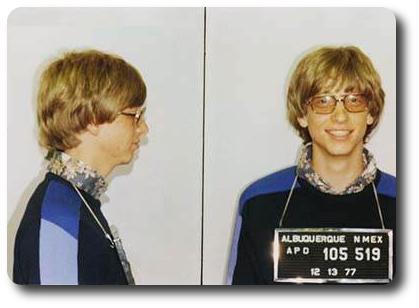
Bill Gates arrested in his younger days (photo in public domain)

RECENTLY I came to discover more about the personaility of Microsoft CEO Steve Ballmer, perhaps possessed by the measles. He has become yet another one of the ugly guys in the block, perhaps even topping the man above. He was caught yelling “I’m going to f—ing kill Google” and throwing a chair across his office. Anger management comes to mind.

Given the aggressive behaviour of Microsoft, it was not too surprising when Massachusetts prepared a proposal that will drop Office in favour of Open Source solutions. I wish them to best of luck in their future endeavours, which are sure to insire the remainder of the country over the long term.

Massachusetts is preparing to deliver another challenge to Microsoft’s core PC software business: a directive to force all 50,000 desktop computers used by state employees to be stripped of Microsoft’s Office, the suite of applications used on an estimated 95 per cent of PCs the world over. Instead, they would be required to run an open-source version, such as OpenOffice or StarOffice – software produced by volunteer programmers and distributed free of charge.

Carkeys Become USB

USB keyMazda are replacing cylinder car locks and make use of electronic keys. Such keys come in the form of a USB drive, also known as a USB key or a pen drive. This move is reminiscent of the new Linux-based IBM laptop, which uses fingerprint recognition for user authentication.

Such moves accommodate for a revolution in security, but also a sudden change of habits. For example, keys are easily duplicable while borrowing or stealing of someone’s fingerprint is not possible. Moreover, it promotes cybercrime while circumventing traditional crime. From the article:

In addition to starting the engine, the flash drives can be used to transfer driving directions for long trips along with the latest songs for the day to the Sassou’s internal hard drive.

Cost of Platform Installation and Operation

Graphs
A comparison to evaluate running costs over a length of time

RECENTLY, a fair bit of discusion focused on costs of Windows in the enterprise versus Open Source solutions. There are still many arguments between those whose familiarity with Open Source-based systems does not coincide with that of the manager. Furthermore, heavy advertising campaigns which Microsoft launched make it difficult to avoid deceit. More than ever before, there are vicious attempts to convince the public that Open Source is more costly, less secure and even bound to vanish.

One of the more disturbing facts is that a large corporation, which at present feeds on billions from the public, is able to run a propaganda whose budget is merely infinite. Despite all, we now come to discover that IBM have run their own independent TCO study, in which they compare cost (taking effectiveness into account) of the different solutions available. The study concludes that:

Linux is 40% less expensive than a comparable x86-based Windows server and 54% less than a comparable Sparc-based Solaris server.

This provides a long-anticipated answer to many who required it. A typical system administrator, who is inclined to favour Linux, can now use the above as concrete backing. The manager who makes the final decisions will sooner or later digest these facts and figures.

Related items:

Retrieval statistics: 21 queries taking a total of 0.197 seconds • Please report low bandwidth using the feedback form
Original styles created by Ian Main (all acknowledgements) • PHP scripts and styles later modified by Roy Schestowitz • Help yourself to a GPL'd copy
|— Proudly powered by W o r d P r e s s — based on a heavily-hacked version 1.2.1 (Mingus) installation —|