


Social Control Media Isn’t Social Because You Don’t Lose Real Friends (or Social Life) Just Because Some Site/Instance/Pod Shuts Down
 Filed under:
  will soon make changes to my microblogging routine. Probably some time next month. Here’s the alta vista of it.
“Social Control Media” is a term I coined many years ago; many people, even Wikileaks, have adopted the term since then. When I say “Social Control Media” I don’t limit myself to Twitter and Facebook; it also applies to LinkedIn (Microsoft claiming to ‘own’ your identity), GitHub (Microsoft claiming to ‘own’ your work/code), YouTube (video), and TikTok (crap). More importantly, as I’ve repeatedly pointed out in Techrights, Free software- and freedom-based sites aren’t robust to many of the same issues (volatility, misinformation) and even if they’re self-hosted, decentralised, federated etc. their existence is transient. Some sites or software will cease to be maintained within 5 years or less (in the case of self-hosting, a new version of PHP, for instance, can break the software you self-host).
Static sites with simple files are generally a good idea if you intend to keep your data, not only through the Web but whatever protocols will exist and get popularised in the future. More importantly, never rely on making “connections” online; make them “in real life” as real friends don’t need the Internet to keep in touch. I’ve hardly used the Internet at all to keep in touch with real friends.
Next Friday JoinDiaspora will go offline after more than a decade. When it comes back online it’ll be “read-only”, available temporarily only for users to be able to export their data and move it elsewhere (to another pod). All the connections will be lost, even if posts and comments are going to be preserved, according to the promises from the project’s core team.
Maybe I’ll fondly remember those 3,000+ “followers” I gained in JoinDiaspora.

What about the 2,000+ “followers” of Linux (TuxMachines)? I hardly ever knew them.
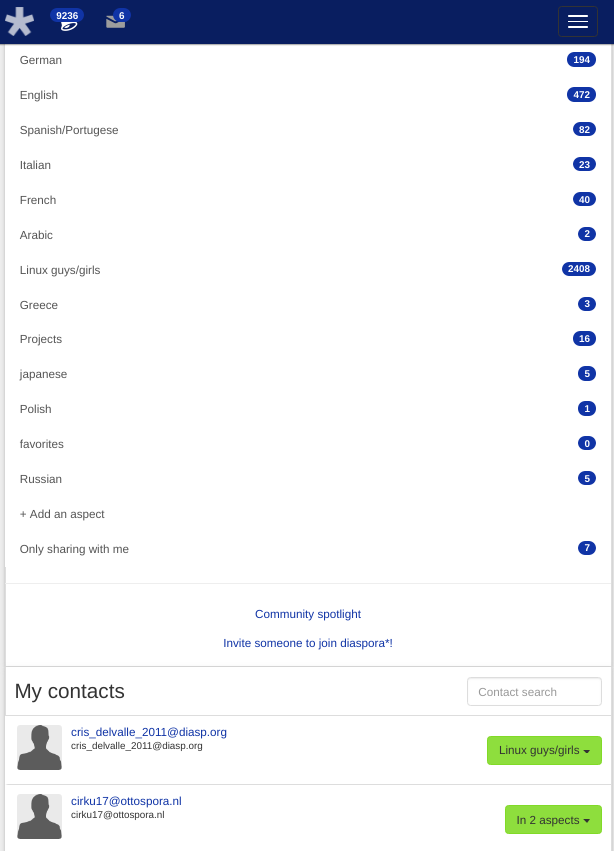
After thinking about it for over a month and having spoken to another person who has posted heavily to JoinDiaspora for over a decade (with many “followers”, too) I am pretty certain I’ll migrate both accounts to another domain, another pod. I’ve not decided which one yet, but it needs to be something that can last and keep alive for at least another decade. As I explained here a few days ago, I’ve already lost more accounts than I can remember. I don’t want to jump from one dying pod to another soon-to-die pod. As for self-hosting, it’s out of the question due to complexity (Diaspora became bloated; I tried installing it almost 8 years ago and it was already very heavy and complicated to manage).
For me, IRC provides a more reliable means of communication and it’s vastly easier — not to mention a lot cheaper — to maintain.



 raph theory is essential to the Surveillance Industrial Complex — the privatised branch which maps people and assigns risk levels to them, depending for example on who they meet/met and/or speak/spoke to. Facebook extracts an immeasurable amount of work previously carried out by the Surveillance Industrial Complex. It outsources the effort. The cost is being passed to the public in exchange for games and pseudo-status.
 new site I’ve launched,
  NE of my clients,

 EVERAL months ago I joined Diaspora and enjoyed the good uptime of the service. The community was thriving, everyone was friendly, and the site reacted to input as one would expect. But then, just like Identi.ca, the site began having performance and uptime issues. At one point the site was down for a week. People soon lost those withdrawal symptoms and perhaps just moved on; some returned only to see sporadic operation of the site, which fairly enough is still in alpha (the software it runs is). But the bottom line is, in the early days people reviewed the site harshly for technical shortcomings. Now it’s just the really terrible uptime and low reliability. Unless this gets fixed the site is likely to lose its most ardent supporters and participants.