


The Rise of the Wiki
 Filed under:
 Only yesterday, one of the regulars in a search engines discussion group (nntp://alt.internet.search-engines) raised the following question/complaint:
Everytime I search for something on google Wikipedia appears in the top 100 results! Is it taking over the Internet?
Last night, IT guru Joel Spolsky asked for advice on Wiki for his site’s translations. He could no longer resist the productivity of a Wiki, which allows visitors to manage content while vandalistic changes can be quickly rollbacked (reversed). The matter of fact is that Wikis have become extremely ubiquitous and they are conquering the Net, much like blogs. They simplify the composition of Web pages, particularly when composition is handled and managed by a group.
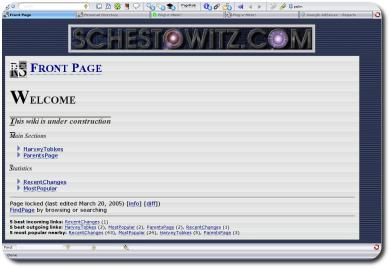
Schestowitz.com has two Wikis — a private one and a public one. At some stage I found that Wikis can conveniently be used for correspondence or for collaboration in academia, e.g. when writing or revising a paper jointly.
There are all sort of reasons for using the Wiki’s simplified mark-up and not WYSIWYG interfaces (as clean as they may be) or plain HTML.
- Firstly, there is the issue of security such as off-site linking. You need to provide a subset of features. Having said that, this can be prevented by imposing restrictions on whichever composition language/method you choose.
- Secondly, one has to worry about the issue of consistency. I have a friend who manages the content of a site and I cannot recall how many times he did something invalid that broke the integrity of the entire site, which I then had to fix urgently. “More restrictive” means “less things to go wrong”. After a few weeks I completely gave up on making his pages valid XHTML/CSS. He had too much freedom and too little experience.
Finally, on the issue of software recommendation, I cannot comment on the popular MediaWiki, which is used to power Wikipedia. I have never used MediaWiki myself, but PHPWiki has been fairly stable ever since I set it up 6 months ago and had it updated many times a day. If you are looking for ease-of-use and trivial embedment of media, I suggest you go with more mainstream packages such as the admirable MediaWiki, which I am familiar with as a user, but not as an administrator.



 venturous article from Softpedia makes speculations with regards to
  Content spam grows worryingly fast. This new type of spam shows its face in a form which is different from spam that we very well know as uninvited E-mail. Such spam is placed on the Web and later infiltrates search engine results pages (SERP’s). If you recently came across a page full of links and ads that did not provide useful information, you would probably understand what content spam is.
 definitely enjoy running my Web log, but
  oogle have recently revealed that they had used Linux from day one. Looking further into the past, why have they not openly expressed their passion for Linux? Perhaps they realised that over 90% of their target audience were Windows users. No user will be inclined to use the service of one that is different, one whose preferences are in ‘disharmony’ with the clients. Under such circumstances, there emerges an inner-conflict, whereby a Google user admits making a mistake, making a poorer O/S choice.
 ollowing rumours and an official announcement in the Google Blog,
  This move can certainly make Google Alerts for news obsolete, yet such alerts for non-news searches remain practical, albeit difficult to handle (periodical HTML-formatted E-mails).