Introduction About Site Map

XML
RSS 2 Feed RSS 2 Feed
Navigation

Main Page | Blog Index

Archive for the ‘Internet’ Category

Open Source Content Management Systems

CogwheelsThe latest generation of Web development involves tools such as the one used for managing this Web log. Although many pages continue to be composed in the level of raw HTML code or using What You See Is What You Get (WYSIWYG) tools, their days appear numbered. Quite simply, both are antiquated methods of composing for the Web since development is usually done at the remote end — the user’s end. Both content and tools (software) reside on the user’s side. Content then needs to be transferred to the Web server and software is not guaranteed to work on any platform.

In the past few years, many free content management systems (CMS’s) have emerged. They typically re-use GPL‘d components for a more rapid development process, which is the power of Open Source. The result is the existence of many packages and some prominent ones are listed below:

There is no “best tool” as it all depends on the task in question and the nature of the Web site to be built. However, Plone is very mature, WordPress is highly user-friendly and PHP-Nuke is versatile. The best thing to do is visit the sites and view demonstrative flagship sites that run on each CMS package. A quick glance will give all the impression that is needed.

Wi-Fi HotSpot Near You

Wi-Fi map

Americans can take advantage of a database/map of nearby Wi-Fi HotSpots. This Web site, WiFiMaps.com, is of course far from ethically acceptable. Perhaps it will force system administrator to finally change the default, out-of-the-box settings on their routers. It is amazing how penetrable Wi-Fi connections have become.

Related links: (external)

The links above are posted as a word of caution. You must ensure that you are not exposed to such hacks, which probably affect old devices the most.

Explorer 7 Against Web Standards

Internet Explorer 7 screenshot

Paul Thurrott, a Windows guru is and well-known Windows advocate, wrote this strong critique of Internet Explorer 7, which he claims punishes both Web developers and users.

Paul closes his write-up with the following words:

My advice is simple: Boycott IE. It’s a cancer on the Web that must be stopped. IE isn’t secure and isn’t standards-compliant, which makes it unworkable both for end users and Web content creators. Because of their user bases, however, Web developers are hamstrung into developing for IE at the expense of established standards that work well in all other browsers. You can turn the tide by demanding more from Microsoft and by using a better alternative Web browser. I recommend and use Mozilla Firefox, but Apple Safari (Macintosh only) and Opera 8 are both worth considering as well.

Related item: Internet Explorer Breaks the Web

One Blog Per Second

Small clock

The BBC have published interesting statistics according to which a new blog is created every second.

The blogosphere is continuing to grow, with a weblog created every second, according to blog trackers Technorati.

…

It suggests, on average, the number of blogs is doubling every five months.

Older related items:

As the number of Web logs continues to rise (nearing exponential growth), an anti-climax is rapidly reached. Attention is spread among more blogs and hence feeds/spiders account for more of the traffic for most blogs…

…in the near future, everyone alive will (on average) write a song, author a book, make a video, craft a weblog, and code a program…

Search Engines and Spying

CCTV

Have you ever pondered or worried about what search engines know about you? If not, you should. It is no secret that even the most prominent and powerful companies see value in tracking their users. Companies do not have any desire to infringe the user’s right for privacy, but information about their users allows them to improve their services, e.g. by behaviour learning which leads to optimisation and targetted content.

A few clarifications are worth making: If you use Windows and, more particularly, if you use Internet Explorer, your privacy is jeopardised the most. I am not pointing my finger at Microsoft, but spyware is targetted at the most prolific platform and application. It is the most cost-effective spyware development process. Have you heard about Alexa rating? Ranks are most likely based on spyware at some level or another. The watchers know what sites you visit. The watchers might also know what pages you bookmark, how long you ‘sit’ on a SERP, which pages you follow and the list goes on and on.

Google should be able to infer, based on a small statistical sample that is exposed to spying, which page got bookmarked the most after it was reached from one given SERP (e.g. leaving SERP, then hitting “back” and requesting the SERP again). This way, spamfull sites can be distinguished from sites the user actually had interest in and ended up bookmarking. It is a machine learning approach. Results adapt to users’ behaviour. With a cunning Google cookie that precisely identifies users, you can only imagine the tonage of data that is accumulated about individuals. Shall it be needed, let it be taken ‘off the shelf’…

Google Cookie
The Google Cookie

On to Microsoft, they already exploit cookies by swapping them across sites, which of course is questionable if not an illegal practice. They have recently bought a spyware company (Claria who make Bonzi and other related ‘goodies’). Consequently, they downgraded Claria’s threat level, which was a cause for controversy, much like a controversy with Firefox. Users reported that Firfox was labelled harmful by Microsoft’s spyware detection application; Firefox removal was recommended too. All in all, it appears as though MSN have similar plans in mind and aggressive behaviour remains one of their innate features.

Disclaimer: I am not entirely sure about each one of the facts above, but spying is nothing unprecedented. What I argued is based on text (and I do not mean science-fiction or conspiracy theory resources), though many speculations were involved and such communication must be taken with a grain of salt.

Evolve or Die

Longhorn

This picture was funnier when Windows Vista was still called Longhorn

It was roughly a decade ago when a mysterious journalism trend emerged. All of a sudden, in a matter of a few years, major newspapers began to migrate their content to the Internet and shield their on-line popularity. A frantic stampede — that was — to what would become the future of journalism. Editors came to realise that it was only a matter of time before readers would take advantage of technology. This new form of publication had very many conceivable advantages:

  • Being able to isolate uninteresting bits from the unmissable (content tailoring)
  • Ability to save article (electronic storage)
  • Reduction in cost (physical properties)
  • The ability to share articles with friends and colleagues (reproducibility)
  • Being able to performs searches (indexing technology)

Whatever gains one can imagine, most likely computers will have them. So, paper was bound to become obsolete sooner or later.

Several years later, particularly in the beginning of this millennium, blogs (Web logs) began to emerge. Suddenly, people had easy access to powerful publication platforms. The growth of blogs in terms of number and amount of content was explosive and their extent soon became excessive. How could a mainstream newspaper keep up with blogs and attract the masses? Journalists became threatened. Later came he feeds frenzy, which unlike blogs, has not reached its anti-climax, yet. Soon enough, operating systems (as we know them) might be put aside in favour of on-line operating systems. So who will be the next victim if not Microsoft? And who will it be that inherits the Earth? Google and Yahoo are among the contenders. For Microsoft, who have made many enemies, the last resort has become software patents, which they are piling up like connonballs for application at the Patents Office.

Slow movement towards on-line data management has been well-comprehended by all fronts. Microsoft attempt to conquer the Net as they are investing a heavy load of resources to reach that goal. From this site alone, MSNBot fetched 13968 pages, trailing by just a decent margin behind Google with 20627 pages in the month of July. Without a doubt, Microsoft have gained plenty of bandwidth and computer power.

It was not long ago that Bill Gates gave his engineers just 100 days to steal Google’s idea of AJAX-enabled maps (satellite and hybrid maps too). In response to Mozilla Firefox, which kept Microsoft on their toes, a decision was make to update rusty Internet Explorer 6 and leap to Internet Explorer 7. Not surprisingly, many ideas were stolen from Firefox, which was considered the main danger at the time.

Later on, Microsoft decided to embed RSS support in the kernel of Windows Vista (formerly Longhorn). Again, this step was taken in order to compensate for the considerable lag behind some recent technologies. Gates et al. were then scheming to buy off popular bloggers — a shrewd idea due to general Microsoft disdain in popular and influential blogspheres. The main complaints of bloggers, along with some major voices in the media, was the lack of inter-operability, being proof that Microsoft are patronising the rest of the IT world with utter platform discrimination. They simply fail to internalise that it is nice to be important, but even more important to be nice (open).

Firefox & FTP

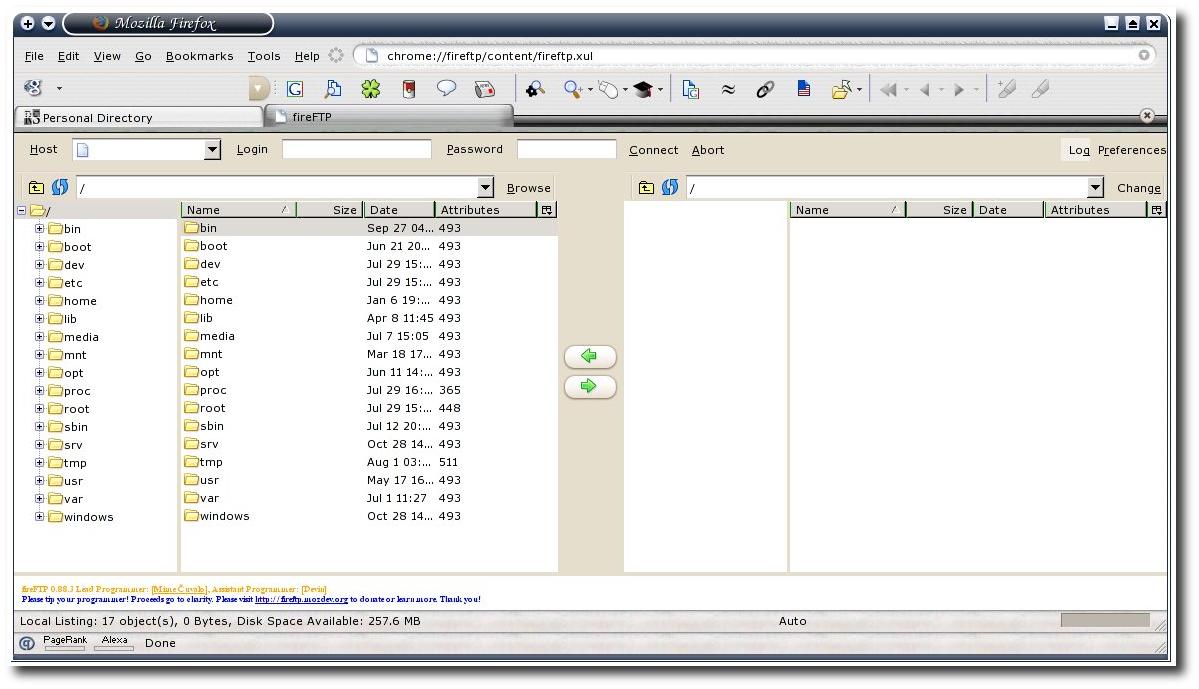
FireFTP

FireFTP – Click image for the full-sized version
Firefox is Mac OSX-themed (Download/install)

Over a thousand people have reached this site when looking for an FTP client for Firefox. As my previous post on the topic was succinct and vague, I decided to elaborate, capture some screenshots, report on my experiences, conduct some comparisons and make recommendations.

I have run FireFTP beta (version 0.88) on two separate computers with different operating systems since late April/early May when it was released to the public. The time and content of my previous post indicates that I got notified via RSS feeds so FireFTP must still be very new and ‘fresh’. Bugs are rare, but they appear recurrent for instance, when recursive, deep downloads/uploads are pushed to the extreme. Nonetheless, in this particular problem domain which is file transfer, nothing is mission-critical by nature. The data never gets corrupted, only the flow of control in the application lacks reliability. Overall, I would happily assign a rating of 7/10 to FireFTP.

As my essays tend to (knowingly) drift away to separate, yet related topics, I shall survey a few alternatives which also make good FTP clients. My experience with FTP clients goes back to age of 15 or 16. Among the applications I have continuously used for the task are:

  • CuteFTP
  • SmartFTP
  • WSFTP
  • CrystalFTP
  • Hummingbird
  • IE
  • …and surely a few more Windows applications, which go back too far for me to recall

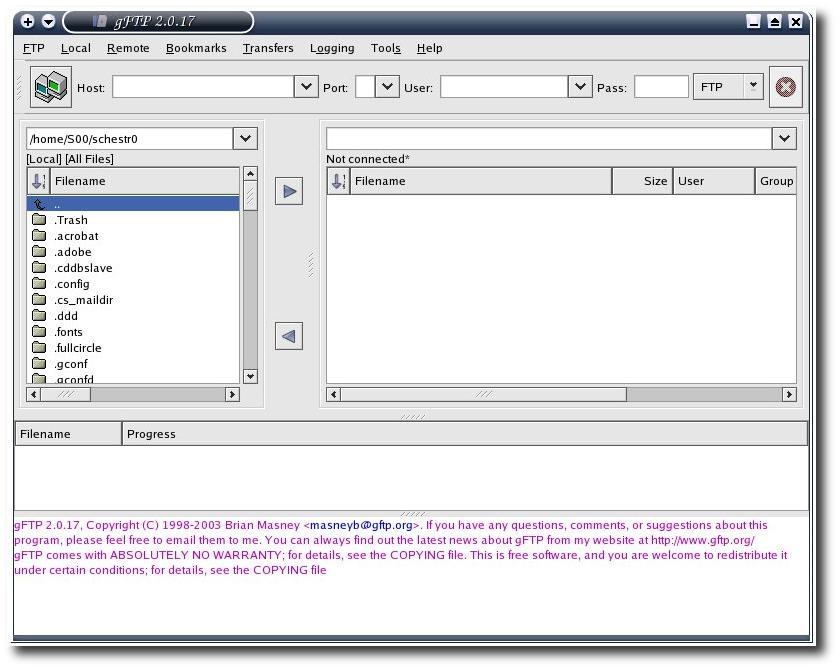
I ordered the list above by frequency or duration of use; it is not chronological. Although most of the above were shareware (especially the former), there were many UI ‘nags’ involved. Around the year 2000 I began to drift to Linux, which by nature, offered nag-free applications that were solid workhorses. My favourite FTP client, which is most valuable for the majority of tasks, is GFTP. I run it remotely from RedHat Fedora Code II clusters. GFTP achieves extremely high transfer rates, perhaps by pipelining (the site corrected me by saying that GFTP is multi-threaded. I believe that in the Windows-oriented list above, only IE supports multi-threading). That powerful feature allows me to download and upload 1,000 files in a matter of seconds. This is useful, for example, whenever I want to apply a massive search-and-replace to a comprehensive site section.
GFTP

GFTP screenshot – Click image to see it full-sized

Linux users are encouraged to use GFTP for any traffic where latency becomes a hindering factor, in particular where a large number of files is involved. Unfortunately, one lost advantage is that GFTP cannot be integrated with the browser. FireFTP gets close to it (it gets embedded in a tab), but KDE‘s Konqueror (father of Safari) is another alternative, which is an HTTP, HTTPS, FTP and file management ‘platform’. It competes in terms of speed with GFTP. It is much superior in terms of usability too. Finally, worth adding is the observation that aforementioned applications are separate from the browser at one level or another. That is something that Microsoft have addressed, may it be good or bad. When the filesystem tool (explorer.exe) is hard-coded into the browser (or vice versa), there is not much room to ‘dance’ from one browser to another (and retain good use of resources).
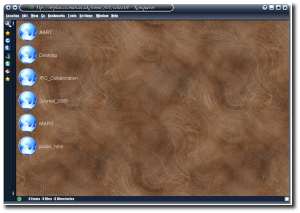
Konqueror as an FTP client

Screenshot of Konqueror as an FTP client
click image to see it full-sized

Retrieval statistics: 21 queries taking a total of 0.095 seconds • Please report low bandwidth using the feedback form
Original styles created by Ian Main (all acknowledgements) • PHP scripts and styles later modified by Roy Schestowitz • Help yourself to a GPL'd copy
|— Proudly powered by W o r d P r e s s — based on a heavily-hacked version 1.2.1 (Mingus) installation —|