


Google Bourbon Revisited
 Filed under:

 oogle results page (SERP‘s) have been unstable recently. This may have affected anyone using Google. It caused a great deal of distress to many Webmasters while others observed a significant, unexplainable surge in traffic. Unlike the many rumours, an article from WWW Coder draws a clearer picture:
Google is undergoing some of the most sweeping changes in its short, seven year history. As of next week, Google will have finished sorting what might be its largest algorithm shift ever as the final points of the 3.5 part Bourbon Update were installed last Monday. This update has been staggered into three and a half sections in order to avoid a massive amount of dislocation in established rankings as was seen in previous major updates. While changes stemming from the Bourbon Update have not actually manifested into a full reordering of Google’s search engine results pages (SERPs), many individual webmasters have reported fairly significant losses or gains in ranking over the past few days.
It is re-assuring to know that the folks at Google keep maintaining and improving their highly-ubiquitous search tool.



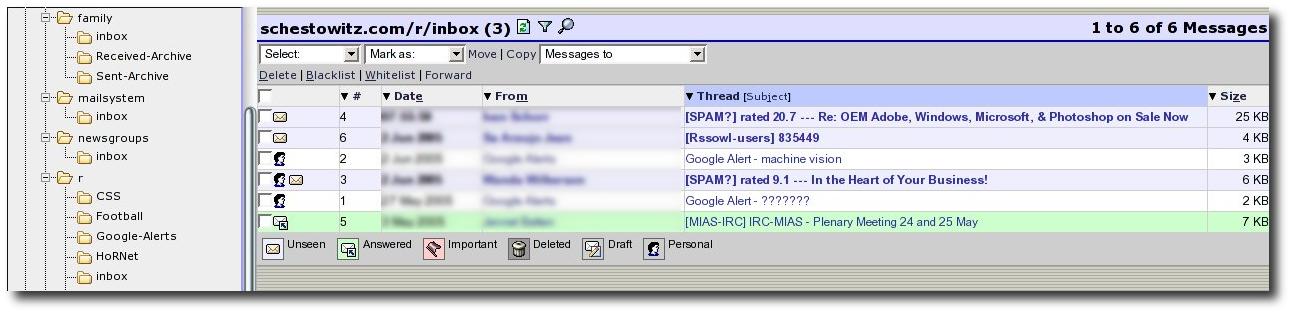
 his entry does not concern spam, but rather the management of mail which belongs to a different ‘classes’, e.g. academia, work and play. It is a simple efficiency tip.
 eer-to-peer (P2P) and the World Wide Web (which we most commonly perceive as hypertext — HTTP) are separate. When one uses an Internet connection to directly communicate with a remote machine, then traffic is uncensored, often not monitored, and there are no restrictions imposed on the exchanged material. This justifies the potential illegality of P2P networking.
 There are less controversial ways of obtaining media. When it resides on the World Wide Web and hosted by a trusted source, it is then subjected to copyright laws. For this particular reason, it is safer to download MP3 files from trusted Web sites, many of which distribute music for free in interests of self-promotion. Downloads are also far faster because data is delivered by a Web server. An older item explains how to automatically (READ: recursively)