“Forty percent of servers run Windows, 60 percent run Linux…”
–Steve Ballmer, Microsoft CEO (September 2008)
 ontrary to figures that account only for shipped volume and revenue (IDC), the installed base of GNU/Linux servers is very high. This is not to be confused with “market share”, whose definition gets changed so as to serve the vanity of companies which directly or indirectly fund such market surveys. There is a lot of selective research and cherry-picking of methodologies.
GNU/Linux is very commonplace on servers. Virtualisation requires those servers to communicate between and within one another, either through open standards or ‘interoperability’, which is typically a two-way bridge. Microsoft is fiddling with companies like XenSource (now Citrix) and VMware (now run by former Softies) to interfere.
In order to understand how Linux is doing against Windows on the server, a market survey would be required which is global. It is harder and more expensive to conduct a survey based on actual deployments (global in particular), as opposed to assembling and aggregating numbers of shipments from market leaders.
One indicator of the success of Linux on the server is internal intelligence conducted and/or used by Microsoft. The company calls this — albeit just internally — “Linux heat map” (I have a copy here, a court exhibit from Comes vs Microsoft). Publicly, realisation of the Linux threat to Microsoft can be arrived at by interpreting the company’s rhetoric and actions, such as threats of litigation, secret deals with Fortune 500 companies that pay Microsoft for their use of GNU/Linux (this is scarcely reported in the press and the companies refuse to identify themselves), and also disinformation initiatives such as “Get the Facts” and “Linux Personas” (defunct just days after debut).
Internal documents which were revealed in the Comes vs Microsoft case not only reveal figures about market share in several areas. They also show the company’s executives running frantic about what they called “Linux infestation”. They said they were not on a path to win against Linux, so they tried to manipulate Dell into dropping or neglecting Linux (on servers) and they also decided to commission studies which show Linux to be more expensive. Failing the first time, Microsoft argued, they can simply try again. This methodology fits well with tactics that are presented in internal Microsoft talks about “Effective Evangelism”. One of the tactics is to manufacture evidence that you need and then reference it. Analysts can be compensated in many ways that escape the public eye, as detailed in the company’s presentations (all endorsed by Bill Gates by the way).
In one of the documents disclosed in Comes vs Microsoft, Microsoft was seen explicitly asking IDC to remove signs of its sponsorship of a study. This study accidentally showed Linux (server) to be superior. Microsoft had similar studies conducted with market research groups like Yankee and Gartner.
It is worth emphasising that what challenges Microsoft is not just the market share of Linux. It’s more complicated than that. As netbooks (sub-notebooks) have demonstrated, tough competition from Linux not necessarily leads to erosion of Windows’ market share; instead, it rapidly leads to erosion of margins. Sources suggest that Windows has become virtually free (gratis) for some form factors, whereas in the case of servers, Microsoft has promotional means for advancing Windows not only through advertising campaigns. I have heard personally from Web hosts who were offered Windows for free so that they migrate away from Linux. In one case, the source was offered subsidies of hardware as well.
All in all, this comes to show that it’s a multi-faceted issue which can be addressed and treated by considering questions like:
1. How has Linux affected Microsoft’s/Windows market share?
2. How is market share defined?
3. How has Linux affected Windows margins?
4. What is the difference between perceptual Linux quality/market share compared to reality? There is room for distortion here and it is actively being exploited, as shown by authentic court evidence.
5. How failure-proof is Linux? How many companies are involved in developing and supporting it? Symbian and Palm OS, for example, have a single breaking point.


 Filed under:
 HIS IS OUR test episode, a pilot so to speak. We did it all in one go (over an hour) without any notes or scripts and it is not edited. We hope that it’ll be acceptable and in our next episode (probably in November) we’ll use experience from this first run and also refine by doing some planning, then editing. Please treat it as a beta episode if it helps and we thank you for listening.


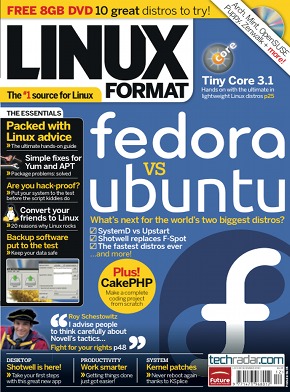
 Summary: Techrights is in the December 2010 issue of Linux Format Magazine
 OR THOSE who want to know more about the history of Techrights, there is a new article in the December 2010 issue of Linux Format. The content is
  am not always a pessimist, but I do believe that in order to make positive progress we must concentrare on the illnesses and try to cure them. This is why most of my work at present revolves around advancing collaborative platforms like GNU/Linux (no tyranny on people’s desktops and servers). Sure, companies like Google and IBM make a lot of money out of the platform, but it does not take away from anyone else’s ability to use the same code. Overall, it leads to solidarity. Just watch how many companies jointly develop Linux (kernel space), including giants like AMD, Intel, and NVIDIA, which must play nice with the free graphics stack. A decade ago it was hardly conceivable, but here we are today with some truly powerful applications for GNU/Linux (some are still proprietary, especially games). It is exciting to see desktop environments like the K Desktop Environment (KDE SC) and GNOME desktop becoming highly competitive with whatever else is out there, proprietary included. LXDE and Xfce continue to serve an important role, especially in less capable PCs that rely on light-weight distributions. New releases of GNU/Linux come at a pace of about one per day and diversity continues to exist, with popular branches like the Mandrake/Mandriva family (with several derivatives), the Red Hat family (including Fedora), and the Debian family, which notably includes Ubuntu for the desktops (it has a huge number of variants).