Introduction About Site Map

XML
RSS 2 Feed RSS 2 Feed
Navigation

Main Page | Blog Index

Archive for the ‘Open Source’ Category

Exploiting and Attacking the Messengers

Does Sirius (still) give anything back to those whose work it is exploiting? Or does it give a shell about Free software communities?
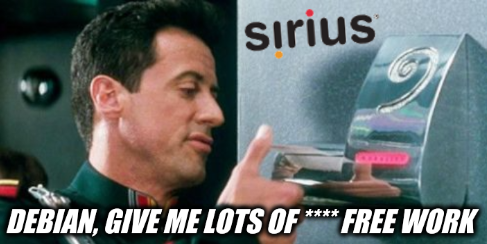
Debian, give me lots of **** free work

Summary: Sirius ‘Open Source’ is in so much technical, legal, and financial trouble that now it is chasing those who criticise the company, even without naming the company or anyone inside the company; this means that on top of being a ‘parasite’ (preying on Free software with false labeling) the company has become a true enemy of freedom of speech, guarding misbehaving people from their critics

THE company I left is in a state of disarray. The management in question was largely exploiting and seeking to start profiting from (aka ‘monetising’) Free-as-in-freedom software without contributing anything back. In recent years it wasn’t even adopting Free software and instead abandoning it in favour of proprietary spyware. There was no debate about it. It’s a one-way relationship.

Similarly, there was a one-way relationship with staff. People were expected to stay up all night, actually working, while some management in daytime failed to do very basic work, very fundamental tasks. High-tech labour with low-end wages may seem sustainable, but as inflation soars it becomes a stretch. Then, the company as a whole becomes untenable.

This past year I started talking privately about the situation with a friend; names of people and names of companies weren’t included (not even Sirius!), but the company was eager to crush staff, silence staff, and dodge liabilities to staff.

Below we include the second part of an extensive section, which will later be supported by hard evidence.

Sirius urgently needs to rename. It is not doing “Open Source”; instead it rips apart the infrastructure that was Open Source, replacing it with proprietary spyware (for a number of years already; this year the trend accelerated further). “Sirius Open Wash” would be a suitable new name for the company, but maybe it’s too late because the company has no future anyway.

The bullying intensified months ago. Managers basically start with the supposition that all workers are guilty of something and then try to dig for “evidence” to justify the foregone conclusion, making up or exaggerating things while resorting to distortion various rules and regulations (gymnastics in logic), reaching out to things said as far back as 4 years ago (when staff had been subjected to bullying from management).

We certainly would have sued Sirius if it wasn’t so broke and operating through shells, at least one of which registered outside the country.

Text from the report included below:


Roy does not talk about the company where he works, at least not by name. He does not mention people and clients of the company. If Roy discusses that with a friend in some chat outside of work, that’s perfectly within his rights. If the company does something wrong and Roy then discusses it with somebody, that might even be a positive contribution. Nobody should be above criticism. If Roy discusses romantic relationship between colleagues without even naming them, that’s perfectly lawful (there’s no need to twist a romantic relationship as “living arrangement”, covering up for how inadequate that is). As the main issue discussed isn’t the nature of the relationship but the nepotism and abject lack of relevant qualification/s, this is a matter of broader or professional interest. It’s not mere gossip and either way, nobody is named. To be very clear, informal IRC chat with one person is not “social media”; pretending that it is would be considered fact-twisting. IRC has been around since the 1980s, Roy has its own IRC network, and there are no companies or “data broker” chewing up this data. The data is maintained in a privacy-conscious manner on a server managed independently. To some people, very fundamental facts about communication tools leads to evasion of proper understanding, either deliberately or accidentally.

The accusations against Roy mostly latch onto cherry-picking of words, all that while ignoring the underlying substance, which is expressed relatively politely (no expletives, but lots of typos because it’s very informal chat). There seems to be a lot of tit-for-tat over the ‘teat’ (to be clear, the company’s high-paid managers were milking Roy for years; Roy’s salary would have increased with inflation by about 40% in 12 years, but that didn’t happen).

So who’s milking who?

How Sirius Open Source Turned From a Company Into Just an Account

Video download link | md5sum 7fe1fe13ceb4d6a779380ededbafb8b4
Security Impermissible in Sirius
Creative Commons Attribution-No Derivative Works 4.0

Summary: Some years ago my employer was abandoning (piece-wise) its own infrastructure along with Free software, security, and privacy, in effect rendering the company a set of accounts in various third-party servers overseas (security breaches were routine but conveniently ignored)

THE company I left this month, Sirius ‘Open Source’, gave me a lot of abuse (like unjust threats) for merely doing what’s right and what’s legal. No person should be in such a position, but choices were limited during a pandemic and working from home is generally preferable, even if the working hours are quite insane.

A company that used to have its own telephony system and do conference calls over Asterisk (or similar) later became some Zoom or Skype or Google tenant, subjecting the company’s operations to total surveillance. A company that used to manage accounts with self-hosted OpenLDAP gradually started creating accounts in third parties like Slack and LastPass. No wonder system administrators left; their job was made obsolete and the roles had increasingly become almost clerical, not technical. Bad technology was chosen or outsourced to. It was all proprietary. No control, no room for learning, no customisation, and nothing to actually offer.

There Are Now at Least Three ‘Shell Companies’ for Sirius ‘Open Source’

Video download link | md5sum 2559ad3e58655ae8f53c6926a800bc30
The Sirius Open Source Shell Game
Creative Commons Attribution-No Derivative Works 4.0

Summary: Sirius ‘Open Source’ is trying to dodge liabilities; in the process it misleads staff and bullies staff, leading some colleagues to abrupt departures and others into mental and physical health problems

THE company that my wife and I left earlier this month no longer has an office and no longer pretends to have an office, either. About 7 weeks ago the address was changed for the second time in a month. The current address isn’t even the company’s own.

The legal status of the company is unclear or barely verifiable. People who ask about it receive evasive if not aggressive replies. The video above goes through the latest 3 posts about the company. This hopefully serves as a bit of a cautionary tale. Do not work for companies like these. Spot the signs.

Sirius Open Source Probably Insolvent

Video download link | md5sum ab839950e7cf004eeab966e8edca96e4
Sinking in Debt
Creative Commons Attribution-No Derivative Works 4.0

Summary: In order to better understand what’s happening at Sirius ‘Open Source’ one must properly examine publicly-available financial disclosures, which are obligatory; annual reports show a company that despite shrinking every year is rapidly falling into debt that it can never repay

THE clientele of Sirius and the ethics of the company have been getting worse. I could no longer keep my mouth shut and at the start of this year I decided that I would leave. In its usual fashion (as of late), the company resorted to bullying and intimidation (including efforts this past Monday to censor this series). If anything, this reinforces the need for transparency.

Sirius ‘Open Source’ still uses the term “Open Source” in its name, but it’s rather misleading. The company rejects Open Source for its very own use, never mind clients’. Sort of like the Linux Foundation, which actively abandons Open Source and moves to proprietary. This foundation will be the subject of our next post.

Sirius Open Source Has Long Been Blind to Criticism

Sirius shown to the public as women-friendly a decade ago

Sirius 'Open Source' in 2012

Summary: Sirius ‘Open Source’ was taken to court after it had wrongly fired a couple of employees, one of whom was blind; this was accompanied by lies about why the staff’s communication server was shut down

THE year was 2011 or thereabouts. Sirius hired a kind German lady, was also completely blind. Colleagues were happy to help, but clients were not being informed that she was blind and management feared that clients might find out that she was blind. A year or two later she was fired and simply ‘vanished’; nobody was allowed to talk about that.

This, among other incidents, is an example of a ruthless company that does not tolerate staff dialogue and relies on secrecy (or clients being blind to what really goes on). The relevant part of the report is below.


Blindness to Criticism

The foundations of the company need to be protected, not the personal agenda of pertinent, individual workers and/or cliques/factions of workers. Lack of communication blinds us to our weaknesses. Over a decade ago when the company-wide Jabber server was disabled (probably to prevent unity and sympathy among staff) workers’ ability to interact with colleagues was curtailed, leaving everyone in a position where supporting clients was a lot harder. The widespread belief at the time was that the server was intentionally offline (nobody wanted to talk about it, let alone lie) because the company faced a lawsuit from a couple wrongly accused/dismissed (at least one of them). Roy and Rianne have supported blind people’s charities for nearly a decade already, so recalling how the company treated a blind colleague, likely an innocent colleague, is a bit of deja vu in light of later sections of this document. Roy and Rianne poured in a portion of their income (received monthly from Sirius) into blind people’s charities after the company, Sirius, had unfairly dismissed a legally blind — and much-liked among her colleagues — vulnerable lady.

Sirius was not always criticised or fearful of criticism, certainly not as a whole (criticising one particular aspect of Sirius is not the same as just rejecting Sirius as a whole). In fact the company used to boast true transparency (also full access to the wiki, which Roy helped manage/install), like telling workers not only which clients were paying but also how much they were paying (so it was possible to understand the commercial side of things). In some sense, workers felt connected to the company, not left out to hang. Internal presentations in the company, or even the habitual workshop, gave all workers a lot of information. The accountant and other people met staff in person, offering good advice on a number of things. Not much was outsourced or left behind walled gardens.

Things have changed a lot since then.

The Old Sirius ‘Open Source’ Was a Patron (Sponsor) of KDE and FSF

Summary: The company my wife and I joined was (at the time) still Free software-centric and reasonably friendly towards staff; today we examine Sirius of a decade ago

IN THE previous part we showed some preliminary statements about this report regarding Sirius ‘Open Source’, a company known very well from the inside for nearly 12 years. Today we can introduce the softer side of Sirius or what Sirius used to be.


The Open Source Era

At the Beginning

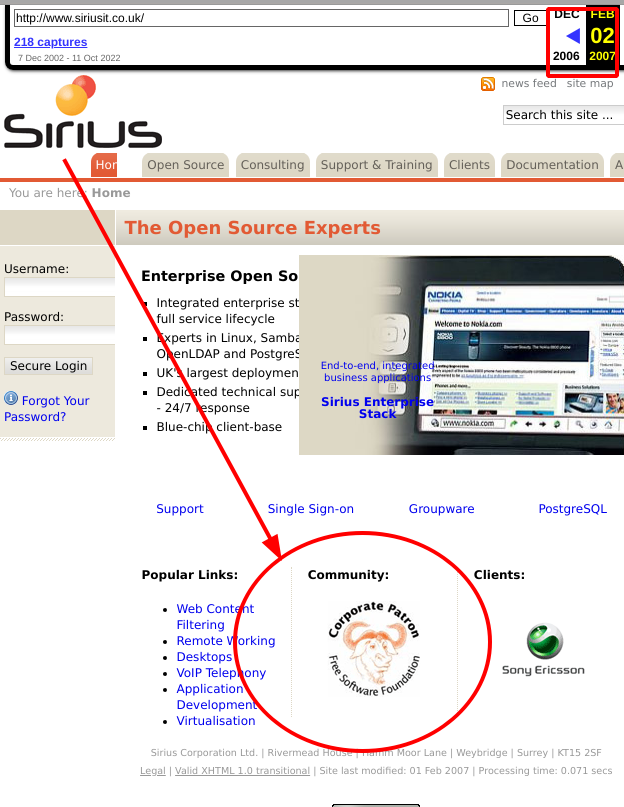
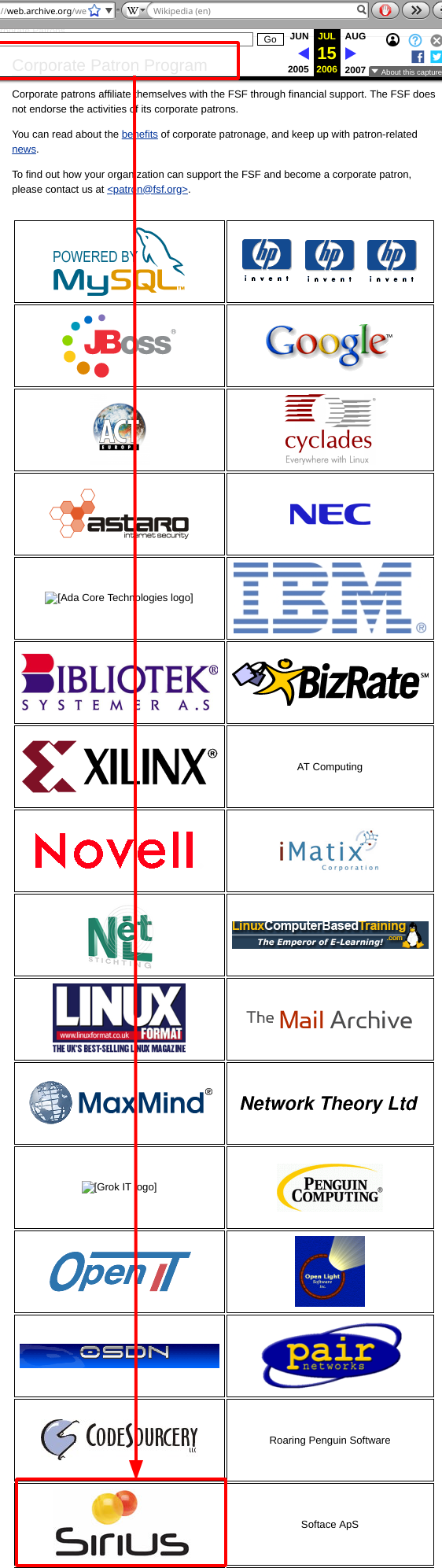
Sirius is early Patron (sponsor but a more modern term for sponsorship) of KDE, a prominent European project for GNU/Linux- and BSD-centric desktops and laptops. Sirius is also an early Patron of the FSF, which stands for the Free Software Foundation (listed and thanked by the FSF for several consecutive years, as The Internet Archive’s Wayback Machine confirms). The FSF was established in the mid 1980s, i.e. almost 1.5 decades before Sirius was even founded. Many early employees of the company were GNU/Linux users, KDE users, even Debian Developers. They were highly technical people who shared the philosophy reflected upon by these (aforementioned) generous donation.

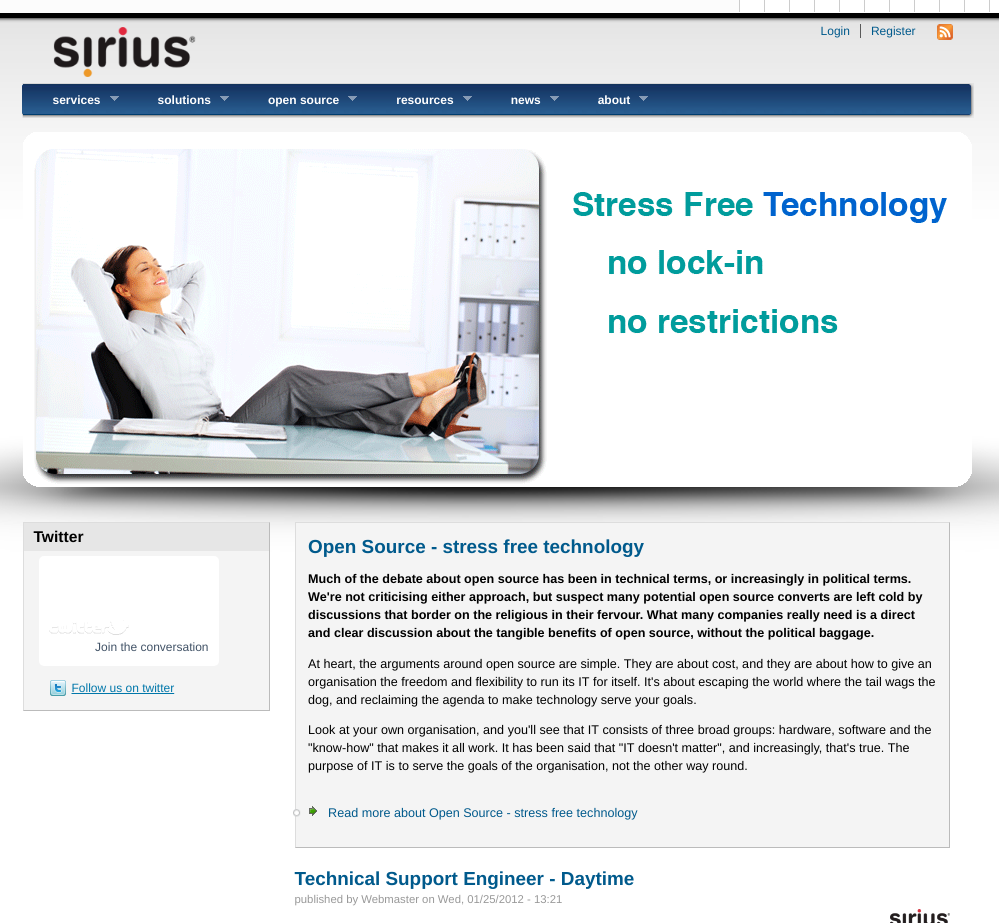
The Wayback Machine shows the Sirius site (old snapshots). Wayback Machine screenshot of the front page:

Wayback Machine screenshot: Sirius and GNU

Wayback Machine screenshot from the FSF:

Wayback Machine screenshot: Sirius and FSF

The company was able to attract high-calibre staff based on these credentials and hard-earned track record. Roy too was attracted to the company based on these publicly- and readily-visible credentials.

People worked overtime to please Sirius clients, some of which were very high-profile. Sadly, as we shall show later in this document, that’s no longer the case and hasn’t been so for several years. The company is living off or leeching off its (distant) past reputation and is extremely paranoid about people finding out about a rapid pivot across numerous dimension, e.g. in-house technology, levels of relevant skill mastered by staff, overt nepotism, and promotion of technologies not compatible with the company’s original mission statement. A lot of the work produced by the company — and it is no longer so much in-house work — leverages Open Source/Free software (libre, or free as in freedom) but does not share back the contributions (or mere code changes), even when initially there’s intention to do so, even if not for licence compliance purposes but status (companies that share back code and don’t just use or exploit code have better karma, averting the image of becoming parasitic to the community).

An Exercise in Optics

The company’s Web site is intentionally outdated. It projects outwards an image of a company that may or may not existed about half a decade ago. Some of the clients being bragged about are well over a decade old. The intention there is to use past clients, no matter how old, to present a credible, potent, highly-experienced firm with high competency. A lot of the actual work gets done by associates (external contractors), not dedicated staff, and those associates have their own firms, which aren’t connected to Sirius at all, except maybe loosely. We’re left to assume that Sirius quietly transforms into a sort of middleman or reseller across a number of domains. For instance, there are a number of things Sirius claims to be supporting, but managers inside the company have no actual staff familiar with ways to maintain such things, so Sirius would typically contract outwards or outsource. This is a crucial point. This isn’t how the company presents itself to the public.

The company, at least in the past, not only had legitimate credibility in the Free/Open Source software world; it goes beyond that. This is well documented and it’s not too hard to find the company’s founder cited extensively in the technology-centric media, especially over a decade ago (Roy used to cite him a lot, including in his site, Techrights). The founder is very visible in national and international press.

The company made a name for itself by attending international events and even hosted an event promoting the use of OpenDocument Format (ODF) in the UK. That’s vital advocacy of Open Standards at a very crucial point in time (format wars and struggles against vendor lock-in). As we shall see later on, these laudable outreach efforts have played a considerable role in attracting Roy’s interest in the company. As an aside, the company first sought to recruit Roy, way back around 2006. The founder of Sirius phoned Roy when Roy was completing his Ph.D. degree in Victoria University of Manchester.

10+ Years in the Same Company, Focusing on Free Software

Roy Schestowitz

DECADES ago somebody told me that changing employers very often is a sign of weakness. Several times later I’d hear the same thing, which follows common sense. Loyalty to an employer or devotion to some particular path shows both a careful choice (of employer) and persistence rather than adventurism. The same goes for housing or residency. Some people move from place to place very often, having to relearn locations of things, spending a lot of time on paperwork, having to meet new people (and losing touch with old friends and colleagues).

When it comes to my current employer, this past week marked 10 years of me working there. There were better times and worse time, both for myself and for the employer.

For the first time in my life I can say that I’ve worked in the same company for over a decade. For just over a year (or about 2 years) I’ve been able to say that I’m the most “senior” (in terms of duration) regular employee there, sans the founder/CEO, who established the company way back in 1998. In a sense, this also means that when I joined the company (with about 20 people in it back then) I was the “latest recruit” and all those people whom I joined are now gone, except the CEO. It’s an interesting situation to be in.

Will I work another 10 years in the same company? It’s hard to tell. The thing I do like about it is that it respects my freedom of expression (it tells off Microsoft when they try to cause issues by phoning the CEO!) and software freedom in general. I realise that many people are forced to use Windows, at least sometimes, and not everyone is permitted to work from home all the time. I’ve worked from home for 14 years now.

Retrieval statistics: 21 queries taking a total of 0.089 seconds • Please report low bandwidth using the feedback form
Original styles created by Ian Main (all acknowledgements) • PHP scripts and styles later modified by Roy Schestowitz • Help yourself to a GPL'd copy
|— Proudly powered by W o r d P r e s s — based on a heavily-hacked version 1.2.1 (Mingus) installation —|