Introduction About Site Map

XML
RSS 2 Feed RSS 2 Feed
Navigation

Main Page | Blog Index

Archive for the ‘O/S’ Category

Vista/IE7 Only to Support Valid Feeds

FeedLounge

FeedLounge: one among many (Web)
applications which tolerate invalid feeds

SHEER hypocrisy is the only way one can describe the latest statement from Microsoft’s RSS team. Microsoft have broken and ignored many International standards over the years. This caused many application to malfunction even when they stuck with standards. Now, when matters do not suit them, Microsoft decide to say farewell to feeds that are not well-formed XML [rel="nofollow"]. Many projects, even the tiniest among them, have tolerated malformed RSS feeds. Yet, this appear to be too much to ask from biggest standards-breaking criminal of all.

Potentially, Windows Vista and Internet Explorer 7 will simply refuse to handle anything that does not adhere to or complies with standards. Need I even mention that Microsoft are set to ‘extend’ RSS, thus breaking RSS protocols?

Our years of experience in with HTML in Internet Explorer have taught us the long-term pain that results from being too liberal with what you accept from others. Hence, we%u2019ve adopted the following overriding principle for IE 7 and RSS platform in Windows Vista:

We will only support feeds that are well-formed XML.

Microsoft Back to Day One?

Longhorn

Longhorn spherical desktop screen-shot
Taken from a Microsoft meeting/demo in Chicago (click to enlarge)
Apparently, over-complexity did not permit this to become a reality

PERHAPS struggling to cope with existing Windows code, an operating system like Longhorn/Vista had to be re-built from scratch. To weed out competition, Microsoft face some serious dilemmas and have just taken some action.

Windows code, which was admittedly insufficiently modular, could no longer be run properly. Troubled and over-occupied with bug fixes and time-critical security patches, the O/S ended up ‘plastered’ all around. Consequently, Longhorn (Vista) lacked several long-promised features. This disappointed many customers and gave no compelling reason to ever upgrade. At present, Windows is conspicuously lagging behind some innovation and development over at Apple, not to mention Linux.

Major news are flowing in as I speak. Microsoft now turn their attention to a new operating system that will be built from the ground up and be named Singularity. Is it possible that Windows is so flawed (beyond our comprehension) that even Microsoft recognise a need to restart? Is the market unaware of the mess Windows closed-source actually is? With so many necessary patches and bloat, it seems to have gone out of the programmers’ control. With managers and staff leaving Microsoft (notably Lee), experience, competence and leadership are lost as well.

Apple was once in a similar situation. Mac OS 9 was rather weak. It seemed to have reached a dead-end and was often complemented by Windows software such as Internet Explorer and Outlook Express. Then, Apple took Darwin as codebase while merely discarding OS 9. Nowadays, we can only behold what a good product they ended up with. Marketing, however, has a limited budget at Apple.

From Microsoft’s Web site:

Singularity is a research project focused on the construction of dependable systems through innovation in the areas of systems, languages, and tools. We are building a research operating system prototype (called Singularity), extending programming languages, and developing new techniques and tools for specifying and verifying program behavior.

It sounds as if Microsoft primarily target the research niche, which is dominated by platforms other than Windows (predominantly Linux).

The Enemy is Inside

Bill Gates
Bill Gates arrested in his younger days (photo in public domain)

ROBERT Scoble is a well-known Microsoft evangelist and blogger. He has recently set up a free blog in wordpress.com, which is of course based on Open Source software. I decided to ask him what he was up to. I was highly skeptic as he made this questionable migration of his popular blog and heavily-requested feeds. Earlier this week I sent Scoble an E-mail and got a disappointing reply; both of which I post verbatim below:

Me:

You are of course aware that you run your blog on Linux while evangelizing Windows. Hypocrisy?

Robert:

No.

An evangelist must be credible if he wants to be listened to.

The only way to be credible is to actually use other methodologies and products.

You must have evangelism confused with marketing. The two are not the same.

Rather than being critical of Open Source or PHP/MySQL, he implicitly revealed devious intentions; at least that’s the way I interpreted it. Only a couple of days later Scoble posted an item titled “WordPress Sucks”. He gets paid to say that stuff. He came in to give a critique and when the WordPress community posted follow-ups in defense of WordPress, they simply echoed his unjustifiable rants.

To make matters worse, Scoble opted for a free software package and complained about an extremely powerful feature in WordPress: RSS feeds. Is he complained about WordPress feeds, he could bash his wrath anything (or envy anything for that matter). Owing to that, he loses credibility rather than gain any.

Scoble on WordPress was a ticking bomb from day 1 and it exploded prematurely for all the wrong reasons. Like Matt said, WordPress is the Burger King of feeds. WordPress.com must become more selective when it comes to people it permits access and subscription to. I once mentioned the importance of WordPress invites. They are perhaps insufficient as they only deter splogs and mirrors, not enemies.

Web-based Office

AS it finally turns out, a Web-based Office suite, which could be an almost unprecedented step, is embarked on by Microsoft. This comes after numerous rumours about an innovative Google Web-based Office. These rumours, which spread like a plague and rapidly made the rounds, were just as quickly shattered by Brin. Google are in fact concentrating on OpenOffice at the moment.

It is worth pointing out that Microsoft have recognised Web-based applications as a major threat to their ‘milking cows’, namely Windows and Office. Office-like Web applications exist already although they are not cohesive. Returning to Microsoft,

Kicking off what he called the “live era” of software, Microsoft chairman Bill Gates said on Tuesday in the United States that the company plans to launch new Internet-based complements to its core products.

Gates said Microsoft is working on two products, “Windows Live” and “Office Live,” that create opportunities for the company to sell online subscriptions and advertising. Both are targeted at smaller businesses and consumers.

Interesting implications are worth pondering:

  • Will MSIE-only compatibility be likely?
  • Will non-Microsoft users be able to load Office document reliably using the Web-based equivalent?
  • Will people eventually get used the the idea of adverts next to an Office document?
  • How will subscription work and will it exclude certain people or be overly expensive?

Making that type of service available to anyone (i.e. without a paid licence) is suicidal. It could drive users away to platforms other than Microsoft Windows, unless of course there is a lock-in. This is why I imagine that there will be a catch. For instance, think of being permitted access to these Internet services depending on some requirements, e.g. premium features are exclusive to holders of a licence for the native version of Office.

Either way, Microsoft now open a peephole to a first glimpse, which I will of course rel="nofollow". Regardless, it looks rather appalling at the moment and is more of a placeholder, I presume. I quite like the standard-compliant clone below as it is not truly associated with Windows. It is a nice demonstration of the power of AJAX nonetheless, so I urge readers to take a look.

Windows AJAX
Windows XP in AJAX – follow the link and tune in

UPDATE: (03/11/2005) Joel re-affirms my point regarding Microsoft’s “half-baked” Web site.

Google Fund OpenOffice

Open officeGoogle have recently formed a pact with Sun Microsystems, best known for their work on Java and Solaris. They have just taken a re-assuring step — re-assuring to those who wish to see Microsoft monopolies fade away over the years.

Sun Microsystems are among the major maintainers, as well as the ‘funds engine’ behind OpenOffice. Finally we come to see that Google, who use OpenOffice in-house, contribute back to the Open Source community which they came from. They are now paying programmers to work on Open Office, which is some sense reminds me of begone “Google Office” rumours. They essentially use their powerful financial position to boost freedom, or so I choose to believe. It is no wonder Microsoft are scared.

Google plans to hire programmers to improve OpenOffice.org, a demonstration of its affinity for open source initiatives and one the company believes also shows sound practical sense.

It is worth emphasising that Open Office 2 was very recently released.

Related item: Google Support Open Source in Academia

Cross-Platform Remote Access

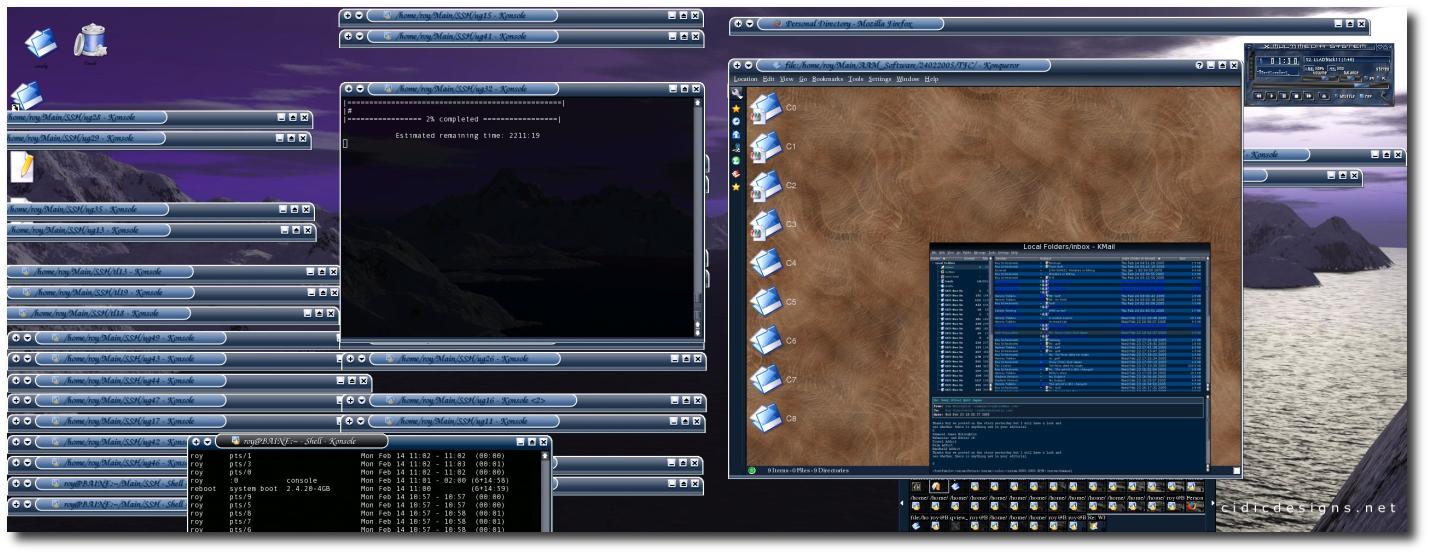
Multiple SSH sessions
Dozens of remote sessions occupying a cluster. Terminals shaded on the left monitor (click to enlarge)

WHATEVER operating system we use, the idea of using remote terminals should not be foreign to us. These days, it is rather common to log on to a computer remotely and manage it from afar as if we were actually there.

Inter-Platform Connections

Windows users frequently stick to VNC, which requires a high-bandwidth connection and grabs the entire desktop/workspace metaphorically ‘across the wire’. Nonetheless, there are some smart algorithms (c/f Citrix clients), which only re-draw elements once they change, so speed/bandwidth might not be the utmost concerns.

Linux users, on the other hand, are capable of establishing transparent connections with Windows machines via VNC, for which there are many applications in existence (Remote Desktop or rdesktop among several more variants). Linux also takes a different approach in its most natural method for remote access. Take, for example, SSH connections wherein individual windows get ‘grabbed’ and communicated over the network, only upon demand. Everything else should be managed from the command-line interface (CLI), e.g. bash and xterm. This might be less natural to the majority of users nowadays, especially to those unfamiliar with CLI’s.

Windows connectivity to *nix protocols can be established using the renowned PuTTY. In the case of Telnet or RLogin, applicability might be slightly different, but merely all protocols seem to have been covered. In fact, Windows typically supports telnet at its core (Start » Run... » telnet » ENTER). This establishes a somewhat mutual relationship. Windows users can remotely log in to Linux machine (might need a commercial X-session if not CygWin) and Linux users can connect to Windows hosts. In modern Linux distribution, all necessary toolsets are already pre-installed from what I can gather.

Extreme Use of Remote Access

When carrying out some computer vision experiments, I was at times using over 30 Pentium 4′s. These were used for quite a considerable overnight resource hogs. The communication barrier was merely inexistent; I an fortunate enough to work upon a 100Mbit Ethernet backbone. To give some indication of how fast the connection actually is, I can transfer an entire CD (~650 MB) across campus in less than a minute. That unbelievable speed is at times truly needed. I estimate that I use up bandwidth of over 100 GB per month, mainly due to backup necessities.

As regards extreme use of remote login, this is one of the most exciting experiences, to me at least. Rather than conducting large-scale experiments over the period of one month on a single CPU, they can be distributed, thus completed within a day. Nothing can beat that in terms of productivity. AI is known to be resources-greedy. Our computer vision methodology falls under that branch too. I will soon write about the use of supercomputers to run my experiments, albeit this is still under negotiation.

Traffic Chain

I could no longer resist my geek spirit so I decided to experiment with the idea of SSH chaining. The dependency of one machine upon another is something that intrigues me, so often I log in remotely to one machine, which in turn connects to another.

I decided to set up a larger SSH chain wherein I connect to my own computer via an entire ‘ring’ of machines, using SSH. I wanted to see how this affects speed and responsiveness in applications that ‘travel’. Needless to mention, this also cripples all computers in that ring. This observation has some interesting implications on its own. These intermediatory machines can be perceived as purposeless routers. If one computer in the chain is reset, the whole chain collapses and the connection is lost. It may also take a while to re-build, which to me at least, is amusing.

Cluster Control

On to some more extreme uses of SSH, some time ago I read about use of SSH to control entire computer clusters in parallel. In essence, the user will be sending any given command to an ‘army’ of computers (clients or computational hosts). The tool is not very flexible, but can be valuable under particular circumstances.

Google-IBM Desktop Search

Google Desktop

AFTER teaming up with NASA1 and forming a pact with Sun Microsystem, Google now sidle nearer to IBM. This move comes to show that Google are recognised as a market leader that is here to stay and further prosper.

SAN FRANCISCO (Reuters) – IBM and Google Inc. are collaborating to make it easier for office workers not only to search for local documents and personal e-mail but to delve deep into corporate databases, the companies said on Friday.

1 Side note: Brin’s mother work/ed in NASA

Related item: Google Desktop Released

Retrieval statistics: 21 queries taking a total of 0.096 seconds • Please report low bandwidth using the feedback form
Original styles created by Ian Main (all acknowledgements) • PHP scripts and styles later modified by Roy Schestowitz • Help yourself to a GPL'd copy
|— Proudly powered by W o r d P r e s s — based on a heavily-hacked version 1.2.1 (Mingus) installation —|