Introduction About Site Map

XML
RSS 2 Feed RSS 2 Feed
Navigation

Main Page | Blog Index

Archive for the ‘Research’ Category

Multidimesional Scaling – Animated Example

Canonical forms animation

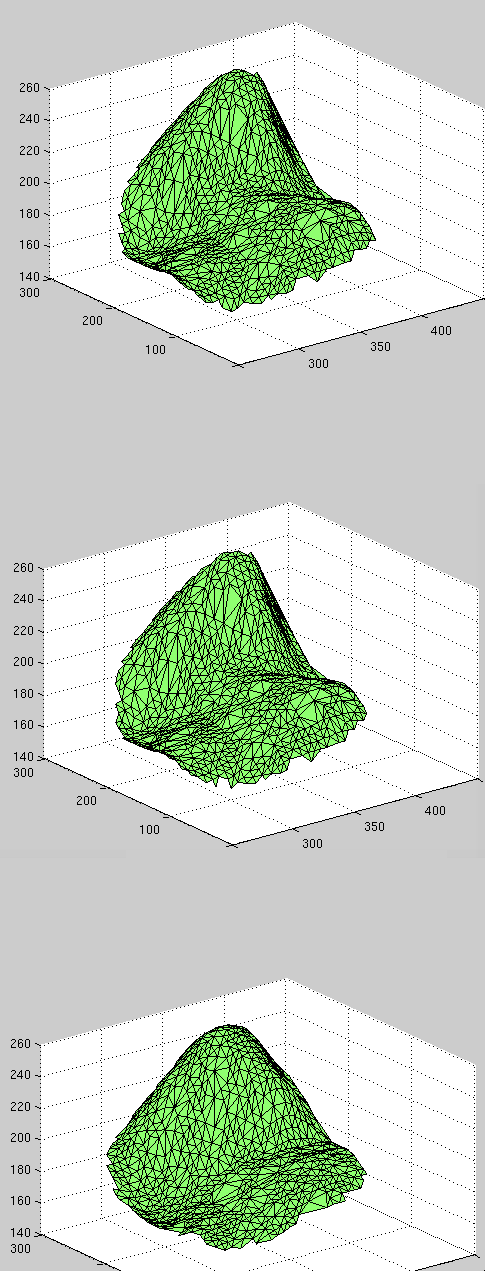
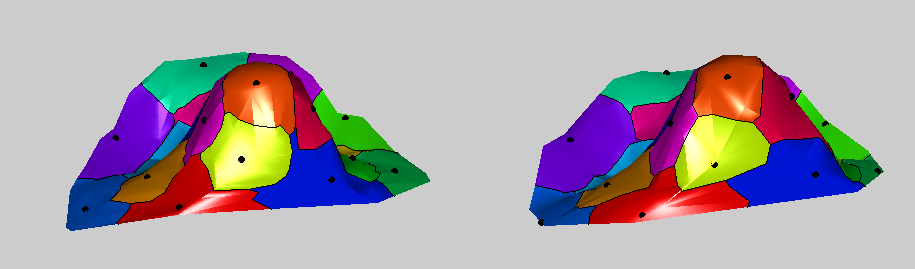
As a demonstration of canonical forms and stress reduction complemented/guided by multidimesional scaling, I’ve created an animation which shows the process applied to each image in the Face Recognition Grand Challenge (FRGC) 2.0 set — albeit Fall Semester only in this case — in turn, in order to approach a more mutually-isometric and pose-agnostic state where distances are tied to inherent surface details (curvature, size, etc.) and the accompanying static image, as seen below, shows the original image too (added at the top). To use this within an objective function it will need to be clearer how points are selected consistently and where correspondences can autonomously be chosen to improve overall performance. The triangulation in this case is Delaunay-based although 3 methods have been implemented and they offer room for further experimental work. The factors affecting performance may be the PCA component, the triangulation, the placement of points, the optimisation of lengths, the pre-processing (ICP for instance), and few minor technicalities less worthy of consideration. Each one of these represents one parameter among many but feasibility tests — those exploring whether the overall framework is effective in the first place (distances as an encoded signature resistant to expressions) — must come first. Based on a preliminary look, this ought to serve as a reasonable discriminant, but many of the pertinent parts of the framework may need tweaking based on trials and errors.

Note: this is an except from an ongoing project and a document exceeding 200 pages so far. It will be released later this year.

MDS-stress and canonical forms

PCA and Multidimensional Scaling in Shapes

This series of videos is a rough explanation of the approach taken in order to utilise principal component analysts (PCA) in the task of shape classification. This was done without preparation or second takes, so the quality and clarity are not particularly high.

PCA and Multidimensional Scaling in Shapes – Part 0

PCA and Multidimensional Scaling in Shapes – Part 1

PCA and Multidimensional Scaling in Shapes – Part 2

PCA and Multidimensional Scaling in Shapes – Part 3

PCA and Multidimensional Scaling in Shapes – Part 4

PCA and Multidimensional Scaling in Shapes – Part 5

PCA and Multidimensional Scaling in Shapes – Part 6

PCA and Multidimensional Scaling in Shapes – Part 7

PCA and Multidimensional Scaling in Shapes – Part 8

PCA and Multidimensional Scaling in Shapes – Part 9

PCA and Multidimensional Scaling in Shapes – Part 10

PCA and Multidimensional Scaling in Shapes – Part 11

PCA and Multidimensional Scaling in Shapes – Part 12

PCA and Multidimensional Scaling in Shapes – Part 13

PCA and Multidimensional Scaling in Shapes – Part 14

PCA and Multidimensional Scaling in Shapes – Part 15

Ramble About GMDS and GPCA (Ongoing Research)


OVER the past few months I have been running many experiments and compiling about 200 pages of text and graphs to document this. Today I made a short explanatory video that was unplanned and totally unscripted (I tend to prefer spontaneity, I loathe staging or reading from outlines/talking points/scripts).

This video is a bit of a test intended to get the hang of the recording software. These are some preliminary thoughts on the approach taken by GMDS (generalised multidimensional scaling) and the one adopted by GPCA (generalised principal component analysis) proponents. Admittedly, I am only at the early stages of properly learning about both. However, the basic principles as they are applied to distances (in space, not within data instances embedded in the shown hyperspace) are analogous at some underlying level, i.e. they measure something which is theoretically a surrogate of one another. The premises are hinged upon unification or use of one method to complement another, perhaps just comparing the results of each one in isolation.

Expressions Data in FRGC 2.0 (3-D)

I recently needed to gather 3-D data of different people’s faces, in order to perform experiments on these and test new algorithms that I had developed. The problem was, without some metadata regarding expressions, how might I find correct pairs suiting a particular criterion/ia? Two universities that I contacted had some data of this kind, but they were unwilling to share it (Open Data principles betrayed). So I had to do it myself using a dataset I mentioned here before [1, 2]. So far I have covered smiles and since it takes a lot of time to achieve this, I would like to share my work with those pursuing similar data.

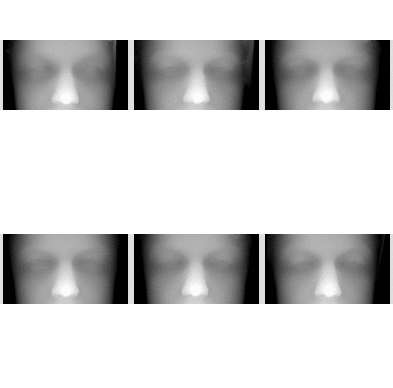
To proactively remove allegations of the set being too easy to deal with (picky-ness in peer review), the most difficult partition when it comes to acquisition quality is taken. The figure below shows some examples of pairs that are being used after being selected as not many images contain expression variation. The selection process of very tedious as very few 3-D images exist with expressions in them, especially ones from the same person (required for consistent training assuming intra-subject residues are alike for common expressions).

Face expressions
Examples of the faces used tor training and recognition, with neutrals on the left and smiles on the right (note: this is just the texture of 3-D images)

About 5 hours were spent classifying the NIST datasets for future experiments. An initial subset of it is put in loader files. From the whole 3-D data of the Face Recognition Grand Challenge, one can only find a few hundreds of distinct individuals. Not all of them have an acquisition with a smile. I found just over 80 by manually browsing everything and some will be hard to work with due to obvious cases of degraded signal. The criteria was that all parts of the face (mouth upwards) must be visible and the expression one of happiness, not necessarily a smile.

The program works reasonably well (see the figure below) with new implementations of ICP (there are two main ones from my research group) and the new data which comprises 86 pairs, or 172 images in total.

Expressions data

Examples of the program with the new data and methods in place

Here is the statement for loading the pairs of expressions in GNU Octave or in MATLAB, in case someone needs a large pile of gigabytes of consistent expressions data.

    images_list={'neutral' 
  ;'~/NIST/FRGC-2.0-dist/nd1/Fall2003range/04471d273.abs' 


  ;'smile' 
  ;'~/NIST/FRGC-2.0-dist/nd1/Fall2003range/04471d271.abs' 


  ;'neutral' 
  ;'~/NIST/FRGC-2.0-dist/nd1/Fall2003range/04472d226.abs' 


  ;'smile' 
  ;'~/NIST/FRGC-2.0-dist/nd1/Fall2003range/04472d230.abs' 


  ;'neutral' 
  ;'~/NIST/FRGC-2.0-dist/nd1/Fall2003range/04473d185.abs' 


  ;'smile' 
  ;'~/NIST/FRGC-2.0-dist/nd1/Fall2003range/04473d193.abs' 


  ;'neutral' 
  ;'~/NIST/FRGC-2.0-dist/nd1/Fall2003range/04479d222.abs' 


  ;'smile' 
  ;'~/NIST/FRGC-2.0-dist/nd1/Fall2003range/04479d224.abs' 


  ;'neutral' 
  ;'~/NIST/FRGC-2.0-dist/nd1/Fall2003range/04484d189.abs' 


  ;'smile'
  ;'~/NIST/FRGC-2.0-dist/nd1/Fall2003range/04484d191.abs'


  ;'neutral'
  ;'~/NIST/FRGC-2.0-dist/nd1/Fall2003range/04485d290.abs'


  ;'smile'
  ;'~/NIST/FRGC-2.0-dist/nd1/Fall2003range/04485d292.abs'

  ;'neutral'
  ;'~/NIST/FRGC-2.0-dist/nd1/Fall2003range/04488d286.abs'

  ;'smile'
  ;'~/NIST/FRGC-2.0-dist/nd1/Fall2003range/04488d288.abs'


  ;'neutral'
  ;'~/NIST/FRGC-2.0-dist/nd1/Fall2003range/04495d313.abs'

  ;'smile'
  ;'~/NIST/FRGC-2.0-dist/nd1/Fall2003range/04495d317.abs'


  ;'neutral'
  ;'~/NIST/FRGC-2.0-dist/nd1/Fall2003range/04496d246.abs'

  ;'smile'
  ;'~/NIST/FRGC-2.0-dist/nd1/Fall2003range/04496d250.abs'


  ;'neutral'
  ;'~/NIST/FRGC-2.0-dist/nd1/Fall2003range/04502d60.abs'

  ;'smile'
  ;'~/NIST/FRGC-2.0-dist/nd1/Fall2003range/04502d58.abs'


  ;'neutral'
  ;'~/NIST/FRGC-2.0-dist/nd1/Fall2003range/04505d218.abs'

  ;'smile'
  ;'~/NIST/FRGC-2.0-dist/nd1/Fall2003range/04505d224.abs'


  ;'neutral'
  ;'~/NIST/FRGC-2.0-dist/nd1/Fall2003range/04507d309.abs'

  ;'smile'
  ;'~/NIST/FRGC-2.0-dist/nd1/Fall2003range/04507d305.abs'


  ;'neutral'
  ;'~/NIST/FRGC-2.0-dist/nd1/Fall2003range/04509d276.abs'

  ;'smile'
  ;'~/NIST/FRGC-2.0-dist/nd1/Fall2003range/04509d282.abs'


  ;'neutral'
  ;'~/NIST/FRGC-2.0-dist/nd1/Fall2003range/04508d83.abs'

  ;'smile'
  ;'~/NIST/FRGC-2.0-dist/nd1/Fall2003range/04508d85.abs'


  ;'neutral'
  ;'~/NIST/FRGC-2.0-dist/nd1/Fall2003range/04511d178.abs'

  ;'smile'
  ;'~/NIST/FRGC-2.0-dist/nd1/Fall2003range/04511d176.abs'


  ;'neutral'
  ;'~/NIST/FRGC-2.0-dist/nd1/Fall2003range/04514d326.abs'

  ;'smile'
  ;'~/NIST/FRGC-2.0-dist/nd1/Fall2003range/04514d328.abs'


  ;'neutral'
  ;'~/NIST/FRGC-2.0-dist/nd1/Fall2003range/04513d303.abs'

  ;'smile'
  ;'~/NIST/FRGC-2.0-dist/nd1/Fall2003range/04513d309.abs'


  ;'neutral'
  ;'~/NIST/FRGC-2.0-dist/nd1/Fall2003range/04530d321.abs'

  ;'smile'
  ;'~/NIST/FRGC-2.0-dist/nd1/Fall2003range/04530d323.abs'


  ;'neutral'
  ;'~/NIST/FRGC-2.0-dist/nd1/Fall2003range/04519d204.abs'

  ;'smile'
  ;'~/NIST/FRGC-2.0-dist/nd1/Fall2003range/04519d210.abs'

  ;'neutral'
  ;'~/NIST/FRGC-2.0-dist/nd1/Fall2003range/04531d297.abs'

  ;'smile'
  ;'~/NIST/FRGC-2.0-dist/nd1/Fall2003range/04531d295.abs'


  ;'neutral'
  ;'~/NIST/FRGC-2.0-dist/nd1/Fall2003range/04537d328.abs'

  ;'smile'
  ;'~/NIST/FRGC-2.0-dist/nd1/Fall2003range/04537d330.abs'


  ;'neutral'
  ;'~/NIST/FRGC-2.0-dist/nd1/Fall2003range/04535d213.abs'

  ;'smile'
  ;'~/NIST/FRGC-2.0-dist/nd1/Fall2003range/04535d217.abs'


  ;'neutral'
  ;'~/NIST/FRGC-2.0-dist/nd1/Fall2003range/04546d75.abs'

  ;'smile'
  ;'~/NIST/FRGC-2.0-dist/nd1/Fall2003range/04546d71.abs'


  ;'neutral'
  ;'~/NIST/FRGC-2.0-dist/nd1/Fall2003range/04542d118.abs'

  ;'smile'
  ;'~/NIST/FRGC-2.0-dist/nd1/Fall2003range/04542d114.abs'


  ;'neutral'
  ;'~/NIST/FRGC-2.0-dist/nd1/Fall2003range/04556d311.abs'

  ;'smile'
  ;'~/NIST/FRGC-2.0-dist/nd1/Fall2003range/04556d315.abs'


  ;'neutral'
  ;'~/NIST/FRGC-2.0-dist/nd1/Fall2003range/04557d337.abs'


  ;'smile'
  ;'~/NIST/FRGC-2.0-dist/nd1/Fall2003range/04557d339.abs'

  ;'neutral'
  ;'~/NIST/FRGC-2.0-dist/nd1/Fall2003range/04559d314.abs'


  ;'smile'
  ;'~/NIST/FRGC-2.0-dist/nd1/Fall2003range/04559d320.abs'

  ;'neutral'
  ;'~/NIST/FRGC-2.0-dist/nd1/Fall2003range/04560d273.abs'


  ;'smile'
  ;'~/NIST/FRGC-2.0-dist/nd1/Fall2003range/04560d275.abs'


  ;'neutral'
  ;'~/NIST/FRGC-2.0-dist/nd1/Fall2003range/04569d288.abs'

  ;'smile'
  ;'~/NIST/FRGC-2.0-dist/nd1/Fall2003range/04569d286.abs'


  ;'neutral'
  ;'~/NIST/FRGC-2.0-dist/nd1/Fall2003range/04577d290.abs'

  ;'smile'
  ;'~/NIST/FRGC-2.0-dist/nd1/Fall2003range/04577d292.abs'


  ;'neutral'
  ;'~/NIST/FRGC-2.0-dist/nd1/Fall2003range/04580d299.abs'

  ;'smile'
  ;'~/NIST/FRGC-2.0-dist/nd1/Fall2003range/04580d307.abs'


  ;'neutral'
  ;'~/NIST/FRGC-2.0-dist/nd1/Fall2003range/04581d200.abs'

  ;'smile'
  ;'~/NIST/FRGC-2.0-dist/nd1/Fall2003range/04581d202.abs'


  ;'neutral'
  ;'~/NIST/FRGC-2.0-dist/nd1/Fall2003range/04588d137.abs'

  ;'smile'
  ;'~/NIST/FRGC-2.0-dist/nd1/Fall2003range/04588d135.abs'


  ;'neutral'
  ;'~/NIST/FRGC-2.0-dist/nd1/Fall2003range/04589d246.abs'

  ;'smile'
  ;'~/NIST/FRGC-2.0-dist/nd1/Fall2003range/04589d248.abs'


  ;'neutral'
  ;'~/NIST/FRGC-2.0-dist/nd1/Fall2003range/04593d200.abs'

  ;'smile'
  ;'~/NIST/FRGC-2.0-dist/nd1/Fall2003range/04593d202.abs'


  ;'neutral'
  ;'~/NIST/FRGC-2.0-dist/nd1/Fall2003range/04595d93.abs'

  ;'smile'
  ;'~/NIST/FRGC-2.0-dist/nd1/Fall2003range/04595d95.abs'


  ;'neutral'
  ;'~/NIST/FRGC-2.0-dist/nd1/Fall2003range/04596d78.abs'

  ;'smile'
  ;'~/NIST/FRGC-2.0-dist/nd1/Fall2003range/04596d84.abs'


  ;'neutral'
  ;'~/NIST/FRGC-2.0-dist/nd1/Fall2003range/04600d249.abs'

  ;'smile'
  ;'~/NIST/FRGC-2.0-dist/nd1/Fall2003range/04600d251.abs'


  ;'neutral'
  ;'~/NIST/FRGC-2.0-dist/nd1/Fall2003range/04603d141.abs'

  ;'smile'
  ;'~/NIST/FRGC-2.0-dist/nd1/Fall2003range/04603d143.abs'


  ;'neutral'
  ;'~/NIST/FRGC-2.0-dist/nd1/Fall2003range/04605d243.abs'

  ;'smile'
  ;'~/NIST/FRGC-2.0-dist/nd1/Fall2003range/04605d239.abs'


  ;'neutral'
  ;'~/NIST/FRGC-2.0-dist/nd1/Fall2003range/04609d98.abs'

  ;'smile'
  ;'~/NIST/FRGC-2.0-dist/nd1/Fall2003range/04609d100.abs'


  ;'neutral'
  ;'~/NIST/FRGC-2.0-dist/nd1/Fall2003range/04606d180.abs'

  ;'smile'
  ;'~/NIST/FRGC-2.0-dist/nd1/Fall2003range/04606d182.abs'


  ;'neutral'
  ;'~/NIST/FRGC-2.0-dist/nd1/Fall2003range/04605d255.abs'

  ;'smile'
  ;'~/NIST/FRGC-2.0-dist/nd1/Fall2003range/04605d253.abs'


  ;'neutral'
  ;'~/NIST/FRGC-2.0-dist/nd1/Fall2003range/04622d238.abs'

  ;'smile'
  ;'~/NIST/FRGC-2.0-dist/nd1/Fall2003range/04622d240.abs'


  ;'neutral'
  ;'~/NIST/FRGC-2.0-dist/nd1/Fall2003range/04619d163.abs'

  ;'smile'
  ;'~/NIST/FRGC-2.0-dist/nd1/Fall2003range/04619d161.abs'


  ;'neutral'
  ;'~/NIST/FRGC-2.0-dist/nd1/Fall2003range/04629d144.abs'

  ;'smile'
  ;'~/NIST/FRGC-2.0-dist/nd1/Fall2003range/04629d146.abs'


  ;'neutral'
  ;'~/NIST/FRGC-2.0-dist/nd1/Fall2003range/04644d204.abs'

  ;'smile'
  ;'~/NIST/FRGC-2.0-dist/nd1/Fall2003range/04644d206.abs'


  ;'neutral'
  ;'~/NIST/FRGC-2.0-dist/nd1/Fall2003range/04645d95.abs'

  ;'smile'
  ;'~/NIST/FRGC-2.0-dist/nd1/Fall2003range/04645d93.abs'


  ;'neutral'
  ;'~/NIST/FRGC-2.0-dist/nd1/Fall2003range/04697d80.abs'

  ;'smile'
  ;'~/NIST/FRGC-2.0-dist/nd1/Fall2003range/04697d78.abs'


  ;'neutral'
  ;'~/NIST/FRGC-2.0-dist/nd1/Fall2003range/04696d40.abs'

  ;'smile'
  ;'~/NIST/FRGC-2.0-dist/nd1/Fall2003range/04696d42.abs'


  ;'neutral'
  ;'~/NIST/FRGC-2.0-dist/nd1/Fall2003range/04691d50.abs'

  ;'smile'
  ;'~/NIST/FRGC-2.0-dist/nd1/Fall2003range/04691d48.abs'


  ;'neutral'
  ;'~/NIST/FRGC-2.0-dist/nd1/Fall2003range/04688d40.abs'

  ;'smile'
  ;'~/NIST/FRGC-2.0-dist/nd1/Fall2003range/04688d36.abs'


  ;'neutral'
  ;'~/NIST/FRGC-2.0-dist/nd1/Fall2003range/04684d232.abs'

  ;'smile'
  ;'~/NIST/FRGC-2.0-dist/nd1/Fall2003range/04684d234.abs'


  ;'neutral'
  ;'~/NIST/FRGC-2.0-dist/nd1/Fall2003range/04682d122.abs'

  ;'smile'
  ;'~/NIST/FRGC-2.0-dist/nd1/Fall2003range/04682d128.abs'


  ;'neutral'
  ;'~/NIST/FRGC-2.0-dist/nd1/Fall2003range/04675d251.abs'

  ;'smile'
  ;'~/NIST/FRGC-2.0-dist/nd1/Fall2003range/04675d253.abs'


  ;'neutral'
  ;'~/NIST/FRGC-2.0-dist/nd1/Fall2003range/04673d188.abs'

  ;'smile'
  ;'~/NIST/FRGC-2.0-dist/nd1/Fall2003range/04673d190.abs'


  ;'neutral'
  ;'~/NIST/FRGC-2.0-dist/nd1/Fall2003range/04699d42.abs'

  ;'smile'
  ;'~/NIST/FRGC-2.0-dist/nd1/Fall2003range/04699d44.abs'


  ;'neutral'
  ;'~/NIST/FRGC-2.0-dist/nd1/Fall2003range/04700d18.abs'

  ;'smile'
  ;'~/NIST/FRGC-2.0-dist/nd1/Fall2003range/04700d20.abs'


  ;'neutral'
  ;'~/NIST/FRGC-2.0-dist/nd1/Fall2003range/04703d46.abs'

  ;'smile'
  ;'~/NIST/FRGC-2.0-dist/nd1/Fall2003range/04703d42.abs'


  ;'neutral'
  ;'~/NIST/FRGC-2.0-dist/nd1/Fall2003range/04704d22.abs'

  ;'smile'
  ;'~/NIST/FRGC-2.0-dist/nd1/Fall2003range/04704d18.abs'


  ;'neutral'
  ;'~/NIST/FRGC-2.0-dist/nd1/Fall2003range/04711d53.abs'

  ;'smile'
  ;'~/NIST/FRGC-2.0-dist/nd1/Fall2003range/04711d47.abs'


  ;'neutral'
  ;'~/NIST/FRGC-2.0-dist/nd1/Fall2003range/04715d12.abs'

  ;'smile'
  ;'~/NIST/FRGC-2.0-dist/nd1/Fall2003range/04715d14.abs'


  ;'neutral'
  ;'~/NIST/FRGC-2.0-dist/nd1/Fall2003range/04717d49.abs'

  ;'smile'
  ;'~/NIST/FRGC-2.0-dist/nd1/Fall2003range/04717d43.abs'


  ;'neutral'
  ;'~/NIST/FRGC-2.0-dist/nd1/Fall2003range/04719d86.abs'

  ;'smile'
  ;'~/NIST/FRGC-2.0-dist/nd1/Fall2003range/04719d88.abs'


  ;'neutral'
  ;'~/NIST/FRGC-2.0-dist/nd1/Fall2003range/04721d48.abs'

  ;'smile'
  ;'~/NIST/FRGC-2.0-dist/nd1/Fall2003range/04721d46.abs'


  ;'neutral'
  ;'~/NIST/FRGC-2.0-dist/nd1/Fall2003range/04728d44.abs'

  ;'smile'
  ;'~/NIST/FRGC-2.0-dist/nd1/Fall2003range/04728d42.abs'


  ;'neutral'
  ;'~/NIST/FRGC-2.0-dist/nd1/Fall2003range/04737d38.abs'

  ;'smile'
  ;'~/NIST/FRGC-2.0-dist/nd1/Fall2003range/04737d36.abs'


  ;'neutral'
  ;'~/NIST/FRGC-2.0-dist/nd1/Fall2003range/04737d38.abs'

  ;'smile'
  ;'~/NIST/FRGC-2.0-dist/nd1/Fall2003range/04737d36.abs'


  ;'neutral'
  ;'~/NIST/FRGC-2.0-dist/nd1/Fall2003range/04749d80.abs'

  ;'smile'
  ;'~/NIST/FRGC-2.0-dist/nd1/Fall2003range/04749d82.abs'


  ;'neutral'
  ;'~/NIST/FRGC-2.0-dist/nd1/Fall2003range/04750d54.abs'

  ;'smile'
  ;'~/NIST/FRGC-2.0-dist/nd1/Fall2003range/04750d56.abs'


  ;'neutral'
  ;'~/NIST/FRGC-2.0-dist/nd1/Fall2003range/04754d78.abs'

  ;'smile'
  ;'~/NIST/FRGC-2.0-dist/nd1/Fall2003range/04754d80.abs'


  ;'neutral'
  ;'~/NIST/FRGC-2.0-dist/nd1/Fall2003range/04756d73.abs'

  ;'smile'
  ;'~/NIST/FRGC-2.0-dist/nd1/Fall2003range/04756d75.abs'


  ;'neutral'
  ;'~/NIST/FRGC-2.0-dist/nd1/Fall2003range/04762d43.abs'

  ;'smile'
  ;'~/NIST/FRGC-2.0-dist/nd1/Fall2003range/04762d41.abs'


  ;'neutral'
  ;'~/NIST/FRGC-2.0-dist/nd1/Fall2003range/04763d68.abs'

  ;'smile'
  ;'~/NIST/FRGC-2.0-dist/nd1/Fall2003range/04763d70.abs'


  ;'neutral'
  ;'~/NIST/FRGC-2.0-dist/nd1/Fall2003range/04766d24.abs'

  ;'smile'
  ;'~/NIST/FRGC-2.0-dist/nd1/Fall2003range/04766d30.abs'


  ;'neutral'  
  ;'~/NIST/FRGC-2.0-dist/nd1/Fall2003range/04767d38.abs'

  ;'smile'
  ;'~/NIST/FRGC-2.0-dist/nd1/Fall2003range/04767d36.abs'


  ;'neutral'
  ;'~/NIST/FRGC-2.0-dist/nd1/Fall2003range/04768d76.abs'

  ;'smile'
  ;'~/NIST/FRGC-2.0-dist/nd1/Fall2003range/04768d74.abs'


  ;'neutral'
  ;'~/NIST/FRGC-2.0-dist/nd1/Fall2003range/04773d84.abs'

  ;'smile'
  ;'~/NIST/FRGC-2.0-dist/nd1/Fall2003range/04773d78.abs'


  ;'neutral'
  ;'~/NIST/FRGC-2.0-dist/nd1/Fall2003range/04775d80.abs'

  ;'smile'
  ;'~/NIST/FRGC-2.0-dist/nd1/Fall2003range/04775d82.abs'


  ;'neutral'
  ;'~/NIST/FRGC-2.0-dist/nd1/Fall2003range/04777d88.abs'

  ;'smile'
  ;'~/NIST/FRGC-2.0-dist/nd1/Fall2003range/04777d84.abs'


  ;'neutral'
  ;'~/NIST/FRGC-2.0-dist/nd1/Fall2003range/04779d52.abs'

  ;'smile'
  ;'~/NIST/FRGC-2.0-dist/nd1/Fall2003range/04779d48.abs'


  ;'neutral'
  ;'~/NIST/FRGC-2.0-dist/nd1/Fall2003range/04805d60.abs'

  ;'smile'
  ;'~/NIST/FRGC-2.0-dist/nd1/Fall2003range/04805d62.abs'


  ;'neutral'
  ;'~/NIST/FRGC-2.0-dist/nd1/Fall2003range/04808d32.abs'

  ;'smile'
  ;'~/NIST/FRGC-2.0-dist/nd1/Fall2003range/04808d30.abs'


  ;'neutral'
  ;'~/NIST/FRGC-2.0-dist/nd1/Fall2003range/04821d44.abs'

  ;'smile'
  ;'~/NIST/FRGC-2.0-dist/nd1/Fall2003range/04820d36.abs'


  ;'neutral'
  ;'~/NIST/FRGC-2.0-dist/nd1/Fall2003range/04836d47.abs'

  ;'smile'
  ;'~/NIST/FRGC-2.0-dist/nd1/Fall2003range/04836d49.abs'


  ;'neutral'
  ;'~/NIST/FRGC-2.0-dist/nd1/Fall2003range/04853d50.abs'

  ;'smile'
  ;'~/NIST/FRGC-2.0-dist/nd1/Fall2003range/04853d48.abs'};

Later on I am going to publish all the code and about 100 pages of text. It needs tidying up first.

Experiments Time

It has been a very long time since I last blogged about research, but things are going well and inactivity in the blog typically implies a lot of progress elsewhere. At the moment I am just putting the final touches, improving the program that I developed to run future experiments. Here is a new screenshot.

PCA modes

Now comes the CPU-heavy part, requiring perhaps weeks of runtime. The memory footprint of the program sometimes exceeds 3 GB of RAM.

A lot more material, including technical explanations, will be released at a later date when it’s more tidy.

Outperforming PCA, Revisiting MATLAB

Post-denoising small

I currently work on a very fascinating project which deals with 3-D face recognition, as already stated back in January. Progress has been noticeable recently (easier to get coding done when the Internet is mostly unavailable due to Bad Telecom [1, 2, 3]) and the accompanying text is now about 50 pages long.

A few observations about MATLAB: the programming framework has not really developed much since 2003. It’s either quite stagnant or improved only in unseen places. I did not forget how to develop a GUI environment very rapidly.

A few observations about PCA: the method is a little antiquated and it can probably be outperformed by more problem-specific implementations of algorithms we explore.

A few observations about Bad Telecom (or Bastards Telecom, although some people view the word bastard as too strong): they only ever serve the customer properly if he/she becomes a threat to the reputation of the business. It is sad that customers must be seen as a risk before they can actually get progress made.

Contracting for Scientific Betterment

Tourists checking a map

Helping hand for Free software entrants in science

Earlier this month I wrote about a new ‘umbrella’ under which I’ll be able to accept contracts, as I’ve been doing for about a decade now. The banner chosen for it is “Scientific Freedom” and the official site for it is still not finished even though I’m reasonably happy with the state that it’s in, so it’s now public. I’m fortunate enough to have met skilled people around the Web — people with whom I can share work in case it’s geographically suitable or in cases where workload is high. So even though there’s nothing too new here, the site is new and it makes it abundantly clear that I only ever code for freedom (preferably GPLv3) because it’s beneficial to everyone, the client included.

Retrieval statistics: 21 queries taking a total of 0.165 seconds • Please report low bandwidth using the feedback form
Original styles created by Ian Main (all acknowledgements) • PHP scripts and styles later modified by Roy Schestowitz • Help yourself to a GPL'd copy
|— Proudly powered by W o r d P r e s s — based on a heavily-hacked version 1.2.1 (Mingus) installation —|