Due to recent (and suspicious) trolling activity I’ve promised to post some new examples of Microsoft astroturfing.
Let it be clear that the following are not speculations. Most of them are clear examples that are well recorded, confirmed, and they are also quite recent (there are far more known examples if one goes further into the past). The issue has become so serious that the EU has decided to crack down on fake blogger astroturfing.
But back to the web, and with sneaky marketing campaigns likely to be more effective than upfront marketing campaigns, what is stopping companies from simply risking it and continuing existing practices?
First, you are encouraged to have a look at this comprehensive ‘smoking gun’ court exhibit. Therein, Microsoft actually provides an admission that it intends to pay supposedly ‘independent’ professionals to praise Microsoft in public. But let’s consider some more recent evidence and examples, shall we?
Here is a case that got exposed a few months ago. Microsoft secretly paid influential bloggers to recite Microsoft slogans.
The stodgy old media industry has a rule that newspaper reporters, and TV news hosts, shouldn’t trade on their public trust to endorse products.
They got exposed and harshly criticised (only by a single site). Where was the press? No coverage of Microsoft astroturfing? Is the story not important enough? Were journalists scared of Microsoft’s wrath? Regardless:
What would possess a collection of online publishers and venture capitalists to pimp a Microsoft advertising slogan?
Valleywag today reported about a site tied to a Microsoft ad campaign where the likes of Michael Arrington, Om Malik and others seemingly lend their support to the “people-ready” catchphrase.
I sent e-mails both to Arrington and Malik and–surprise, surprise–heard nothing back. (Obviously, they are not yet sufficiently “Coop-ready.”) Microsoft was still checking for me into whether money exchanged hands. But even if not a single shekel exchanged hands, I must wonder about the absence of common sense. Why would ostensibly independent voices come across as Microsoft shills? If they were hoping for a free dinner with Bill Gates, there are smarter ways to go about it.
Here’s more from the marketing person who is responsible for this scam.
“The main thing I’m pissed off about right now is that they pulled all the ads, which mean we’re taking a revenue hit. We’re running a business here, and have payroll to make. We run ads to make that payroll. Those ads have now been pulled.”
Microsoft once again corrupts confidence in the blogsphere. They turn ‘citizen journalists’ to marketing people in disguise.
Microsoft uses proxies to hire its shills, but you can always follow the money (if you try hard enough) and find Microsoft.
The sad fact is that Microsoft needn’t even hire many shills when it can keep its own employees very busy.
Microsoft Chairman Bill Gates emphasized the importance of blogging in a May 2004 speech during the company’s annual CEO summit. But Gates doesn’t blog; same for Microsoft CEO Steve Ballmer.
[...]
Many Microsoft employees do blog, reportedly more than 4,000 of them. The number of employee bloggers was comparatively quite small, about 300, before the launch of Channel 9 and the success of Scoble’s blog.
Last year could be called year of the blog at Microsoft. Employee blogrolls swelled and Microsoft bloggers disseminated lots of vital information about the company. Increasingly, employee bloggers are becoming Microsoft’s primary evangelists. They are certainly a group over which the company can exact some control and which can spin information to Microsoft’s advantage.
I’ve personally seen cases where Microsoft employees in disguise attacked the authors of open source blogs. It was only IP address lookups that revealed this.
The following two reports lack confirmation, but they are noteworthy nonetheless.
1. Example from October 2007:
Unleash the Astro-Turfers!
Already on Apple oriented developer mailing lists one can see the astro-turfing has begun. A really amateurish attempt by ‘Mac Developer’ (no one uses a stupid handle like that) turned up today.
2. Just shortly beforehand:
It’s unfortunate that paid blogging is becoming all the more prevalent in communities like 1UP. And it’s not just the blogs or reviews, it’s also the message boards. Microsoft, for instance, also has a person (or people?) who is paid to post on some of the popular gaming boards (and no, Jeff Bell wasn’t part of that plan). But it’s not just Microsoft — I know of a few other game publishers who pay users to blog. They don’t necessarily require bloggers to say positive things about their products, but it’s certainly implied with the paychecks.
What bums me out about all this viral stuff is that, to some extent, you don’t know who to trust anymore. There was a time when, if you no longer believed in what the professional editors where saying, you could at least count on your fellow gamers for honest opinions. Not anymore. In a sense, perhaps that helps elevate the importance of the professional word once again, which I suppose is a good thing for us. But I’m still not happy about it.
What do you think about this one?
Microsoft regularly flies customers and industry experts to its campus in Washington to listen to the feedback given by those people.The company invites dozens of key customers and partners to the event,where they spend brainstorming as a group.But as of late, Microsoft has changed it’s strategy and the company is making extensive use of blogs to get direct customer feedback.
Within a year,more than 1000 Microsoft employee blogs featured developers and product managers talking directly to customers every day, instead of once a year.Microsoft employees read dozens of blogs every day to see how customers react to Microsoft products and services. In fact,Microsoft employees have taken a bigger leap and even contribute to other’s blogs in the expanding space of Blogosphere.
How about this one?
Microsoft has announced the “Microsoft BlogStars” contest, to Hunts for Developer Bloggers in India. After feeling the power and increase of the Bloggers community in India, Microsoft tries to trap and hunt Bloggers in India to buildup the blogging community, for writing blog posts supporting towards Microsoft Technologies.
Remember the Ferrari laptops fiasco?
A former Microsoft manager said it was a case of bribing bloggers.
This is the most frustrating thing about the practice of giving bloggers free stuff: it pisses in the well, reducing the credibility of all blogs. I’m upset that people trust me less because of the behavior of other bloggers. Don’t even get me started about PayPerPost.
Another article: Microsoft’s Laptop Giveaway Becoming PR Disaster?
This thing is starting to feel like a PR disaster. Bloggers are starting to smell blood and this thing very well may begin to turn into yet another episode of bloggers gone wild.
And another one from eWeek: Bribing Bloggers
It’s a bribe. Period. You say nice things about us, you get nice things from us. Heck, just say neutral things about us-we’ll give you a killer new laptop and we know that you’ll be inclined to say better things about us.
You must have gotten the impression that Microsoft had learned its lesson and stopped that sort of laptop giveaway. But no! 4 months later I found evidence that Microsoft carried on with this malpractice.
Microsoft Belgium rang me yesterday (I don?t think they realised it was a public holiday here!).
[...]
The phone call yesterday was to confirm my address – the laptop (a Sony Vaio – dunno which model or spec yet) is en route with Vista Ultimate and Office Ultimate pre-installed.
Let’s not get started with the issue of brainwashing and pressuring journalists because that could make another very extensive post. To give just a couple of examples, consider these:
1. The Inquirer, renowned for its anti-Microsoft biases, got invited for some Microsoft ‘treatment’.
The Vole (Microsoft) supposedly invited The INQ over for tea because we are notorious “Microsoft doubters” – and we were accompanied by other supposed Vole doubters such as the folk from lifehacker and a very nice man from Slashdot, as well as some Microsoft MvPs.
As you can see, the Inquirer was not alone. There was a party, and there was plenty of Kool-Aid for everyone!
2. Linux.com (yes, a Linux site) is no exception.
I spent December seventh, eighth, and ninth in Seattle as Microsoft’s guest. Microsoft flew me there from Florida at its expense, put me up in a nice hotel, provided decent food, and comped me and four other invitees to this “special conference” with presentations about the marvels of Vista and other recent or upcoming Microsoft products. They didn’t quite play the old Beatles song “Love Me Do” in the background, but it was the event’s unstated theme.
What do you reckon? Would that journalist think twice about criticising Microsoft after a jolly good time and freebies from Microsoft?
Going further into the past, there are far more examples, but in order to keep the length of this post moderate, we’ll provide just two examples:
1. The Los Angeles Times ‘dared’ to expose the sort of manipulation we are still seeing today (even amidst the ISO/OOXML fiasco).
In 2001, the Los Angeles Times accused Microsoft of astroturfing when hundreds of similar letters were sent to newspapers voicing disagreement with the United States Department of Justice and its antitrust suit against Microsoft. The letters, prepared by Americans for Technology Leadership, had in some cases been mailed from deceased citizens or nonexistent addresses.
Notice the fact that once again, as usual, Microsoft uses one of its proxies to do the ‘dirty work’. One need only follow the money though.
2. Going further into the past, remember OS/2?
Some years back, Microsoft practiced a lot of dirty tricks using online mavens to go into forums and create Web sites extolling the virtues of Windows over OS/2. They were dubbed the Microsoft Munchkins, and it was obvious who they were and what they were up to. But their numbers and energy (and they way they joined forces with nonaligned dummies who liked to pile on) proved too much for IBM marketers, and Windows won the operating-system war through fifth-column tactics
Should honest guys finish last? â–ˆ [originally published in Boycott Novell]


 Filed under:
  HIS is too early, I know…


 year ago Rianne became fully vegetarian (we had both been gradually stepping in that direction for about 3 years already) and last month we got to meet some adorable highland cows and sheep at the outskirts of Manchester.




 nce a year I take a break from the Internet, usually for about a week. This need not mean being absent from the Net altogether, just a lot less omnipresent (if present at all). Last year I took my longest break ever (well, since the 90s) from the Internet, lasting about 5 days of zero access to the Net. It was an interesting experience. Usually I take these breaks in summer, but due to problems with the Internet connection (although I do work to have it restored in the new house as quickly as is feasible) this time it happens in spring. Anyway, for those who might be interested, here are my experiences when stepping offline after virtually ‘living’ on the grid on a daily basis for 51 weeks.
 OR about 5 days now I’ve been spending an increased amount of time over at
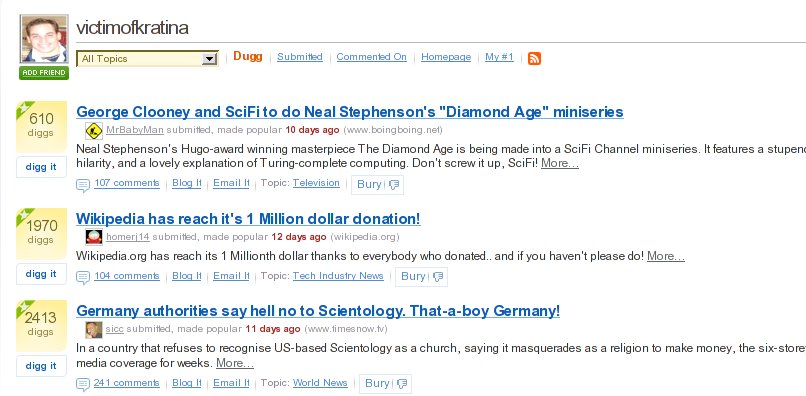
  N recent days, attacks on my character have returned and they are reaching a peak. I mentioned this before on various occasions in this blog, but it is worth repeating. Some of the stuff that you find on the Web with my name attached to it is fake. You cannot assume anything which has my name as the poster (even with a valid E-mail address and homepage URL) is really from myself. Forgeries have gone quite far, even as far as Digg. Check out these fake accounts/images for example: