BT Complaints Again (Updatedx14)
 Filed under:
  T is driving us up the walls again. My wife and I do our job over the Internet, so this is a very big deal. BT cannot even handle a seemingly simple case.
A month ago we started having horrible connection speeds at certain hours (lasting for many hours), as well as chronic disconnections. This is far from a normal behaviour and it makes it impossible to do all sorts of things. Lots of sessions are lost, some sites are inaccessible, etc.
It’s bad enough when there’s an issue, but it’s a lot worse when the handling of the issue is so appalling that it can take over a month to tackle it.
When I first reported the issue to BT the first-line support person failed to diagnose the issue and said they would escalate the issue and phone back with the findings within 72 hours. I never received a call.
After 4 days or so I phoned BT again. They knew almost nothing of my initial report and so I had to go through the aforementioned long process again (it takes a long time, not just waiting in the queue). They said they would phone back with the findings and this time they even set a precise time for the call. They never called.
At this stage I had already spent about a fortnight with a faulty connection.
I phoned BT again and the person on the other end of the line said that my issue had been closed. Well, I didn’t even know what made them assume that. I was furious at that stage, so I had them escalate to the manager and I made a complaint (that was on April 19th).
What followed then was a long series of calls (much time already wasted due to bad connection, never mind time on the line, testing the connection, etc.).
The manager, Mr. Gupta, decided to send a home hub and said it would take just 2 days to do this. A day later I was told it would actually take almost 10 days, which means another week and a half with a faulty connection.
The home hub finally arrived on the 29th of April and it did not resolve the issue. I didn’t think it would, but then again, it wasn’t my idea to have the hub replaced. Mr. Gupta took over the case and did too little to actually tackle the issue.
I immediately responded the issue to BT but received no response, so I called them up and had to work hard to speak to the manager again (their log was too choppy to identify him). He then assigned this for a person to investigate and I was promised a call between 11 and 12 today (I asked several times for reassurance that the call would be made, having experienced several failures by BT to call back). What an utter disaster.
Well, guess what? I received no call between 11 and 12. I phones BT again and got through to another person, Raj. I have just spent about an hour on the phone with him, in vain (he could not find the issue either and apparently no investigation was made, despite their promises). I have asked him to make a complaint to higher management about the way it has been handled and this case is still unresolved (2 calls scheduled for tomorrow, although given the poor rate of callbacks and the false promises, it remains to be seen).
To be continued…
Updates from Twitter:
Dr. Roy Schestowitz: War on #vpn even for those who use it for #security http://www.theregister.co.uk/2014/03/27/bt_home_hub_3a_scuppers_some_vpn_connections/
Dr. Roy Schestowitz: All my VPN connections are now dead. Thanks, #bt https://schestowitz.com/Weblog/archives/2015/04/30/bt-complaints-again/ … http://www.theregister.co.uk/2014/03/27/bt_home_hub_3a_scuppers_some_vpn_connections/
Dr. Roy Schestowitz: The case against #bt is not building up as it seems like they silently suppress the use of #vpn by #sabotage – grounds for litigation
Dr. Roy Schestowitz: 2 years ago I wrote about “BT Connection Throttling” https://schestowitz.com/Weblog/archives/2013/02/15/bt-connection-throttling/ … now it looks like they punish people whose job requires #vpn
Dr. Roy Schestowitz: If #bt is targeting (punishing) particular clients on behalf of Big Clients (government, Hollywood, Army etc.), then it’s ground for lawsuit
Dr. Roy Schestowitz: #bt home hubs do have a back door. How does one know? Ask BT staff; they can remotely access and see your home network in action.
Dr. Roy Schestowitz: Over the past 4 years I must have spent about 50 hours on phone with #bt and endless hours due to bad connection. Now they push #censorship
Dr. Roy Schestowitz: Criticism of #bt for technical reasons is one thing; BT also a core partner in #drone #assassination hubs – #uk gov. killed British citizens
Dr. Roy Schestowitz: Words cannot express how scary a company #bt is (instrument of power): censor, assassination, back doors/DPI, traffic ‘shaping’, bad service
BT staff (but not officially representing BT): @schestowitz with respect, your assertions aren’t true. Traffic throttling at exchange & in HomeHub about guaranteeing consistent service
Dr. Roy Schestowitz: [to BT staff] That’s what they say; what about when traffic is slowed down because of protocol type?
BT staff: @schestowitz limited in what I can say here as not spokesperson or support, but if you have issues can point you in direction of help 
Dr. Roy Schestowitz: [to BT staff] I have some friends who work there, but it’s usually not of use in such a vast company
Dr. Roy Schestowitz: [to BT staff] I wouldn’t be surprised if BT are quietly trying to stifle “bittorrent by vpn”, “netflix by vpn” and other such use cases
BT staff: @schestowitz traffic shaping of any kind is always controversial. To my knowledge BT doesn’t throttle VPN traffic.
BT staff: @schestowitz prod them to use the employee action line!
Dr. Roy Schestowitz: [to BT staff] Which in terms harms people like me who require many VPNs just to do their job
Dr. Roy Schestowitz: [to BT staff] Reports say that BT now admits a ‘bug’ that breaks VPNs in their home hubs
A another person (to the BT staff): That throttling used to render BitTorrent unusable. I solved problem by moving to non-throttling ISP. @schestowitz
Dr. Roy Schestowitz: [to BT staff] Tonight I expect two calls from BT management; I will raise the VPN issue as well
BT staff: @schestowitz not seen them myself, but looking now. If so, worth bearing in mind a bug by definition is unintended behaviour.
Dr. Roy Schestowitz: [to BT staff] Facebook called surveillance of non-useds “bug”. Companies say “bug” for legal reasons.
Update #2:
Dr. Roy Schestowitz: Tonight I am going to confront managers at #bt over the ‘bug’ which broke #vpn for millions of people. Let’s see if it’s really a ‘bug’.
Dr. Roy Schestowitz: I was unable to do my job last night because it requires several VPNs (and different VPN software), all of which #bt broke.
Dr. Roy Schestowitz: Real British journalists like @MarkJBallard should press #bt and find out if the company is breaking VPNs as part of Hollywood’s latest push
Dr. Roy Schestowitz: Web search for “vpn block isp” reveals that quite a few ISPs already admit blocking/suppressing VPNs at the behest of abusive monopolies
Update #3: BT was supposed to call between 6 and 8 today. It ‘forgot’. Someone else, however, called at 9. So there again we have BT failing to call back when promising to do so and now we have two issues, a bad connection (it’s still faulty and choppy) and no VPN. Here is what I posted online:
Dr. Roy Schestowitz: #bt is a massive disaster. Their solution to 2 major issue (preventing me & my wife from doing our job)? “We’ll phone again at 11PM” sigh
Dr. Roy Schestowitz: Despite #bt admitting (to the press) that a ‘bug’ is blocking #vpn connections in Home Bub, the BT manager I speak to is totally unaware of it
Dr. Roy Schestowitz: On phone with #bt now. They failed AGAIN to phone back (fifth time in 3 weeks), they’re not working to fix anything https://schestowitz.com/Weblog/archives/2015/04/30/bt-complaints-again/
Rather than 1 issue now we have 2. After a month of work…
Update #4: From social media…
Dr. Roy Schestowitz: 11PM. #bt promised to call by now, but again, for the 6th time in 3 weeks even management makes false promises, false hopes, no fix
Dr. Roy Schestowitz: More than 1.5 hours on phone with BT manager. He can’t solve this issue. They’re so unbelievably useless. For a month now…
Dr. Roy Schestowitz: #bt are basically giving up on trying to fix the issue, or at least they say they don’t know how to fix it (even managers)…
Dr. Roy Schestowitz: #bt management on phone now, still asking me what problem I’m having after I reported it a dozen times for a month
I have meanwhile swapped back to the old Home Hub, restoring VPN access and proving that the ‘new’ BT hubs are — deliberately or not — breaking VPN connections over ipsec, openvpn and probably more VPN tools. The issues persist and BT say they will call again in 2 days, despite having no plan or concrete steps towards solving the issue. The manager I spoke to at one point tried to blame wireless, only to be proven that the issue affects wired connections as well (he wanted me to buy a Wi-Fi booster at my own expense). He also tried blaming GNU/Linux…
BT are hopeless and so are we, as we need to get our work (daytime and nighttime job) done. BT offered no advice on VPN and refuses to give any (except on a premium, i.e. expensive, helpline). Advice put on the Web regarding BT Web Address Help (some say we should disable it) has not helped fix the VPN on the new hub.
Some British journalists ought to investigate why BT is breaking people’s Wi-Fi connections with its ‘new’ hubs, especially given what Sony leaks revealed, alongside other similar reports about a conspiracy to derail VPN connections (privacy tools).
Update #5 (May 1st): From social media…
Dr. Roy Schestowitz: BT staff (management) even asked us to waste money on “Wi-Fi booster” despite the issue clearly affecting wired connections as well.
Dr. Roy Schestowitz: BT staff (management) tried blaming Linux or “you’re using a lot of devices” for its connection being faulty https://schestowitz.com/Weblog/archives/2015/04/30/bt-complaints-again/
Dr. Roy Schestowitz: I can now confirm, based on a detailed analysis, that #bt breaks #vpn (IPSec, OpenVPN etc.) in its ‘new’ Home Hubs. Appalling. #uk #internet
Dr. Roy Schestowitz: If the connection always drops at midnight (and just now at midday) for wired devices and #bt management blames Wi-Fi it shows that they lie
Dr. Roy Schestowitz: When I reported #bt speed test results that confirm there’s an issue they refused to accept it (management), asked for REMOTE ACCESS to PC
Update #6 (May 1st at night): From social media…
Dr. Roy Schestowitz: #bt connection is a disaster again (unusable), a month-long issue. BT is supposed to phone back now, but they rarely keep such promises.
Dr. Roy Schestowitz: #bt seems to be getting closer to finding culprit. Probably faulty equipment in BT exchange, perhaps drip in electricity/wire. Cheers Tilak!
Dr. Roy Schestowitz: #bt is now experimenting with my line, perhaps realising that the issue affects many houses and that I am the one who helped them solve it
Dr. Roy Schestowitz: #bt managers full of arrogance and Hubris. They refused to escalate for a MONTH. Now it’s finally escalated to BT Wholesale. Hardware issue?
Dr. Roy Schestowitz: #bt managers blamed “Linux”, “too many devices”, “need Wi-Fi booster”, “change hub”, “give me remote access to your PC”. Issue at their end?
Dr. Roy Schestowitz: Sleepless nights, dozens of hours of phone, lots of diagontics, reporting. Seems like I did #bt ‘s job for them because they blame customers
@angrymofo: Did you actually get to speak to someone who knew what they were talking about, I’ve found that this is the hard part.
@angrymofo: Once I called BT to tell them the DNS servers are offline and had been for hours. They had no idea what I was talking about.
Dr. Roy Schestowitz: @angrymofo The guy I spoke to (my wife did too yesterday) was quite good. His name is Tilak. He’s technical and nice. #bt
@jrobertson: @schestowitz That’s an interesting insight to what sort of support answers BT have to provide. I couldn’t do that job.
Dr. Roy Schestowitz: .@jrobertson They only try to blame the customer, even when their own systems are at fault. A month to acknowledge this? #bt
So a guy called Tilak, a good guy who knows his job, seems to have finally found the issue (based on logs he had looked at), he ran some tests, then escalated this to the local team. At long last. After a month.
Update #7 (May 5th at night): From social media…
Dr. Roy Schestowitz: #bt complaints (several formal ones) in preparation, scale of compensation to be negotiated, then I’m dropping them for good
Dr. Roy Schestowitz: #bt now confirms there is an error on our line every 3 seconds; dropping out all the time as a result; took one month to ‘find’ this?!
Dr. Roy Schestowitz: #bt told me that escalation of the fault took almost one month, April 30th (to second line), despite them knowing about the issue
Dr. Roy Schestowitz: Over a month unable to do my job, wife also unable to do job, many hours on phone, bad connection, damage immeasurable. #bt
Dr. Roy Schestowitz: BT issues in 2013 took them 3 months to fix (sending engineers at end), this time it’s already over one month. #bt
Dr. Roy Schestowitz: #bt says that if I quit BT, I cannot receive compensation for the suffering (must resolve first). Is that even legal as per #eu law?
Dr. Roy Schestowitz: Port reset by #bt on May 2nd, not kept us in the loop, made things even worse, didn’t bother to check if it solved the issue
Dr. Roy Schestowitz: Another day, another couple of hours on the phone with #bt and line more faulty than ever. Over a month to merely send an engineer.
Dr. Roy Schestowitz: The exchange-to-router issue still persists, meaning that the fault with with #bt all along, took over 1 month to send engineer
Update #8 (May 8th at night): From social media…
Dr. Roy Schestowitz: #openreach engineer here (BT took over a month to send him), turns out a neighbour has just reported the issue also
Dr. Roy Schestowitz: #bt could have probably solved an issue for a lot of houses if only it wasn’t so arrogant to blame me rather than the issue
Dr. Roy Schestowitz: #bt was asked by me over a month ago to investigate the fault (I have technical details), refused to send out engineer
Dr. Roy Schestowitz: #bt did not send an engineer before I told 3 staff (including management) that I wish to cancel my BT account
Dr. Roy Schestowitz: A company as wealthy as #bt shouldn’t be in the business of saving money on engineers where real issues are being reported
Dr. Roy Schestowitz: Some equipment of the #openreach team has the letters “BT” on it, the uniform too. So much for hiding who’s really behind Openreach.
Dr. Roy Schestowitz: Moving away from #bt would not have solved the issue; it’s a wiring issue. The issue is BT refusing to fix upon report.
Dr. Roy Schestowitz: #openreach (BT with another uniform) spent half a day here drilling, changing wires, plates, still error unresolved. Argh…
Update #9 (May 9th at night): From social media…
Dr. Roy Schestowitz: Chaotic and truly unproductive month and a half due to what seems like faulty wiring that #bt is still unable/unwilling to fix
Dr. Roy Schestowitz: #bt knows that my connection is faulty, still isn’t sending another engineer to fix it. Now it’s dropping every hour, thousands of errors.
Dr. Roy Schestowitz: For a digital house, where everyone works in IT over wire, having a faulty #bt connection is like having no water. BT doesn’t seem to care.
Update #10: I have gotten truly tired at this stage. The connection is in a state of disarray, it is worse than ever before. Nobody in the house is able to do anything reliably, the line drops very often, there is endless packet loss/errors. I do my job (for a living) over this wire and so does my wife. The BT wires, managed and owned by BT, have been faulty for about a month and a half and BT is unable or unwilling to fix them. Not enough is being done and whatever is being done is too little, too late. This is a colossal failure. I already reported this issue to BT — several times — a very long time ago. I spent many hours giving useful technical details, but BT was arrogant enough to always try to blame the issues on me.
As I must do my work reliably I am not wishing to pursue the full scale of compensation, even by a lawsuit if necessary (I have pages of text written to support my case), I am prepared to ask for a refund for line rental and I am going to register for a wireless connectivity pack at my home. My BT line is just defunct and after a month and a half with a dozen hours on the phone and hundreds of hours in loss productivity it is clear that BT has no plan for fixing the line. I cannot rely on this line anymore, so I will receive compensation from BT (even if by suing) and work my way out of their infrastructure. 2 years ago it took 3 months for BT to fix a similar issue. It took them 3 months to send engineers out.
Update #11: From social media…
Dr. Roy Schestowitz: Passed between 4 people, 4 departments in BT, including Barry in the sales team in the UK (not India) just to cancel my account
Dr. Roy Schestowitz: #bt is now taking almost an hour to just process cancellation. They keep passing me between people, refuse to escalate to managers.
Dr. Roy Schestowitz: Now over an hour with #bt on the phone trying to process cancellation. Still nowhere near success. They’ll “phone back”…
Update #12: From social media, 12/05/2015…
Dr. Roy Schestowitz: #openreach says electrical interference noise (e.g high voltage), e.g. rain issue, affects other people (confirmed now, number 34)
Dr. Roy Schestowitz: The #openreach “rain team” to work underground on D side. The engineer confirms to me the whole block likely affected.
Dr. Roy Schestowitz: It is unclear to me why an issue I reported when it started around March is only now being taken care of by #bt (affects many people)
Dr. Roy Schestowitz: In the month of April a wiring serious issue affecting a whole block was blamed on me “using Linux” or “many devices”. #bt blame games.
Update #13: From social media, 13/05/2015…
Dr. Roy Schestowitz: Another half an hour spent on phone with #bt – still no resolution, they’re trying to act dumb, assigning new (unfamiliar with case) people
Dr. Roy Schestowitz: Our whole neighborhood is now suffering from bad wiring — a fault that #bt has now failed for 1.5 months to fix (I told them about it)
Dr. Roy Schestowitz: I have explained to #bt that if I distributed flyers in the neighborhood about how BT f**ed everyone’s connection , they’d cancel in anger
Update #14: From social media, 13/05/2015 in the evening (another incoming call from a manager)…
Dr. Roy Schestowitz: Every single day now (even right now) is wasted acting as a volunteer debugging person for #bt because they’re too stingy to do this work
Dr. Roy Schestowitz: It seems like next step re #bt fiasco: going door to door to post letter regarding BT’s failure to fix neighborhood-wide issue for 1.5 months


 NE THING I’ve learned while moving between houses is that over the past few years the UK made giant leaps towards Internet censorship. I used mobile broadband while BT was transferring the connection/account from one address to another, whereupon I felt what it’s like to use mobile broadband in the UK these days (not on a phone but through a dongle, or a USB-mounted cellular modem for those who are not familiar with British terminology/slang). O2 was fine 3.5 years ago when I used it for one month, but now it is flagging as “porn” numerous important sites, including one of my sites which is basically a Free software project site, demanding that I register and prove I’m over 18 before I can access my own site, which is perfectly banal and safe for children.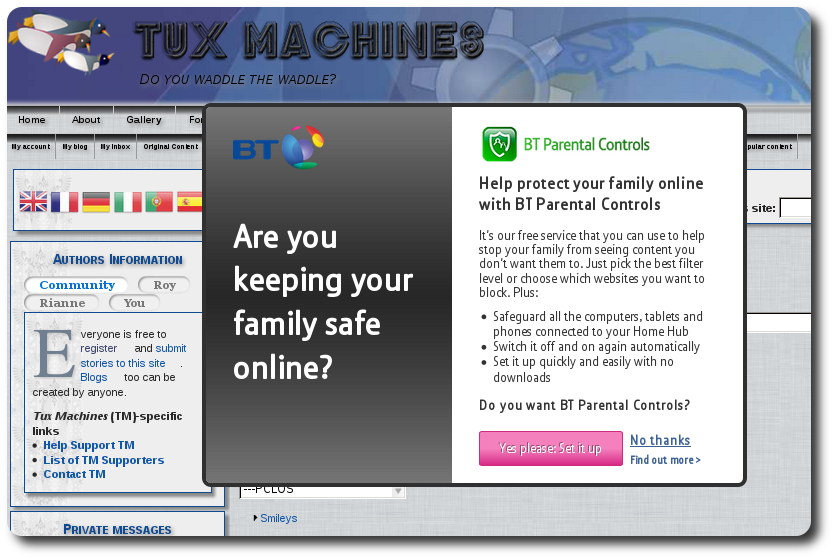
 oday I received yet another SPAM E-mail from BT, this time too promoting censorship of my connection under the guise of “Parental Controls” (which I guess means Cameron and his cronies are our parents who try to control us). The key content of the E-mail was as follows: