


Identi.ca is Throwing Away Everybody’s Work That Made Identi.ca What it is
 Filed under:
 Identi.ca becomes part of the ‘Internet rot’ problem

“Wait, What? Identi.ca Doesn’t Care About My Data???”
 ell, it just had to happen sooner or later. Face the facts. So-called ‘Cloud’ (or Fog as I prefer to call it) Computing is hype and it is dangerous not just in the security sense. Your data, or even your sentimentally-valued information, memories, etc. have no value to others, those who merely provide hosting for self gain or ego or whatever.
Over the years I have seen many so-called ‘clouds’ collapse, whereas with my stuff, almost everything is in tact, even what was online a decade ago (maybe IP addresses changed a little, but it is all still “up there”). This is because to oneself, data matters and data has value. It’s my data. To Fog Computing providers, your data is just mere “content”, something for other users to “consume”, potentially for “monetisation” by the managing party.
Even if the ‘cloud’ is built on Free/Open Source software, and even if that software is made available for download, there is no guarantee that data will be exportable from the database. Identi.ca is a good example of this point (more on that later). What a travesty!
“Why Are You Surprised?”
I previously wrote about my experience losing all my data and work at Digg and Netscape (see the posts “Digg Stabs All Users in the Back, Deletes All Their Content, EVERYTHING!” and “With ‘Cloud Computing’ You Can’t Keep Your Data Under Your Control“).
One could rename and do a rendition of “never fall in love again” as “never fall in cloud again”. Fog Computing is toxic, and the more years go by, the more people (and businesses) will recognise this. From losing access to new binary releases or newly-updated source code people are now losing access to actual data, which they never even retained on their own devices in the first place. What a suicidal decision that would have to be…
“Backup? Export? Where’s the Profit in That?”
Some days ago I made an effort to advise Identi.ca to preserve content and make old URLs accessible, for the sake of preservation. About a week earlier I enquired about the backup feature (experimental) being broken and not allowing me to export my data; this had been broken for years! I never receives a response Right now it says it “provides an incomplete backup” and finally I can actually export some data, but only the past month’s data (I have posted there for over 4 years).
Recently, having suffers another major ‘cloud’ data loss, I made a local copy of all my tweets. Twitter’s archive dump is well-formatted after Twitter announced the feature (months ago) and refined it over time, making it available to all users and not just select few, taking minutes to generate an archive and then sending a notification by E-mail, indicating an archive is ready for download (I have posted nearly 85,000 tweets). This is a commendable move by Twitter, but still, given that Twitter traffic declined 20% in the past 3 months alone (based on Alexa.com), how long will Twitter be hosting the tweets itself and thus keep URLs in tact?
“Sites Go Dark? Never!”
Well, actually it happens all the time, usually financial considerations being a major factor for the operator/s. Consider all the third-party image hosting services and link shorteners such as http://ping.fm/ that I used a lot in 2009-2010. These latter services are a nightmare even in the eyes of the founder of the World Wide Web as lacking any contextual information like link/page, the URLs are worthless; they are utterly dead and useless links, they cannot be recovered even through the Web Archive. Often enough this renders the tweets too rather useless. If people use shorteners in blogs, then they are truly misguided and they too will suffer the consequences.
“Didn’t Identi.ca PR Say it Was Just a Conversion
Identi.ca is trying to call this a “conversion”, but the only thing such sites seem to be planning to convert is user accounts, and not even many of them. Reading “Identi.ca conversion to pump.io” again, it seems clear all user data will be deleted (not left online, thrown away). As manual backup is trimmed/incomplete, this leaves users like myself unable to even pull the raw data while the site and the database are still online. What incompetence; what a betrayal!
“So New Software Platform Means Starting From Scratch?”
It sure seems to be the case. “The Identi.ca social network service will be moving to a new software platform on June 1, 2013,” says the announcement. This is a nice way of saying that the site is reassessing the way it operates and perhaps the business/operating model, neglecting all that was put into it by many users. It started by stating the migration would occur in one of the secondary domains and now this is coming to Identi.ca, as some people feared.
In a month-old post titled “Identi.ca conversion to pump.io” says:
Active accounts will be converted automatically to the new platform. Active users don’t have to do anything to continue using the service.
Accounts that have not been used since May 1, 2012 will not be converted. If you have friends or people you like on Identi.ca that you think should keep being users, please let them know. Just posting one notice will mean their account gets converted.
If you’re interested in seeing how pump.io works right now, you can set up an account by going to http://pump.io/ and clicking the “try it” button.
pump.io has a very different API than StatusNet. If you use a desktop or mobile client for Identi.ca, please check with the software developer to see if they’re planning to port to pump.io.
Backups of all public data will be available on archive.org after the switchover. You can also make a manual backup.
pump.io is under active development; some features you’re used to from StatusNet will be unavailable or will be implemented by third parties. There are a lot of things that pump.io does better, though. Social games, sharing pictures, and web-wide social buttons are just part of the new fun.
How hard would it have been to just keep the old CMS in tact, even for the sake of old URLs being accessible? Probably trivial bar space and CPU concerns, right? Identi.ca should reconsider its position on this. Maybe Evan (Identi.ca founder) can ‘kickstart’ a fund-raiser to help sponsor this; I would put my money in to preserve my data. Maybe others would, too.
New Identi.ca means the following: Heaps of broken URLs, disregard for people’s work which was posted online (essentially just like in the case of Digg, Netscape/Propeller, etc.), and elimination of many connections like “Followers”/”Following”. It was bad enough when theme-related information got dumped as part of the previous software upgrade. Not the same is being done with post data. Only user data is preserved (name, E-mail, etc.). Imagine if YouTube did the same thing, throwing people’s videos out with the bathwater… YouTube did throw away people’s theme-related information when it applied some updated, but these are often restorable with some effort. The same goes for Facebook with its layout tweaks. Imagine the outrage resulting from a Facebook announcement that it is dumping all old posts and photos…
“So It’s All Gone in a Few Days?”
Seems so, unless Identi.ca decides to keep the StatusNet setup in tact, as least for legacy purposes (I have thousands of links to Identi.ca URLs out there, and they are needed for context).
I have some mirroring of selected Identi.ca accounts in a IRC channel, which I back up and make available online for good. Alas, that is hardly a substitute.
“What Can I Learn From This Disaster?”
When your online work (including Facebook, Twitter, etc.) will no longer align with someone else‘s business model, say goodbye to it all. Yes, seriously. This is not a charity.
Yesterday I wrote about self-hosting one’s photographs. No guarantee of export options in Flickr, eh? Are you listening, Flickr MicroHoo! users? As my friend Tract put it in “Tracy’s photo album,” this is “better than flickr! I won’t lose all of my pics when flickr disappears.”
Recently, speaking to relatives or mine, I advised them to access Friendster to export or save their accounts’ contents before it’s too late to do so. A stampede to export would cost a site in the process of shutting down a lot in terms of bandwidth, reducing incentive to provide such an option, especially when there is no brand/reputation to protect anymore. And if you think Twitter and Facebook are any different, think again. The only difference is, those sites are probably quite a few years away from shutting down and throwing the content down the drain. Why else would the Library of Congress already amass tweets of everyone? Spying concerns aside (profiling people based on their posts from decades in the past), this shows that the US government too recognises that all Fog Computing ends up the same way — it ends up down. Not up, down. Offline, probably stored on some magnetic tape/disc in some warehouse owned by some company which had nothing to do with the data and not making accessible online, even to those who provided all this data. In due course this storage media too will erode, collect dust, and become inaccessible (incapable or getting salvaged), in essence destroying the data for good and not even giving data contributors a chance to preserve/curate the data themselves.
“What Should Identi.ca Do?”
It’s simple. Keep the data up. Keep the old URLS in tact. Make the privately-owned database accessible one way or another. If the backup feature permits complete download of all data for a given user, then it doesn’t resolve all the issues, but it may resolve some.



 Y BT Internet connection has been faulty since the beginning of this year. I have spent no less than about 10 hours speaking to support representatives in an offshore call centre, all of whom go through the script and a list of steps that “test” the connection, never mind if a dozen people before them ran the same tests. I have been polite but assertive, especially after these issues persisted for months. But never ever did they send out an engineer (meaning, a UK-based person paid at UK rates) to address the issue. At one stage they sent out a replacement router, but unsurprisingly this did not resolve the problem.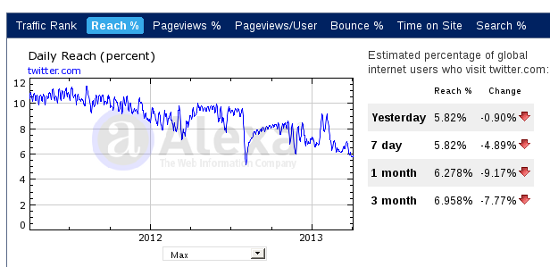
 LEXA data is not an accurate measure of site popularity (see
  OMETIMES I get asked how much traffic my Web sites are getting. The only honest answer I can offer is that I don’t know. It depends a lot on how it’s measured, what measures it (if anything), when it is measured (peaks taken into account), and how spiders or spam traffic get culled out. Bot traffic is increasingly made more sophisticated, so it is hard to classify one thing as a bot viewer and another as a human viewer. In any event, by far the biggest site that I run is Techrights. It has almost 20,000 pages that I wrote over the past 6.5 years.


 OR ALMOST a month now BT has been throttling speeds on its exchange, thus crippling/impeding connections, breaking what was previously working without issues. Interlacing and full capacity, they appear to have decided, can just arbitrary be disabled, disconnecting people with all their lives sessions at any time. When phoning BT — as I have done for about 3 hours over the past month (in total) — they acknowledge the issue, although their technical staff seems unable to even recognise the problem or communicate it properly (among peers), which leaves them having to issue pathetic compensation (also requires hours on the line) while continuing to throttle the connections. This is a technical issue at their end — one that they can address and resolve remotely, but why do they knowingly break their systems in the first place? They make a lot of verbal promises — hence not legally binding — only to break those promises and leave people like me wasting a dozen or so hours, incapable of doing proper work or even keep good temper.
 YING is a crude term, I admit, but when something circles around the toilet’s spiral, then you know it’s inevitably dead. Based on some Web statistics I prefer not to name, while Twitter boasts expansion in the number of registered users (this number can hardly even decrease), it sure seems like fewer registered users log in or are being actively followed. This can be also felt by many existing (and sometimes long-lasting) users in the form of communication, participation, and “engagement” as marketing people like to call it. Before I joined Twitter I had posted a fair deal in