


Fedora, Importance of GNU/Linux Competition, and Technological Freedom
 Filed under:
 EDORA 11 is a fine distribution of GNU/Linux, but my session got stuck (frozen) today. Generally, scheduling on the desktop in this out-of-date operating system is somewhat deficient. Windows sometimes do not respond for a period of several seconds. The bug where a text selection cursor is made permanently visible and allows no real interaction with any applications kicked in… again… today. It happens quite rarely with other distributions and there’s an escape route out of it, e.g. if the terminate signal can be sent to the application causing it, assuming it can be identified. But not this time though. Bearing in mind that it’s not the very latest version of Fedora and having used the fourteenth release since it was made available (even installed it for others), it does seem fair to say that for a smooth experience on the desktop, one is still better off going with the Debian family. Mandriva (predominantly but not strictly RPM-based) has been very good too, probably a lot better than Fedora.
The problems with Fedora are not really caused by adherence to freedom. Some creases and bugs, however, might not be addressed early enough because Fedora’s adherence to freedom (not strict adherence, but better than Ubuntu’s for example) limits the extent of its userbase, which in turn reduces the incentive Red Hat has to concentrate on the desktop side of things.
I have been working with Fedora 11 since last Friday (just waiting for my home computers to get back online with the new line activated) and as much as I try to love Fedora, I cannot help feeling that Kubuntu and Ubuntu have been giving me less hassle. Deep inside I wanted to declare that Fedora was better, but the experiences simply suggest that any such claim would be wishful thinking, even deceptive. The problem is that Canonical was made quite arrogant (hello Hubris!), which harms Ubuntu on technical and communal grounds alike. Canonical could use more competition.
It may be true that Linux in the mainstream is all about Android, Google, Ubuntu, mainframes, and Red Hat Enterprise Linux these days. That’s fine. As long as Fedora uses and reuses the same pertinent packages, there is no risk of Fedora truly falling behind. The wonder of Free software is, as long as one is allowed to copy the competition or branch out of it, unfair advantage is harder to gain. Canonical and Google have both attempted to produce “added value” (or enhancement) which is hard to emulate, replicate, or even get involved in. They are using some very vendor-specific code, which changes the balance of control not just with copyright assignment. It’s not progress and it is usually counter-productive.
Next week I will resume GNU/Linux advocacy and do a lot less programming (below is a new screenshot of the application I have been developing, but it’s unfortunate and regrettable that the code depends on a proprietary framework) and there is a lot of thinking to be done regarding strategy. Generally speaking, the world’s population loses control over technology at a very rapid pace* and software freedom is no longer the only freedom worth pursuing by a developer with passion for humanism. The head of the Free Software Foundation (FSF) has just stepped down and it is hard to blame him; maybe he too reached similar dilemmas and came to realisations that software freedom is not enough. Collaboration too is crucial (GPL encourages it), not to mention education in general.

____
* I spent half an hour this morning chatting with a lady in her 70s. She too — not too surprisingly — feels as though mobile phones are a burden rather than a blessing. In general, she is also concerned about today’s society which lacks face-to-face interaction and intimidates her generation that’s not at all accustomed to a technological control grid. Free/libre software is being used a lot in this context (primarily for companies to bring their user-hostile proprietary layer to market immediately), not as much is being produced though. If technology is not built to provide the user some more control, then it usually tries to control the user. But people are not made sufficiently aware of it, unless the FSF speaks out, as it recently did against Android.


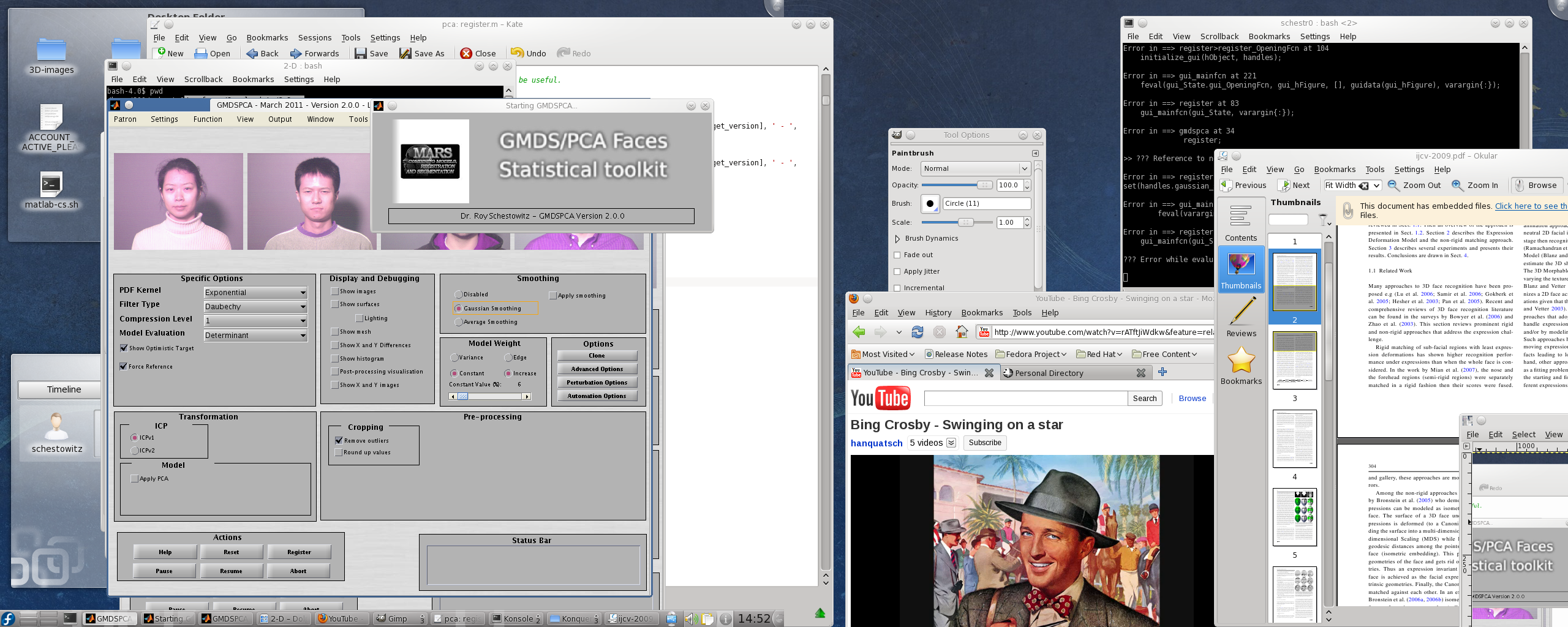
 oday I set up my alternative machine in a way which enables me to get the best of GNOME and KDE. It was set up in a way that I never tried before. Back in 2001 or thereabouts I would have gnome-panel imported into my desktop session (from another computer) and I repeated this type of practice locally around 2005-2007 when I wanted my KDE desktop to also have gnome-panel and therefore allow easy access to GNOME-side administration tools or applications. Today I tried something different altogether by installing KDE alongside GNOME and then running plasma-desktop in GNOME, which obviously imported panels and the background utilities, including 2 folderview plasmoids that import directories over SSH (the remote server on which I run workloads).

 ORKING with bare metal for the purpose of maximal hardware utilisation and performance is not the same as working with typical computer programs. Developing software for research is also different from software development for end users, where the software is treated as a product. Different scenarios require different methodologies and different levels of polish, and thus have different specifications and priorities. In research, brute force becomes essential to the success of one group or another.
 ESTERDAY I encountered my first major setback in Octave for Kubuntu. It was a bug, not a missing feature. It involved an outside library again. I tried installing a newer version of gnuplot (installing the latest one by compiling the source code), but this did not resolve the issue. All in all, over an hour was spent on it, first assuming that I was coding wrongly and later realising that

