Introduction About Site Map

XML
RSS 2 Feed RSS 2 Feed
Navigation

Main Page | Blog Index

Archive for the ‘Linux’ Category

Free Software – What Does it Truly Mean?

Season of the playful penguins
Season of the playful penguins from Oyonale

I decided to explore and assemble a few favourite essays that explain what “free software” actually means. It does not mean what people tend to believe. I can assure you that, so please read on.

Essay #1: What software freedom means to me

Some seem to view software as a closed sphere; meaning that one person or group’s success must come at the expense of another’s. For those that have this rather selfish and narrow view of a closed world of zero sum games, I guess it makes sense to be able to take software and ideas that others have created, and offer them back with some modifications as proprietary solutions under the exclusive control of one individual or group.

Essay #2: Debunking common GNU/Linux myths

(Fallacy:) Free software is Communism. Free software promotes a gift economy and is anti-capitalist. Free software will kill the software industry and hurt the economy. First let’s examine free software. Basically it is software that you are allowed to use, sell, distribute and modify in any way you see fit. Compare that with proprietary software, which most often only allows you to use the software on a limited basis — no redistribution, sale, or modification of the software is allowed. Actually it goes further than that; criminal and civil penalties can be imposed on you for doing any of those things. It would be more accurate to say that proprietary software is fascist rather than suggest that free software is communist.

The “free” in free software does not mean “free of charge;” it means “free of restriction.” That’s free as in rights, not price. This is a point often misunderstood or misrepresented by proprietary software CEOs and others who have a proprietary software agenda to push.

That being said, free software is often also free of charge.

[...]

So, as the GNU slogan clearly says, it is “free as in freedom“.

Linux Advocacy Graphics

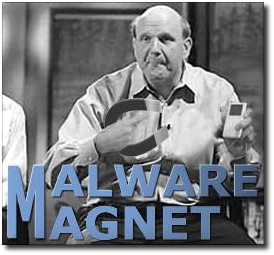
Malware magnet

AMUSING photos are appreciated whenever light entertainment is sought. So, in the past months I have created a few using the GIMP. Steve Ballmer is involved in two of these, both of which stem from discussions in the Linux advocacy newsgroup.

Lastly, I decided to give my own version of Microsoft Linux. I hereby present the box set of Microsoft Linux. Anti-virus and Service Packs are included free of extra charge.

(To Webmasters: You can borrow these images to use in your Web site; no need to request for consent. In fact, I do not mind HotLinking either.)

Huge Success for Open Source Tablet

Nokia 770

THE Nokia 770, which I have mentioned before its arrival, is an Internet tablet that is based on Open Source and the Debian Linux distribution. It has proven to be very popular among gadgeteers from either side of the world. In fact, high demand rendered it “understocked”.

A new development environment has recently been introduced to the public. Its intent is to encourage involvement from the Open Source community. Many Open Source projects will sooner or later be ported to run on the Nokia 770 with its high performance hardware and high-resolution screen. As for size, the dimensions of the device are comparable with that of a typical Palm handheld.

The world’s largest mobile manufacturer Nokia looks to have scored a major hit with a new wireless device that doesn’t have any phone functionality. The Finnish firm announced on Wednesday that, against its expectations, it is to increase production of its 770 Internet Tablet handheld after achieving huge online sales since its launch in early November. In fact, demand for the product in Europe and the US is so great that the company has currently run out of stock and customers are facing a minimum two-week wait for the device.

As I said half a dozen times before, I am tempted to ditch Palm after many years. The Nokia unit suits my needs, as well as ‘development mantra’.

Plain Text Justify and Hyphenate

Book scanning
Giving the more professional look to your text

THIS blog item revolves around a wonderful Perl script which can revolutionise the layout of your plain-text messages, giving them looks reminiscent of that found in professional literature. The tool is called the Paragraph Adjuster with Hyphenation and it is of course free.

To give an example of its use, a file I created in ~/Main/Programs/Scripts/indent.sh contains the following:

perl ~/Main/Programs/paradj/paradj.pl --width=74 -h -n -b
     ~/in > ~/out

kedit ~/out

The first command invokes the script from its path and passes it some arguments, which are personalised. The input come from the file in and output is sent to a reserved file (out) which acts as a common container and somewhat of a placeholder. The last command makes the output available to me (on screen) to copy and then paste, often to be used in newsgroups, mailing lists, and rarely in E-mail too.

The script is based on a Perl module that was inherited from TEX. The LATEX family is rather presentation-aware and smart in terms of its fragmentation decisions. It ‘knows’ when it is reasonable to hyphenate and where added spaces for justification are least distracting. Maybe the same applies to indentation. There are many options in the script, which control the tendencies, the priorities and thus the behaviour of the output.

The command example above hopefully illustrates how simple it is to use the script, as well as invoking it rapidly, without too much manual intervention and input/output ‘piping’. I have also set up a shortcut (CTRL+ALT+7) to convert in to out and then copy and paste onto the required place, so indent.sh need never be called from the command-line.

Example from my most recent use of the script:


The  short  answer:  Windows has  got  itself
trapped. Over the years it has adopted overly
permissive  and  lenient mechanisms that  ne-
glected security. Security seemed like a cost
hat  hindered functionality. Unauthorised in-
stallations and lacking verifications are one
example. ActiveX controllers are another.

Notice that all text lies within a rectangular block. This needs fixed-sized fonts, which cannot be guaranteed by all recipients or readers. If sent to a recipient and read by a mail client, feed reader, newsgroups reader, browser, etc., it may be displayed in whatever form the user prefers, even proportionally-differing font sets.

IBM Said to Challenge Microsoft the Most

Bill Gates
Not much to worry Bill Gates

ACCORDING to Reuters, Bill Gates states [enormous ASP ‘URL‘] that IBM is the main rival to Microsoft. Google are Apple are said to be smaller factors of concern, which lies in contrary to some fairly recent memo and even a few urgent strategic moves.

IBM studies show that Linux TCO is 40% lower than that of the Windows equivalent. What happens when IBM begin to pull out the Windows equipment from their clients’ operations environment?

What I find most admirable about IBM is that, unlike Google and Microsoft, they give no compelling reason to be hated. They embrace and encourage standards. They cater for diversity where it seems suitable.

Linux Migrations in the Corporate World

Servers stack

FOR quite some time, companies with large budgets have feared the inclusion of free software in their server rooms. Cost was not an issue. Naturally, price was never assumed to lie orthogonally to quality either. Is there a fallacy? There certainly is and it is being perpetuated by those whose interests it serves.

I store about 1.5 GB of mail only to see great reliability. I also maintain Web spaces of roughly the same size and a continuously increased level of complexity. The Linux server and its Linux Web-based applications are both reliable and free. As seems as though the issue remains that in the wealthy working place, people have budgets that they need to make use of. Often they opt for Exchange servers and IIS. The expenditure due to acquisition of ‘premium’ solutions costs people their jobs. Cost cuts are more easily approached due to this. Pure and simple.

The same issues arise in a different context — the context of liability and job protection by sticking to brands. This pattern is an impediment in its own right. FUD continues to impede adoption, as does the norms and perceptions in people’s mind.

Related essay: Operating System Monoculture

Windows Munchkins

Money on keyboard

The use of money to skew real facts and lure customers

LINUX forums (including newsgroups) often encounter harassment by trolls that spread anti-Linux FUD. This puts off a few participants and adds noise to discussions that are largely Linux-oriented.

There is often a suspicion arising that this community sabotage ‘bubbles up’ to managerial roots. Some would suggest that disruptive involvement by trolls is actually paid for. Past evidence supports such suspicions and is echoed in this blog item which quotes John Dvorak.

“Some years back, Microsoft practiced a lot of dirty tricks using online mavens to go into forums and create Web sites extolling the virtues of Windows over OS/2. They were dubbed the Microsoft Munchkins, and it was obvious who they were and what they were up to. But their numbers and energy (and they way they joined forces with nonaligned dummies who liked to pile on) proved too much for IBM marketers, and Windows won the operating-system war through fifth-column tactics”

Mr Dvorak wonders if Microsoft is today using reverse-dirty-tricks to promote the Xbox 360: pay people to create Web sites that slam the gaming computer in order to provoke a barrage of defenders.

Last week I went to watch King Kong. There were no less than 3 Xbox 360 commercials before the film commenced. Microsoft sure know how to spend money. It is worth mentioning that Xbox 360 units are sold at a cost which accounts for a significant loss. Regardless, the Xbox fails to sell in Japan, despite the heavily-invested-in commotion.

Related item: Xbox 360 Off to a Slow Start in Japan, Microsoft-funded Benchmarks

Retrieval statistics: 21 queries taking a total of 0.246 seconds • Please report low bandwidth using the feedback form
Original styles created by Ian Main (all acknowledgements) • PHP scripts and styles later modified by Roy Schestowitz • Help yourself to a GPL'd copy
|— Proudly powered by W o r d P r e s s — based on a heavily-hacked version 1.2.1 (Mingus) installation —|