Introduction About Site Map

XML
RSS 2 Feed RSS 2 Feed
Navigation

Main Page | Blog Index

Archive for the ‘Linux’ Category

Second SuSE Machine

SOME time ago I mentioned the three Linux machines which I have accumulated, but this situation has changed due to a miserable hard-drive crash. I received a new (and slightly better) machine as a replacement yesterday. Rather than having 2 Ubuntu boxes and 1 SuSE box, it is now 2 for SuSE and only one for Ubuntu.

The main motive for this shift was a video card incompatibility, but I also must confess that I do not like GNOME as much as I like KDE. Moreover, SuSE is a more comprehensive and self-contained distribution where fewer installation tasks need to be completed once the operating system has been set up.

SuSE screenshot

Arbitrary screenshot of my SuSE Linux box at work

SuSE, which comes from Novell, has become one of the market leaders as far as Linux in the enterprise is concerned. Novell are among the most prolific vendors of Linux as they incorporate merely any modern desktop environment. When I installed SuSE on the new machine yesterday, I received the re-assurance that Novell, much like Canonical (makers of Ubuntu), simply understand usability, as well as the need for a friendly UI and stability. Therefore, they are bound to flourish at the expense of more ‘stubborn’ distributions, which often pose challenges rather than assist the user and adhere to abstraction. Their support and community are quite strong as well.

Ubuntu, on the other hand, continues to have a few weaknesses, so I will continue to favour and evangelise SuSE whenever I get the chance. I must stress that Ubuntu is an excellent distribution for beginners and it also boasts excellent hardware detection so it involves little or no gamble. Its accompanying Live CD gives further reassurance too.

Linux to Penetrate Tablets, PDA, Mobile Market

Nokia 770

Some of you have possibly heard about the Nokia 770. For those who haven’t, have a look at this snippet from a recent review in the Washington Post.

The Finnish mobile firm had originally expected the Tablet, which runs on Linux-based software, to enter the market before the end of September.

I personally use a Palm handheld and I consider myself an avid Palm enthusiast. Yet, I was deeply disappointed by the move which had a Treo run Pocket PC. To me, this was beyond a simple “deal with the devil” as I also use Linux and I can imagine the implications of such a dangerous pact. Palm were committed to Linux for quite some time, but were recently taken over by a Japanese giant, so the future is uncertain and past promises or planned strategies should now be taken with a grain of salt.

I started to explore alternative paths and the Nokia 770 is one of these. I have just been reminded that it would not be surprising if Nokia dumped that rusty Symbian altogether and implemented a port of the existing GUI to run on top of the Linux kernel.

From recent articles about the Nokia 770, it sure seems as if the codebase will be made available for other devices as well. I believe the device will be ready by Christmas, so expect a homebred Linux distribution for mobile devices soon. It can then be sold to other vendors which will mark yet another revolution — the entry of Linux into the mobile phones, handheld PDA‘s, tablets, etc. First the servers, then the desktop and soon a penguin in everyone’s pocket, Palm included perhaps.

More on Linux-powered PDA’s:

The remainder of this item slides off the theme of Linux and discusses Web 2.0-like transitions.

How come nobody has implemented a portable PDA synchronisation method? Many PDA’s these days can establish an Internet connection and very many computers reside in a connected environment with always-on connection. Would it not be rational to implement a Web-based Palm Desktop, for example? One which centalises data in on-line accounts? I still wait for a handheld that integrates with and synchronises with all platforms more seamlessly. The Internet, being open, can easily bridge that gap and assist users from the fuller spectrum of operating systems. Sooner or later, this all will happen.

Cited by: PalmAddict

Windows Today Worse Than Windows in 2001

Windows XP
Windows XP slows down as time goes on due to patches, protective software, and Registry bloat

WINDOWS Vista was already said to be a trainwreck, primarily due to its inability to deliver something innovative. It gives no compelling reason whatsoever for users to upgrade. People who have had the chance to fiddle with the Vista beta build can confirm this. In fact, it seems to be lagging behind other operating systems, notably Mac OS X as was previously confesses by a Microsoft evangelist.

On top of it all, hardware requirements of Windows Vista make it rather unappealing. Novell have said that Vista will drive away Windows users and ultimately lead them to Linux. To many, adopting Windows Vista probably means acquisition of a new computer, which will most probably contain Windows pre-installed for a variety of reasons that involve anti-fair trade practices.

Windows XP was first introduced to the public in late 2001 and, as we approach the end of 2005, Windows XP is worse than ever before. The many critical patches, which came in the form of Service Pack I & II have made it slower and less likely to interact with all underlying modules gracefully. With more Windows viruses in the wild, it requires more attention and maintenance than before, which has definitely led to unrest among its users community. In the mean time, Apple’s Tiger has been gaining strength and has even surpassed, in term of it functionality, the Microsoft equivalents — something that even Microsoft could not truly deny. KDE, in the mean time, has been growing very rapidly and it is now comparable with any other desktop layers and often surpasses the competition in terms of its functionality. See, for instance:

It is also worth mentioning Ubuntu Linux, which has done tremendously well at easing a transition to a free operating system. Hewlett Packard have recently started selling Ubuntu desktops and laptops, as a matter of fact. Ubuntu comes in just a single CD, its hardware detection is admirable, and moreover it is stable and user-friendly. Its bundled Live CD makes another big pro as users who are too resistant to delete Windows can have a period of adaptation and gain some re-assurance with regards to their platform migration.

Linux Adoption Sabotaged

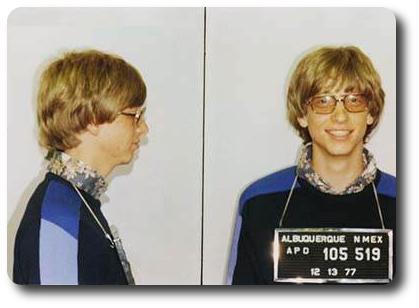
Bill Gates
Bill Gates arrested in his younger days (photo in public domain)

JOHN H. Terpstra, a bold IT consultant, explains in an excellent article, which comes in 3 parts, how Microsoft and its disguised allies are working as a group toward abolishment of Linux on the desktop. The article presents a made-up case study and explains how some Linux incompatibilities are to be blamed for at a higher level.

Joe felt that Airgo Networks should be commended for its honorable handling of OSS, but he still had no luck there. When he called the company, he found out that no Linux drivers will be available for the Airgo chip set until late 2005 or early 2006.

The author also mentions the issue of cost, which is apparently well-controlled from up above, or contrariwise from down below, i.e. under the table.

Joe figured that since Linux is free, the cost of a laptop computer pre-loaded with Linux would cost less than one that shipped with Microsoft Windows. Wrong! The cost estimates he came up with were between $300 and $500 more for a system with Linux than for one with Windows.

Joe did a Google search to find Linux on laptop suppliers and obtained five price offers. Many Windows laptop specials offered a free bundled LCD monitor or a free bundled printer. No such offer was found for a Linux pre-loaded laptop.

It is worth referring back to an item that illustrates that fact. Dell Computers are selling an open PC (i.e. no operating system = bland hard-drive) for more than a computer with Windows pre-installed. Microsoft is apparently subsidising hardware or relishes on illegal kickbacks.

In John’s article he tends to become more political towards the end.

Joe had to pay for Microsoft Windows when he had no desire to use it, because he would have paid more for a machine without it. Why should consumers suffer cost increases to use a free operating system? Why are governments around the world so silent on this matter? Isn’t it time for the consumer to be better informed of the graft and corruption in the IT retail industry?

I, for once, could not agree more.

Desktop Environment Freedom

Desktop with previews

PDF‘s, text files, HTML‘s and
directories in the KDE Desktop with previews
(click to enlarge)

CERTAIN issues arise when habits and user orientation in his/her desktop are interfered with. Desktop environments, installers, filesystem structures, or even platforms in general are often more workable and thus successful if they comply with the expectation of new users. What if these are made too stringent by the developers, however? What if decisions and conventions are voted for without involvement of the end-user?

Many desktop environments, free ones in particular, are not made uniform. The resulting diversity and flexibility leads to difficulties in using somebody else’s settings, i.e. working in conjunction under the same session. Some GNU/Linux distributions include more or less any desktop environment which exists while settings are kept apart and well-separable for each user of the system and each desktop environment. So, where does the the problem lie? Give users more freedom, I suggest, and make that the norm. It is, after all, their own computer and they understand their needs better than the developers of the operating system.

What appears worse than all is the scenario where decisions are arrogantly by the vendor and then enforced. This is often the path that operating systems such as Mac O/S (to its varieties) and Windows do. Give the user some more choice, I say, by adding options for endless customisation that has very few boundaries, if any (Open Source). Give all users the freedom they deserve and allow them to express individuality and adapt/tailor their desktop environment to suit their needs. Menu entries and other widgets will remain unaffected, so documentation, for instance, will not suffer as a consequence.

People work differently on a variety of applications, for a wide variety of purposes. The domains in which they work differ as well. A person working with many open windows at any given time might prefer to have “focus follows mouse cursor”. Contrariwise, to some, this “focus follows mouse cursor” behaviour is highly adverse to habits. To list yet another example, a Web server needs to have a light desktop environment that is less susceptible to breakage and consumes small amounts of RAM.

These considerations are all highly defensible. If Linux was to be deployed in more public clusters, for example, choice could (and should) be given as to which desktop environment should be used. Different strokes for different folks, but all can be catered for provided that disk space is made available. The pertinent settings would reside in the home directory of each user. Thumbs up to Gnome, KDE, and the rest of the self-motivated window manager teams around the world.

Related item: KDE Versus GNOME

Linux Tablet

Nokia 770

As a sequel to my previous reference to Linux-powered tablets, it is worth mentioning the Nokia 770.

When the Nokia 770 Internet Tablet hits the streets in the coming weeks, it will mark a technological milestone for the world’s largest mobile phone manufacturer. The tablet not only is Nokia’s first non-voice Wi-Fi device, but it also runs on the Linux operating system (OS).

To me, this seems like an excellent (yet more expensive) replacement to Palm handhelds. Palm have recently lost their direction and their commitment to Linux appears to have been crippled.

Windows Dies Again

Broken CRT

THIS morning I received a flash reminder of how disasterous Windows can be. I tend to forget this as my professional life is Microsoft-free. My mother’s computer refuses to boot as the hard-drive cannot be mounted by Windows XP. Not even safe mode can do the trick.

This comes at a time when I strongly urge my mother to switch to Linux (probably Ubuntu), which perhaps would be a blessing as the computer reached a halt (over 5 minutes to boot) due to Registry bloat. Perhaps this O/S crash will wind up serving us well, but the amount of distress and required restoration work is enormous. This all comes at a time when we are reminded how mature Linux has truly become.

“Why choose Ubuntu for the parents?”, one might ask. I have 3 Linux machines at Manchester and 2 of them (the more recently set up) run Ubuntu while the main one (repository or so-called ‘mother ship’) runs SuSE, which is my favourite.

While I’m here at home I occasionally the Ubuntu Live CD because, let us face it, it can be a pain working under Windows as you cannot (trivially) SSH with X forwarding. Only the bandwidth is somewhat of a barrier at the moment (ADSL as opposed to proper LAN).

Retrieval statistics: 21 queries taking a total of 0.311 seconds • Please report low bandwidth using the feedback form
Original styles created by Ian Main (all acknowledgements) • PHP scripts and styles later modified by Roy Schestowitz • Help yourself to a GPL'd copy
|— Proudly powered by W o r d P r e s s — based on a heavily-hacked version 1.2.1 (Mingus) installation —|