Introduction About Site Map

XML
RSS 2 Feed RSS 2 Feed
Navigation

Main Page | Blog Index

Archive for the ‘Linux’ Category

Desktop Environment Freedom

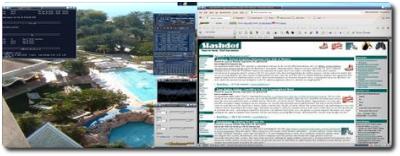
Desktop with previews

PDF‘s, text files, HTML‘s and
directories in the KDE Desktop with previews
(click to enlarge)

CERTAIN issues arise when habits and user orientation in his/her desktop are interfered with. Desktop environments, installers, filesystem structures, or even platforms in general are often more workable and thus successful if they comply with the expectation of new users. What if these are made too stringent by the developers, however? What if decisions and conventions are voted for without involvement of the end-user?

Many desktop environments, free ones in particular, are not made uniform. The resulting diversity and flexibility leads to difficulties in using somebody else’s settings, i.e. working in conjunction under the same session. Some GNU/Linux distributions include more or less any desktop environment which exists while settings are kept apart and well-separable for each user of the system and each desktop environment. So, where does the the problem lie? Give users more freedom, I suggest, and make that the norm. It is, after all, their own computer and they understand their needs better than the developers of the operating system.

What appears worse than all is the scenario where decisions are arrogantly by the vendor and then enforced. This is often the path that operating systems such as Mac O/S (to its varieties) and Windows do. Give the user some more choice, I say, by adding options for endless customisation that has very few boundaries, if any (Open Source). Give all users the freedom they deserve and allow them to express individuality and adapt/tailor their desktop environment to suit their needs. Menu entries and other widgets will remain unaffected, so documentation, for instance, will not suffer as a consequence.

People work differently on a variety of applications, for a wide variety of purposes. The domains in which they work differ as well. A person working with many open windows at any given time might prefer to have “focus follows mouse cursor”. Contrariwise, to some, this “focus follows mouse cursor” behaviour is highly adverse to habits. To list yet another example, a Web server needs to have a light desktop environment that is less susceptible to breakage and consumes small amounts of RAM.

These considerations are all highly defensible. If Linux was to be deployed in more public clusters, for example, choice could (and should) be given as to which desktop environment should be used. Different strokes for different folks, but all can be catered for provided that disk space is made available. The pertinent settings would reside in the home directory of each user. Thumbs up to Gnome, KDE, and the rest of the self-motivated window manager teams around the world.

Related item: KDE Versus GNOME

Linux Tablet

Nokia 770

As a sequel to my previous reference to Linux-powered tablets, it is worth mentioning the Nokia 770.

When the Nokia 770 Internet Tablet hits the streets in the coming weeks, it will mark a technological milestone for the world’s largest mobile phone manufacturer. The tablet not only is Nokia’s first non-voice Wi-Fi device, but it also runs on the Linux operating system (OS).

To me, this seems like an excellent (yet more expensive) replacement to Palm handhelds. Palm have recently lost their direction and their commitment to Linux appears to have been crippled.

Windows Dies Again

Broken CRT

THIS morning I received a flash reminder of how disasterous Windows can be. I tend to forget this as my professional life is Microsoft-free. My mother’s computer refuses to boot as the hard-drive cannot be mounted by Windows XP. Not even safe mode can do the trick.

This comes at a time when I strongly urge my mother to switch to Linux (probably Ubuntu), which perhaps would be a blessing as the computer reached a halt (over 5 minutes to boot) due to Registry bloat. Perhaps this O/S crash will wind up serving us well, but the amount of distress and required restoration work is enormous. This all comes at a time when we are reminded how mature Linux has truly become.

“Why choose Ubuntu for the parents?”, one might ask. I have 3 Linux machines at Manchester and 2 of them (the more recently set up) run Ubuntu while the main one (repository or so-called ‘mother ship’) runs SuSE, which is my favourite.

While I’m here at home I occasionally the Ubuntu Live CD because, let us face it, it can be a pain working under Windows as you cannot (trivially) SSH with X forwarding. Only the bandwidth is somewhat of a barrier at the moment (ADSL as opposed to proper LAN).

Forking Applications

Double-headed arrow

DEVIATING from the a development branch, thus staying away from the regular updates cycle, is a step which is bound to have its problems, e.g. security and missed out extensions. I am fully aware of these issues and I made mistakes in the past nonetheless, particularly with Web applications. I am rather confident and comfortable with my choices to extend applications, but one must remember the pitfalls, as well as the very few advantages.

Rather than simply downloading pre-installed and/or pre-configured packages like Gallery, WordPress, a VPN client or PHP-Nuke, one can add a wee bit of ‘individuality’ to them. For example, with actual words and vocabularies that do not suit your way of speaking, you can instill some personality within the software — a beauty to be found most commonly in Open Source software. It gives a feeling of ownership, a sense of personal contribution.

Linux users are often inclined to hack software and customise it, maybe because they can. With some Linux distributions like Gentoo, people struggle to compile individual components and some have the odd habit of re-compiling the Linux kernel. Again, it gives an utterly unnecessary sense of achievement. That free platform, however, unlike other platforms, can be claimed to be one where very little intervention should be involved. With 5-CD installations, for instance, all the necessary software is in place, is well-integrated and simply works without any apparent conflicts. Somebody else took care of all the nasty installations and then burned some ISO to be distributed and put as-is on other people’s computers. So, we perceive a situation where there is a great deal of freedom, but at the same time that freedom is unneeded or even discouraged.

Change to existing packages is risky. It can bring an application to a fragile state. Attempts to exploit vulnerable (usually non-existent if the owner is fortunate) components are being re-directed to an unpleasant page at server level on this domain. I hope these can successfully deter a determined hacker. The only ones to come across such a page would be those attempting to sabotage (hence the rel="nofollow" in the link above).

When forking and choosing to no longer follow a development cycle, there is always some possibility of ‘flushing’ self-made components and starting fresh with similar, even identical data and an application belonging to the current generation, hence incorporating state-of-the-art technologies. Upgrades usually mean some loss of personal changes which are better off never lost. This may lead to feelings of regret due to waste. It also means hours of conversions, not to mention the laborious process that is involved in updates and getting accustomed to new interfaces. As it stands, I continue to fork, but do so cautiously.

Linux Tablet and $100 Laptop

Laptop

I am still on vacation, but I would be sad to see the blog remaining static. The following are a few pointers that I have accumulated in recent days:

  • Linux tablet – running fully-featured Linux on a modern tablet PC
  • $100 laptop prototype – a proposal from MIT
  • Why would a Linux device be as capable (or more) as any other platform which is expensive and bound to restrictions? See the Slashdot roundup of Web applications. The collection of links therein is makes an excellent proof of the emergence of AJAX in several major aspects of work, e.g. scheduling and spreadsheets. I mentioned this as a future possibility a few days ago and wrote a long essay about it on the plane just a day before coming across the item from Slashdot.

Did you know there was AJAX word processor, AJAX spreadsheet, AJAX calendar, AJAX presentation-building software, AJAX e-mail client, AJAX note-taking software and some other interesting applications, which, deployed on your local server, do not need installation and “just work” in a browser window?

Palm Endow Microsoft with Unjustifiable Flattery

AS Palm form an alliance for their smart phone with their former rival Microsoft, many perceive the step as a damaging one to the Open Source community or advocates of open standards and inter-operability. Microsoft are already strutting about, showing off in their front page a Palm device while labelling it “Windows-powered” (a segment of the image is shown below). This image looks rather offensive since they go a rather long way in order to pass across the message: “the enemy is ours”. Sadly, Palm do similarly in their front page; maybe a reciprocal exchange?

This aggressive attitude is by all means nothing new. It comes after a great deal of trouble and distress at Microsoft. Windows Vista, for example, needed to be-built from scratch and there was recent loss of government support and trust, which in turn opted to move to OpenDocument. So, that “incompetent-at-best” move from Palm gives Microsoft a small victory among the many recent losses, ‘Google threat’ being the most prominent one.

Palm on Windows
How can Palm live with the shame? (from Microsoft’s front page)

In UseNet, several threads come up with misleading subject lines insinuating a complete Palm migration to Windows, which is evidently false. Then again, when will Palm complete their promised move to Linux? Is the recent Access-Palm takeover going to have an effect on strategic alliances? What if Palm carried on with Windows for their smart phones, as well as Linux in tandem, primarily for older-generation devices?

Looking at the users’ side, how would smart phone owners, whose data has been stored in line with Palm’s conventions, synchronise their data with a Mac or a Linux machine? Are they supposed to be swayed to change their desktop environments because of a PDA?

This move by Palm left me bitter and I am not alone in feeling somewhat betrayed. I came to witness a platform which I voluntarily supported (assisting many hundreds, if not thousands, of Palm users in UseNet) as it gave strength to an opponent — an opponent whose purpose is to destroy and cripple anything that is not Microsoft. I am beginning to investigate a migration to the Zaurus after many years of sticking and evangelising Palm. I truly hope that Palm prove that their commitment to Linux is true, thus keeping me ‘on board’. They will need to do that soon enough, or else rumours will grow wings and suggest that Palm(One) have become merely a hardware vendor and that PalmSource are history.

Cited by: PalmAddict

Massachusetts Goes OpenDocument, More to Follow Suit?

Bill Gates
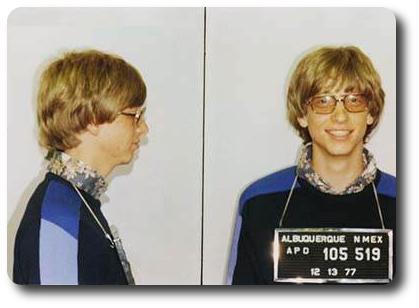
Bill Gates arrested in his younger days (photo in public domain)

As previously discussed, the admirable state of Massachusetts is able to recognise problems with closed applications and proprietary formats. It is now confirmed that Massachusetts will carry on and dispose of Office in a staged migration to OpenDocument, culminating in 2007.

With Microsoft’s OpenOffice XML the loser to OpenDocument in Massachusetts, the war of desktop formats is likely to spread to other governmental bodies, says one participant in the deliberations who sees the decision as a tipping point.

“In many ways it becomes circular,” said Doug Heintzman of IBM in an interview Friday. “It emboldens other entities. We are on the cusp of a big change.”

Immense perseverance at Microsoft did not help avoid this key loss of the Massachusetts ‘flagship’. Awakened interest in Linux recently emerged among African governments as well. Only last week, South Africa wished to ditch proprietary and get rid of hundreds of millions (USD) worth of licences. All the same, it is still worth reading the open letter from the KDE team to Microsoft.

Penguin animation
Is this the beginning of the end for Office proprietary?

Retrieval statistics: 21 queries taking a total of 0.090 seconds • Please report low bandwidth using the feedback form
Original styles created by Ian Main (all acknowledgements) • PHP scripts and styles later modified by Roy Schestowitz • Help yourself to a GPL'd copy
|— Proudly powered by W o r d P r e s s — based on a heavily-hacked version 1.2.1 (Mingus) installation —|