


Letter From Anonymous on Windows Going ‘Open Source’
 Filed under:
  he other day I was sent an anonymised E-mail from someone who entertained the possibility of an “open” Windows/Microsoft — a notion that I reject for realistic reasons. Here is the full discussion.
Defining the Cause
Friday October 25, 2013
Hi Roy,
A like to share with you a thought and hear what you think.
By some twist of faith, how many Linux users are pushing for Linux over Microsoft? That would be a lot, right? But, as long as Linux users are pushing for Linux, you know they forget that Linux was “proprietary” too. So doesn’t it make a whole lot more sense, to do the SAME to Windows and make it “open source” too, just like GNU did for Linux?
This is not an accurate account of history. Linux Torvalds chose the GPL for his kernel, which was only briefly licensed as proprietary (it was obscure at the time). This is similar to MySQL. Windows cannot be compared in an apple-to-apple fashion by warping suppositions.
Here are some reasons for it, although not in much order or cohesion. I’m just rushing this to get it out. Please don’t be offended, just consider the possibilities of where this leads for the cause, okay?
If Windows become “open source”, shouldn’t that be a good thing? Don’t we want to see more corporations becoming “open source” free providers?
We want to maximise freedom, for freedom’s sake. If Windows was able to use deceiving labels to perpetuate control over users, that would not be a good thing.
Is the battle of Linux overshadowing GNU? Which isn’t about a kernel, as so much for being “open source code” to be a lot more important, right?
Maybe that SCARES Linux developers? Why would anyone want to use Linux if Windows was made “honest” by releasing ALL of the “open source” code?
It’s not just a problem of honesty and the “battle of Linux” can be viewed as a battle for GNU/Linux, however “battle” may be defined. Advocacy perhaps, given the context.
Haven’t Linux enthusiasts pointed out that Gnu/Linux is trusted more for being “open source”? But the same could be true if Windows did the same!
It’s not just about trust. There is more to it than that.
Are we fighting for “open source” code or against proprietary code? Or is that we just loath and hate anything about Microsoft? Hopefully, we will realize, the main real reason why Microsoft become hated, for using “proprietary code”.
Microsoft is not hated for this. Based on my experience talking to people, ethics are the problem, business ethics in particular. The framing of advocacy as a “fight”, or the choise of pro- or con- (for or against) is quite arbitrary; if you are for something, one can always portray you as being against something, or vice versa. Bias guides language.
Proprietary code is locking in vendors, people and society.
And it is not just about lock-in.
Of course, Linux is designed a bit differently than say Windows. Windows has made it easy for novice, no need to learn “terminal”. But, it always had a clumsy dependency to backup plenty of DLLS versions for instance. Which is just ridiculous! It takes a Chinese hackers to offer the only unofficial tool to actually trim and reduce the WinSxS bloatware.
Windows had and still has competition which makes it easier for novice users to embrace computing. There are suppositions above that I cannot accept, so I cannot reply to them.
You know, “open source code” would be the BEST thing for Windows and Microsoft. That’s not as scary as it seems, because the real reason Linux despises Windows and Microsoft, is for the lack of interoperability, vendor lock-ins, and shoddy development, that has comes to be known as mostly vaporware branding in the world!
Microsoft has already tried openwashing. It also created some proxies that try to make Microsoft look “open”. I don’t think these have been effective as people very much distrust those proxies and many detest Microsoft even more for trying to infiltrate the philosophical rivals. sometimes derailing it from the inside.
But, all of this could be eliminated, if Microsoft adapted “honesty” as their policy by supporting and releasing “open source” code under GPL3 or GPL4 (coming soon).
Honesty, tenets, etc. have been tried by Microsoft marketing already (microsoft.com still has some Web pages to that effect). The same goes for “transparency” (for example reports on surveillance requests compliance). If everything Microsoft ever released was re-licensed GPLv3+ (unlikely as they incorporate bits of code from other parties), that would not mean honesty. Malicious features like DRM (for Hollywood) and perhaps back doors would still be in there.
I am beginning to think, it was NOT Linux that matters at all for whom without having “open source” code, Linux would had remain proprietary. The only reason Microsoft is proprietary, is related to it’s CEO, “Bill Gates”, who pushed the business into a market monopolizer for profiteering, right?
Gates is no longer the CEO and Linux would not have become popular if it remained proprietary (BSD was already ahead). There were other forces in industry pushing for proprietary, even predating Gates.
Didn’t he advocated and pushed that software freedom by taken away for the sake of profits? This works against an open free society, it is evil, it is immoral and that’s the pain, misery and suffering we are having to cope and deal with here from the very beginning.
The same practice is embraced by the medicine ‘industry’ (oligopoly), where generics are being kept away for the sake of profit (more people die, but large corporations make more money). India seems to be the only country that is eager to fight against this, at least sometimes.
What is to prevent the same thing from happening with Linux now? Won’t some rich corporation take it over, once it matures into a rich profitable market? We (creators and developers) do all the work and they (proprietary owners) take over, right?
The GPL does not quite allow this. Linux can be forked if this happens and all the developers then work on the fork.
So what is important here, is the push for “open source code” more than anything else. But tell that to Linux users who bash Windows a lot, instead of realizing there will always be another proprietary around the corner to replace Microsoft. Maybe that would be Apple OSX. Maybe, it might even come from China or Taiwan!
Windows is being replaced by Android to a large degree. Android is a free/libre system for the most part. Taiwanese companies and Chinese companies (RPC) use Android a lot. The notion of ownership is different when licensing is copyleft-leaning.
How much longer will it be before Ubuntu or Linux gets bought by proprietary rich corporation like Microsoft? But, if we got Microsoft to use GPL3, maybe a GPL4 is required, to become “open source” this would INSURE GNU life of living!
These are unlikely — if not impossible — scenarios. There are other risks — urgent issues like software patents. Using these, for example, Microsoft is believed to be already making billions of dollars from Android sales.
The open source community is no less human like the rest of us. There will be temptation to swing back to proprietary. So it is just better to get all public businesses to ditch proprietary code all together, once and for all.
Swinging back to proprietary or “semi” proprietary (like “half” pregnant) is a real issue these days.
The same can be said for freedom, as a democracy cannot be both ignorant and free at the same time! When you fail to demonstrate adequate concern for the freedom of others, you embolden and empower those who want to take yours away.
The same applies to “open source” code. If we don’t insure it for everyone, there will be others who will want to push “proprietary” code.
Now, imagine how the world would had been improved differently had Microsoft not been proprietarized. All the best ideas and software code could had been shared freely with everyone and a more open free society.
Microsoft was proprietary from the start, not proprietarized, except when Bill Gates fished other people’s code from the dumpster, as he himself admitted.
Which is greater to have, your freedom or wealth? What good is wealth if you have no freedom? In comparison, if you have freedom, you can do anything.
Which is greater to have, your health or wealth? If you have wealth, you need it to afford healthcare, but you still may not obtain health. However, if you have your health, you can always earn wealth.
Now you diverge.
Which is greater to adapt in society, proprietary code or open source code? If you use proprietary code, nobody else can build upon it. If you use open source code, and it’s kept free for all, then everyone can contribute and build upon it.
The same can be said for society, as an open free society who strives with self-determination will thrive as a people. As compared to a tyrannical totalitarian society that is reduced down to a few possibilities.
That’s why Linux isn’t or shouldn’t be the focus. GNU must be the spotlight by insuring Windows is made “honest” to release the source code. It may even help fund GNU to discover all the infringing code used in Windows. What is it, 70 million lines of code there?
GNU/Linux is not the sole area to focus on. Ethics and justice are important, Free software is the means to reach the higher goals.
The only people who have something to hide, are those using proprietary code! What is Windows hiding? We should have the legal right to know, if there are backdoors built in. We should have the right to correct the source code, for mistakes, design flaws, to let everyone improve it.
Someday sooner, we will realize by releasing our freedoms, so that profits can be given away to a few will be viewed as both illegal and immoral. It puts the rich and wealthy first, and makes the society hindered, handicapped, crippled and censored.
Secrecy in code — as in anything in life — harbours misbehaviour. Richard Stallman foresaw the applicability to computer programs.
Feedback? Feel free to interject. I especially enjoy a rebuttal.
When is the new TechRights site going to be up and running?
Did you like any of the ideas for the documentary video?
Waiting to hear!
The scope of Techrights expands because GNU/Linux has outgrown the “advocacy” stage and our enemies are no longer just tech companies. A documentary video needs to be short in order to be viewed by many, or split into chunks because people have become too lazy (of overburdened by information overload) to sit through a full-length film.
If you want to write a guest post for Techrights (highlighting some of the above points), please go ahead.
For those who are not aware, I have been redesigning Techrights with Drupal.


 AVING spent over an hour searching the Web and asking around the Web for a way of automating suspension and continuation (SIGCONT and SIGINT) of process execution in GNU/Linux, I finally found a script from Q. Boiler, which I have modified a bit to make it simpler to use.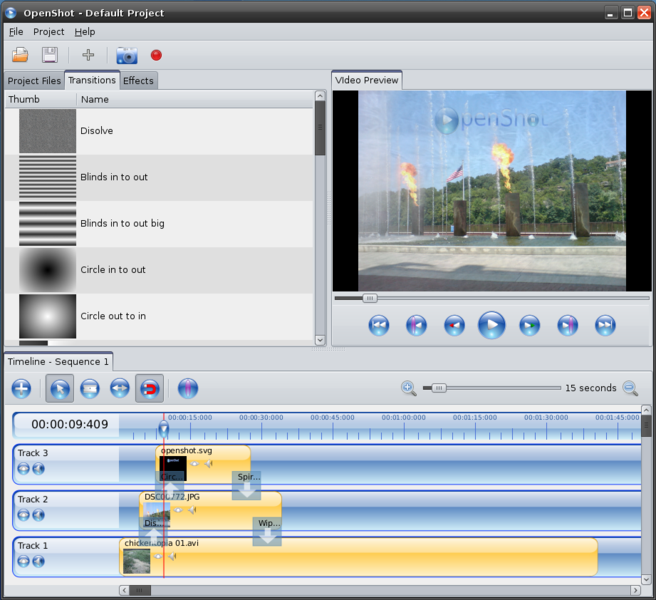
 penShot is a fantastic video editor for those — who like myself — are not video editing experts and cannot afford to spend hours just learning how to use a video editing program.
 But what about all the valuable news stories? Not too long ago DesktopLinux and LinuxDevices went dark. The domains were left to rot and the articles accumulated there for over a decade became inaccessible, essentially deleted from the Web. It has come to our attention, after some inquiries with relevant individuals, that people who contributed to DesktopLinux and LinuxDevices — including the founders — do wish for the content to return online of for the copyrights or the articles to be changed — explicitly or implicitly — such that all the articles can be brought back to the Web by those to whom DesktopLinux and LinuxDevices were important resources or a matter of personal contribution.

 ast year I asked Dr. Stallman to comment on what Ubuntu/Canonical had done with regards to privacy and since then he has expressed his view very clearly, most recently in this video.