Introduction About Site Map

XML
RSS 2 Feed RSS 2 Feed
Navigation

Main Page | Blog Index

Archive for the ‘Science’ Category

Report on Origins of COVID-19

Just when did the covid virus start spreading around the world?

Senator’s report on viral origins

(Richard Burr)

https://www.help.senate.gov/imo/media/doc/report_an_analysis_of_the_origins_of_covid-19_102722.pdf

Section III

China’s early COVID-19 Vaccine Development versus the U.S. Operation Warp Speed

Full genetic sequence, SARS-CoV-2

First posted, global virus database, January 11, 2020

Chinese professor, violated government restrictions

Then

Vaccine developers inserted viral genome into cells to produce viral proteins

Preclinical animal toxicity

Safety and efficacy studies

Human clinical safety and efficacy trials

Commercial scale vaccine production.

Operation Warp Speed

Pre OWS work started on January 11, 2020

E.g. Adenovirus vector vaccines

The AstraZeneca-Oxford, went from sequence to phase I clinical trials in 103 days

(Ebola platform)

J and J was 185 days

Three adenovirus vector vaccines

Pfizer trail started 7th May 2020

Another Chinese vaccine was patented on 24th February 2020

(Brigadier General Yusen Zhou, Academy of Military Medical Sciences)

Question

Did Chinese researchers have access to the genomic sequence before January 11, 2020?

If so, how far in advance of January 11, 2020?

MEP Cristian Terhes

https://www.youtube.com/watch?v=2jTgDj7uiX8

In the case of Pfizer

Submitted a clinical trial that started in 14th January 2020

Three days later Pfizer already started a test for these vaccines

Moderna

Trials since 2017

https://www.modernatx.com/en-US/about-us/our-story

https://apnews.com/article/fact-checking-161756112404

https://www.riotimesonline.com/wp-content/uploads/2022/02/Moderna-Patent-US9587003-B2.pdf

https://patentimages.storage.googleapis.com/01/6e/60/8951ab8f4118b5/US9587003.pdf

Virus shares a sequence of 19 nucleotides with Moderna genome

Part of spike protein
Coincidence or not a coincidence?

(Adenine, Cytosine, Guanine, Uracil)

2019 Compared to 2022 Week 42 (Based on New ONS Numbers): England and Wales Infant Mortality Rose 13%, in Kids Aged 1-14 It Rose 50%

Released a few hours ago:

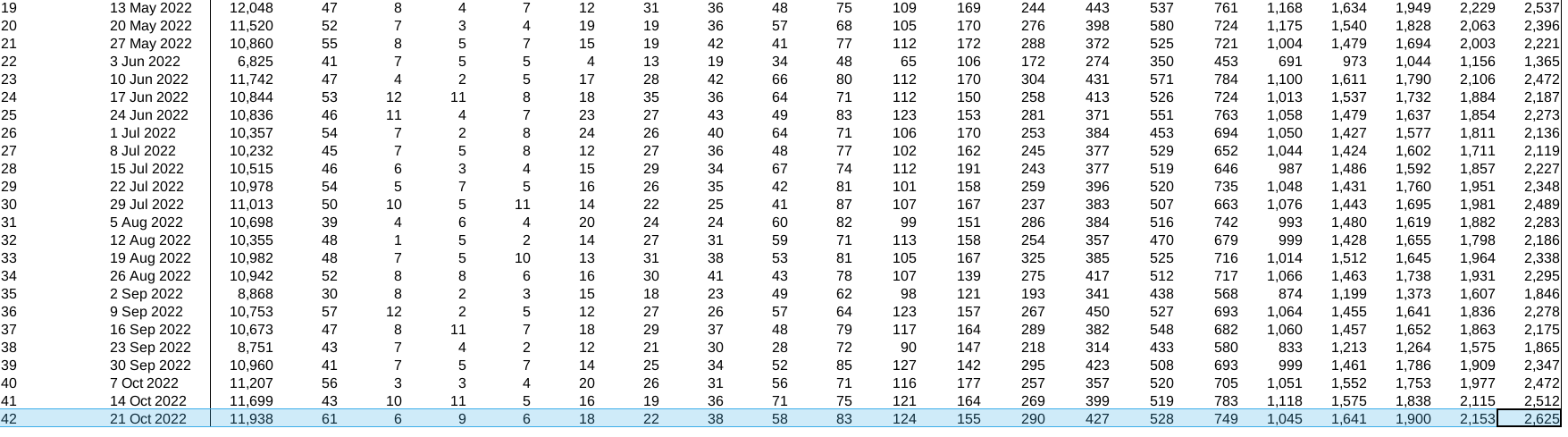
Released week 42

From the same authoritative source but for 2019 :

2019 week 42 by age

Analogous 2019 figures for the same week are a lot smaller.

Comparing 2022 to 2019:
Infant (under 1): 61 compared to 54
Kids (1-14): 6+9+6 (21) compared to 14
Adults (15-44): 18+22+38+58+83+124 (343) compared to 303
Older adults (45-64): 155+290+427+528 (1,400) compared to 1,154
Retired (65-74): 749+1,045 (1,794) compared to 1,628
75-84: 1,641+1,900 (3,541) compared to 2,920
Above 85: 2,153+2,625 (4,778) compared to 4,083

Also see (for the prior week, week 41): England and Wales Increase in Deaths by Age Group: 62% in Children, 12% in Teens, Almost 20% in Adults, and 16% in Old People

Deaths in England and Wales Up 22.74% in Latest Week (New Figures From ONS) Compared to Pre-Pandemic Levels

New data has just been published by ONS. It shows that things continue to get yet worse in terms of increases in mortality. It’s worse now than it was in prior weeks and deaths have increased nearly 23% for the week (compared to pre-pandemic levels).

The data sets were shared here before (we had made local copies), so here’s just a pair/couple of screenshots.

2022 deaths (totals):

ons-week-42

Compare to pre-pandemic:

pre-pandemic

Pre-vaccine fatality rates lower than previously thought

Link

Lower than previously thought

Impact of non-pharmaceutical interventions (NPIs) to reduce COVID-19 mortality and healthcare demand (16th March 2020)

Imperial College COVID-19 Response Team

https://www.imperial.ac.uk/media/imperial-college/medicine/sph/ide/gida-fellowships/Imperial-College-COVID19-NPI-modelling-16-03-2020.pdf

We assumed

Incubation period of 5.1 days

Infectious 12 hours before to 4.6 days after

R0=2.4

Non-uniform attack, applied to the GB population

Result in an IFR of 0.9%

with 4.4% of infections hospitalised

10.4 day stay

30% of hospitalised, ICU (50% death rate)

(not accounting for the potential negative effects of health systems being overwhelmed on mortality)

Age-stratified infection fatality rate of COVID-19 in the non-elderly informed from pre-vaccination national seroprevalence studies

Stanford California, Rome, Montreal

https://www.medrxiv.org/content/10.1101/2022.10.11.22280963v1

40 eligible national seroprevalence studies,

covering 38 countries with pre-vaccination seroprevalence data.

For 29 countries publicly available age-stratified COVID-19 death data,

and age-stratified seroprevalence information were available,

and were included in the primary analysis.

IFRs for 0 to 59 years

median IFR = 0.035%

(IQR, 0.013 – 0.056%)

Without accounting for seroreversion

(average time from seroconversion to seroreversion at 3-4 months)

IFRs for 0 to 69 years

IFR = 0.095%

0 to 19 years

IFR = 0.0003%

20 to 29 years

IFR = 0.003%

30 to 39 years

IFR = 0.011%

40-49 years

IFR = 0.035%

50-59 years

IFR = 0.129%

60-69 years

IFR = 0.501%

At a global level

Pre-vaccination IFR,

may have been as low as,

0 to 59 years = 0.03%

0 to 69 years = 0.07%

Global population

94% younger than 70 years

91% younger than 65 years

86% younger than 60 years

The current analysis suggests a much lower pre-vaccination IFR in non-elderly populations than previously suggested.

Large differences did exist between countries and may reflect differences in comorbidities and other factors.

These estimates provide a baseline from which to fathom further IFR declines with the widespread use of,

Vaccination

Prior infections

Evolution of new variants.

Unmitigated epidemic
(March 2020)
UK deaths = 510,000 (168,913)

US deaths = 2.2 million (1,065,152)

During 2021 and 2022

Vaccination, new variants, prior infections,

resulted in a marked decline in the IFR

New Paper by Aseem Malhotra: Administrating COVID-19 mRNA Vaccines to Young People Increases Risk of Heart Failure

September 2022, Journal of Insulin Resistance: “Curing the pandemic of misinformation on COVID-19 mRNA vaccines through real evidence-based medicine – Part 1″

Astract:

Background: In response to severe acute respiratory syndrome coronavirus 2 (SARS-CoV-2), several new pharmaceutical agents have been administered to billions of people worldwide, including the young and healthy at little risk from the virus. Considerable leeway has been afforded in terms of the pre-clinical and clinical testing of these agents, despite an entirely novel mechanism of action and concerning biodistribution characteristics. Aim: To gain a better understanding of the true benefits and potential harms of the messenger ribonucleic acid (mRNA) coronavirus disease (COVID) vaccines. Methods: A narrative review of the evidence from randomised trials and real world data of the COVID mRNA products with special emphasis on BionTech/Pfizer vaccine. Results: In the non-elderly population the ‘number needed to treat’ to prevent a single death runs into the thousands. Re-analysis of randomised controlled trials using the messenger ribonucleic acid (mRNA) technology suggests a greater risk of serious adverse events from the vaccines than being hospitalised from COVID-19. Pharmacovigilance systems and real-world safety data, coupled with plausible mechanisms of harm, are deeply concerning, especially in relation to cardiovascular safety. Mirroring a potential signal from the Pfizer Phase 3 trial, a significant rise in cardiac arrest calls to ambulances in England was seen in 2021, with similar data emerging from Israel in the 16-39-year-old age group. Conclusion: It cannot be said that the consent to receive these agents was fully informed, as is required ethically and legally. A pause and reappraisal of global vaccination policies for COVID-19 is long overdue. Contribution: This article highlights the importance of addressing metabolic health to reduce chronic disease and that insulin resistance is also a major risk factor for poor outcomes from COVID-19.

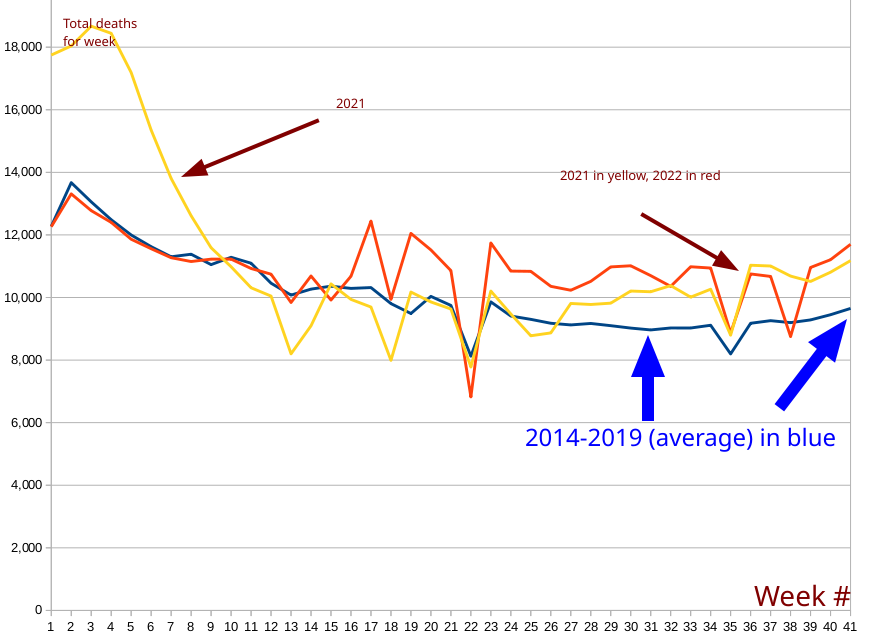
Chart: England and Wales Deaths (Totals) in 2014-2019 (Average), 2021, and 2022

Spoiler: we’re seeing about 2,000 more deaths than usual per week, including in many young people.

Chart: deaths in UK; Week #; Total deaths for week; 2021 in yellow, 2022 in red; 2014-2019 (average) in blue

Chart data and the chart itself (as ODF): # of deaths chart, per week. Data from ONS.

In the United States, Winter Deaths Increased 28% Between 2016 and This Year (But President Biden Insists Pandemic is Over)

CDC is authoritative, but it is curious that it doesn’t wish to give access to data from pre-COVID-19 years (I needed to use the Wayback Machine for that).

Local copy of the data (ODF): VSRR – State and National Provisional Counts for Live Births, Deaths, and Infant Deaths 2016-17 (via Wayback Machine)

January 2016: 246,000 deaths
January 2016: 230,000 deaths
March 2016: 244,000 deaths
Total deaths: 720,000

January 2017: 261,000 deaths
February 2017: 232,000 deaths
March 2017: 249,000 deaths
Total deaths: 742,000

Latest data:

January 2022: 368,000 deaths
February 2022: 288,000 deaths
March 2022: 266,000 deaths (latest month in public record)
Total deaths: 922,000 (28% more than in 2016 and 24% more than 2017)

Also see: CDC Data: US Deaths About 25% Higher This Winter Than Last Winter Before COVID-19 (Updated)

Retrieval statistics: 21 queries taking a total of 0.095 seconds • Please report low bandwidth using the feedback form
Original styles created by Ian Main (all acknowledgements) • PHP scripts and styles later modified by Roy Schestowitz • Help yourself to a GPL'd copy
|— Proudly powered by W o r d P r e s s — based on a heavily-hacked version 1.2.1 (Mingus) installation —|