Introduction About Site Map

XML
RSS 2 Feed RSS 2 Feed
Navigation

Main Page | Blog Index

Archive for the ‘Technology’ Category

Mac OS on Every Machine

Mac OS X

For those who have not followed the headlines, Apple ditched their IBM processors and made a decision to sidle next to Intel. Since Intel represent a Microsoft monopoly to most (most latterly the DRM outrage), the move resulted in flames, as well as isolated loud voices of support.

Quickly after the move, Michael Dell showed interest in shipping Dell boxes with Mac OS X. Steve Jobs (Apple co-founder, CEO) declined any such requests, probably since Apple wish to cash in on overpriced hardware. Yet, quite inevitably, hackers have successfully taken the Intel (x86 architecture) version of Mac OS X and made it possible to install Mac OS X on any box. Consequently, there are many Mac OS bit torrents on the Net at the moment. Some say it is exactly what Apple had at the back of their minds, but Apple strongly deny it, as do other skeptics including myself.

Interfaces Commonality

KDE menu bar
KDE‘s Konqueror menu bar
Firefox menu bar
Firefox menu bar
Firefox is Mac OSX-themed (Download/install)

It is no secret that various software vendors use similar conventions for menu layouts, icons and so forth. As an instance, have a look at the one-to-one correspondence in the screenshots above (Edit, View, Go, Bookmarks, Tools, Help) where even menu accelerators are identical. It is inevitably so because consistency needs to prevail. Users who moves from one piece of software to another must be able to re-orientate quickly by identifying familiar phrases and labels (terminology) or images.

What impact does that have on innovation and diversity though? The most rational interface will not necessary make it easiest for the user to adapt to. For example, Windows users are accustomed to going to “Start” when they want to End the current session. Is that not preposterous? Yet, if this convetion gets changed, this will probably result in confusion.

Software that is most usable is one which implements control interfaces that most users are familiar with. Familiarity of the novice users is influenced by high-impact software such as Windows or Photoshop. Due to the nature of this trend, imitation becomes easier to claim. In fact, this would be one reason for the scare among anti-software patents activists. The main sufferer would be the user who needs to master different distinct interfaces and ends up in a lock-in situation, whereby migration between software packages become an ardonous experience.

Finally, let us consider a practical example where the damage of patents is apparent. Xerox sued Palm for the use of Graffiti — a one-stroke method for inputting text, which they claimed they had patented. As a result, Graffiti 2 (see criticism) emerged so Palm users had to throw away years of experience, learning a new ‘handwriting’ method, which involved 2 strokes rather than just one.

Wi-Fi HotSpot Near You

Wi-Fi map

Americans can take advantage of a database/map of nearby Wi-Fi HotSpots. This Web site, WiFiMaps.com, is of course far from ethically acceptable. Perhaps it will force system administrator to finally change the default, out-of-the-box settings on their routers. It is amazing how penetrable Wi-Fi connections have become.

Related links: (external)

The links above are posted as a word of caution. You must ensure that you are not exposed to such hacks, which probably affect old devices the most.

Dirt-Cheap Computers

European centWould you believe that a base unit with a monitor can be sold for as little as $225? Although there is no mentioning of the O/S and software that is included, buyers can get it all for a mere pittance in India. There are some amazing offers in westernised countries as well. In the UK, for example, a Linux box can be as cheap as 140 pounds ($247) plus tax, albeit it does not include a monitor. From the article in the BBC:

India’s first low-cost personal computer has been launched in the Tamil Nadu state capital, Madras.

Designed by IT firm HCL Infosystems, it is priced at 9,990 rupees ($225) and includes all the basic features required for a first-time user.

There is no mentioning of which operating system is used; the acronym PC is no indicator either.

Evolve or Die

Longhorn

This picture was funnier when Windows Vista was still called Longhorn

It was roughly a decade ago when a mysterious journalism trend emerged. All of a sudden, in a matter of a few years, major newspapers began to migrate their content to the Internet and shield their on-line popularity. A frantic stampede — that was — to what would become the future of journalism. Editors came to realise that it was only a matter of time before readers would take advantage of technology. This new form of publication had very many conceivable advantages:

  • Being able to isolate uninteresting bits from the unmissable (content tailoring)
  • Ability to save article (electronic storage)
  • Reduction in cost (physical properties)
  • The ability to share articles with friends and colleagues (reproducibility)
  • Being able to performs searches (indexing technology)

Whatever gains one can imagine, most likely computers will have them. So, paper was bound to become obsolete sooner or later.

Several years later, particularly in the beginning of this millennium, blogs (Web logs) began to emerge. Suddenly, people had easy access to powerful publication platforms. The growth of blogs in terms of number and amount of content was explosive and their extent soon became excessive. How could a mainstream newspaper keep up with blogs and attract the masses? Journalists became threatened. Later came he feeds frenzy, which unlike blogs, has not reached its anti-climax, yet. Soon enough, operating systems (as we know them) might be put aside in favour of on-line operating systems. So who will be the next victim if not Microsoft? And who will it be that inherits the Earth? Google and Yahoo are among the contenders. For Microsoft, who have made many enemies, the last resort has become software patents, which they are piling up like connonballs for application at the Patents Office.

Slow movement towards on-line data management has been well-comprehended by all fronts. Microsoft attempt to conquer the Net as they are investing a heavy load of resources to reach that goal. From this site alone, MSNBot fetched 13968 pages, trailing by just a decent margin behind Google with 20627 pages in the month of July. Without a doubt, Microsoft have gained plenty of bandwidth and computer power.

It was not long ago that Bill Gates gave his engineers just 100 days to steal Google’s idea of AJAX-enabled maps (satellite and hybrid maps too). In response to Mozilla Firefox, which kept Microsoft on their toes, a decision was make to update rusty Internet Explorer 6 and leap to Internet Explorer 7. Not surprisingly, many ideas were stolen from Firefox, which was considered the main danger at the time.

Later on, Microsoft decided to embed RSS support in the kernel of Windows Vista (formerly Longhorn). Again, this step was taken in order to compensate for the considerable lag behind some recent technologies. Gates et al. were then scheming to buy off popular bloggers — a shrewd idea due to general Microsoft disdain in popular and influential blogspheres. The main complaints of bloggers, along with some major voices in the media, was the lack of inter-operability, being proof that Microsoft are patronising the rest of the IT world with utter platform discrimination. They simply fail to internalise that it is nice to be important, but even more important to be nice (open).

Is Nintendo Dying?

Super Mario

Nintendo’s profits are down by nearly 80% so worries about Nintendo’s vocation begin to resurface. The giant game maker has high sentimental value to many, including myself. Above is a screenshot that I took weeks ago while playing the classis Mario series from Nintendo.

Returning to the dysphoric news:

Reuters Japan passes on word from Nintendo of a 78.5% reduction in operating profits for the quarter ending June 30. Speculation from the news service on the reason for the drop makes perfect sense – the GameCube doesn’t have enough exclusives, first-party and third-party, and sales of GBA SP and GameCube have been declining.

Bill Gates Photos

Bill Gates
Female fan: “Oh, Bill, your floppy is so long

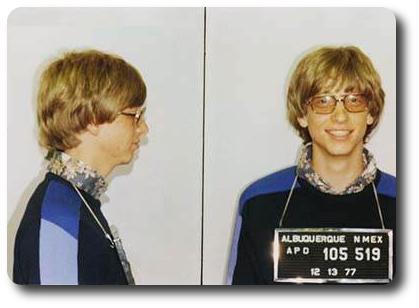
When there is nothing particularly interesting to post, the typical blogger will publish a photo. Shown above is Bill Gates posing for a teen magazine in 1985. The photo below is from WikiMedia.

Bill Gates dancing
When nobody else is in the room, I sometimes get jiggy with it

Retrieval statistics: 21 queries taking a total of 0.081 seconds • Please report low bandwidth using the feedback form
Original styles created by Ian Main (all acknowledgements) • PHP scripts and styles later modified by Roy Schestowitz • Help yourself to a GPL'd copy
|— Proudly powered by W o r d P r e s s — based on a heavily-hacked version 1.2.1 (Mingus) installation —|