Introduction About Site Map

XML
RSS 2 Feed RSS 2 Feed
Navigation

Main Page | Blog Index

Archive for the ‘Windows’ Category

Things That Microsoft Will Have You Believe

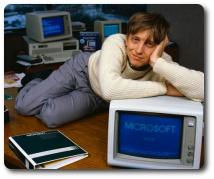
Bill Gates
Will such folks ever lie to you???

DIVERSION from the truth has been one of Microsoft’s greatest strengths and marketing techniques for decades. Here are the most recent examples, accumulated over the past couple of days alone:

  • Microsoft “re-launch” or “unveil” a shiny, brand-new search engine, to reside on a new domain. This hype-driven drivel (e.g. “MSN is twice as good as Google”) sounds better than “we have improved our rusty search engine slightly”, right? Microsoft pulled the same trick a few years back, arguing that MSN had been re-invented to incorporate major innovation (all in vain of course). Such overstated facts are intended to attract curious Web surfer, nothing more. It is an enticement, which is sometimes backed by financial rewards too.
  • Arguably, the following was alluded to by Windows advocates: Do not attempt to take Linux Live CD’s for a spin as they can destroy your computer. Such calls for ejection were deterring Windows users from seeing something else and carry on with an installation and progressive platform migration. Fortunately, some ‘penguins’ (not ones with a beak and a tuxedo) have taken matters into their own hands.
  • OpenOffice 2 is 10 years behind, according to Mr. Yates of Microsoft. Lo and behold: another FUD campaign which indicates that Microsoft’s revenue suffers. Similar dirty tactics were embraced as means of halting the momentum of Linux servers sales. Merely everyone knows the false and controversial campaign that followed. A Google search for ‘linux’ still puts microsoft.com at the top, owing to a sponsored link paid for by the Dark Forces. Such conflicting search results have led to lawsuits in the recent past. I still await Google’s rectification of such shameful fiascos. Lastly, let us remember paid forum members that advocated Windows.

Microsoft can try hard to conceal their past lies, but a few journalists, observers and professionals will never forget.

Windows-Linux Emulation and Transition

WINE is one among various projects that enable Windows programs to run on Linux and other UNIX derivatives. While Wine is probably the most mature and best known ‘emulator’ (WINE truly stands for Wine Is Not an Emulator since it uses an abstraction layer cunningly), there is also the commercial tool called Win4Lin, which snatched a few headlines recently.

The Wine team has just released another version of their software, as reported by broad media, The Inquirer included.

The people behind Wine, some clever software that tries to get Windows to run on Unix and Linux machines, have released another version.

Wine is a translation layer capable of running Windows applications on Linux and other POSIX compatible operating systems.

It seeks to get Windows programs running in Wine to behave normally, without suffering the performance problems of an emulator.

On top of it all, IBM have recently become obliged to OpenDocument, which eliminates Microsoft Office dependencies. No wonder IBM are perceived as the most daunting rival to Microsoft. IBM further ease the transition from Windows to Linux (and Java), either by using portability through IDE packages for Linux (Mono) or by teaming up with other companies. This makes any transition and penetration to Linux as smooth as necessary, even without prior familiarity with Linux. Windows becomes a a transparent layer, much like a man on laxatives and milk!

Related item: Free Emulators

A Monoculture that Could Never Survive

Windows XP
Yet another day in La-La Land®

FILLED with frustration over some recent rotten conducts, I once assembled a few streams of consciousness to compose a bitter essay. It was saturated with citations on the way Microsoft continues to exploit its desktop monopoly-like state-of-affairs. I titled the essay On Operating Systems Monoculture and it spanned 4 pages. Today I would like to elaborate on that matter, whilst venting some anger (rant alert) and pointing out facts that Microsoft prefer to hide from their users, owing to Vista’s prematurity.

In a world where a desktop monopoly prevails, there is also mental manipulation of minds. Innocent people are (mis-)led to believe they are IT-proficient when they manage to change font size in Word. Skills are not sufficiently generalised and MSCE qualifications are a glaringly-obvious example of this. Advice must be taken from people who live in a broader reality and are neither delusional nor biased.

To take an overview, as well as a look into the future, Microsoft continue to use dirty tactics to push away any type of rivalry. They also propagate some hackney myths. Microsoft cried “Wolf” whenever someone criticised Windows Vista. Yet, based on some recent screenshots, Vista Starter Edition will allow only 3 processes to run at any one time. It is one among the numerous ‘penalties’ that will force a paid-for upgrade.

Then comes the issue of desktop environment visualisation. Graphics in Vista are unimpressive, assuming Aero cannot be run. Aero is the glass-like component in Vista’s window rendering, which enables translucency (as in Linux and Mac OSX). Aero is estimated to be properly-supported by 50% of today’s hardware. So, is Microsoft taking a step backwards, both in terms of hardware support and functionality? Even when Aero is enabled, it offers nothing out of the ordinary. LiteStep can already enrich the looks of Windows, so Vista offers nothing innovative. Aero only suffocates the CPU. The 3-D effects make the system choke. Vista is the same product which is known as XP Service Pack II (or Windows Server 2003), but it was put in a new dress. It is no surprise given the recent major fallback in terms of the codebase.

Microsoft employ a famous composer to work on sounds in Vista. Judging by what the O/S has to offer and rave about, Microsoft could take the easier route and just go with Mozart’s Requiem. It may soon be “Hasta la Vista“.

Vista Encryption and Back Doors

LockAccording to a recent article from the BBC, there was collaboration involving the British Government and Microsoft — collaboration over getting the back door to Windows Vista.

In jeopardy: people’s privacy, on thier own workstation.

The controversy: encrypted filesystems made futile due the ability of governments to penetrate them. Government were said to be liaising with Microsoft, which could theoretically provide a ‘master key’. In turn, Microsoft denies any such claims.

Windows Vista won’t have a backdoor that could be used by police forces to get into encrypted files, Microsoft has stressed.

‘Origami’: Ultraportable PC?

iPod head
Can Origami become an iPod killer?

WE are all yet to hear about “Origami”. It is now at its ‘rumour stage’, but it is said to be a revolutionary piece of equipment from Microsoft. “Origami” could probably a miniature wearable (thus the name) hardware that is connected to a centralised network. CNET have some details.

Like Slashdot and other blogs and online forums, we, too, are getting tips about a new Microsoft concept gadget codenamed “Origami” that we understand is sort of a “Mini Me” PC.

The Misjudged Security Model

Bill Gates

BILL Gates comes from a dynasty of businessmen and politicians. Over the years he was trying to commercialise software and nowadays he monopolises it. So what gives?

Commercial software companies liquify no assets into cash. They merely sell binaries (not even code) and offer little or no direct customer support. Accruing profits in such a matter is just lush, but is it acceptable at all? Is the final product doing what ‘it says on the tin’? Often it is not the case. Microsoft will soon sell a product to fix yet another broken product of theirs, which is absurd. Rather than offer refunds and benefits, which somehow compensate for a broken operating system, more money is extracted from the customer.

The above leads to serious questioning. Such marketing tactics do not appeal to anyone but the obedient Microsoft programmer whose understanding of hacking is flawed and often inexistent. That perhaps is why Windows fails to cope with that vital aspect which is security. That is why minor DDOS attacks pose a big threat to Windows servers, machines get hijacked and remote execution of code has become worryingly prevalent. Planting of programs and vandalism from afar is a face of evil that continues to take place. And yet, only few among us choose to blame the real culprit — Microsoft software.

Proprietary Formats and Their Sordid Mess

OPEN formats are based upon a standardised specifications, which ensure global collaboration among applications. Without common formats, hardware are software are simply unable to communicate, unless they come from the same vendor. Formats are also analogous to the notion of a language, or technically speaking, “protocols” and “standards”. They are often agreed upon by an ample panel, which involves industry experts and industry/academy leaders.

What happens, however, when a company goes astray and implements its own formats, which it is unwilling to disclose for competitive reasons? What happens when a format is extended without acceptance by others who already use and depend on it? When common language is violated, disaster is foreseen. An industrial majority (or a monopoly) can use miscommunication as a ‘tool’ which drives competitors away. The temptation to use that tool as a weapon is often there, yet the seminal formats must always be honoured. If not, conversion facilities must be made available, so that a non-lossy route can be followed to ‘sanitise’ the unknown data structures and appendages.

LockI have already complained about proprietary formats that lock one’s personal data. The context in this blog was Palm-powered devices, as well as software packages from Microsoft. It is a terrible scenario when one chooses an appliance or a software package over open formats and is thereafter obliged to use it perpetually. It is an utter lock-in, which has even reached the Web that is openness-motivated. Internet Explorer-only beame more commonplace, yet Firefox has shouted out for a change in recent years.

Let us illustrate the primary contention with the aid of yet another specific example. In question are the advantages of open fromat and exportable data, so let us consider address book (contacts) data on a variety of platforms. I currently hold my address books on Palm’s Address, KDE’s KMail, and Mozilla Thunderbird. Maybe I base my statements on the wrong factors, but experience shows that address confusion and poor organisation skills are prevalent among those that still rely on Microsoft to organise and manage their data. I used to be among those who delegate data organisation to applications (packages) rather than formats. As a consequence, I struggled to move between application, inter-operate or even decipher my own data in the absence of one particular commercial application. Sounds familiar?

In summary, as food for thoughts to ponder: maybe it’s the obscurity of moving data without adherence to standard formats. Maybe it is the lack of import/export utilities and maybe frequent hard-drive re-formatting due to virus attacks and the like. Either way, Linux and Mac users appear to have extensive data which is easily-locatable, inter-changeable, rocoverable and resilient. Openness entails true benefits, which are better understood in the long term.

Retrieval statistics: 21 queries taking a total of 0.085 seconds • Please report low bandwidth using the feedback form
Original styles created by Ian Main (all acknowledgements) • PHP scripts and styles later modified by Roy Schestowitz • Help yourself to a GPL'd copy
|— Proudly powered by W o r d P r e s s — based on a heavily-hacked version 1.2.1 (Mingus) installation —|