Introduction About Site Map

XML
RSS 2 Feed RSS 2 Feed
Navigation

Main Page | Blog Index

Saturday, November 19th, 2022, 8:25 pm

Treating People Like Lepers

Just released:

Description: (in case the video is removed in the future; the author has been cautioned by Google already)

G20 Bali Leaders’ Declaration

Argentina, Australia, Brazil, Canada, China, France, Germany, Japan, India, Indonesia, Italy, Mexico, Russia, South Africa, Saudi Arabia, South Korea, Turkey, United Kingdom, United States, and European Union.

https://www.consilium.europa.eu/en/press/press-releases/2022/11/16/g20-bali-leaders-declaration/

https://www.whitehouse.gov/briefing-room/statements-releases/2022/11/16/g20-bali-leaders-declaration/

Part 22

We recognize that the extensive COVID-19 immunization is a global public good

Section 23

We recognize the need for strengthening local and regional health product manufacturing capacities

We support the WHO mRNA Vaccine Technology Transfer hub

We acknowledge the importance of shared technical standards and verification methods,
to facilitate seamless international travel,

interoperability, and recognizing digital solutions and non-digital solutions,

including proof of vaccinations.

Establishment of trusted global digital health networks,

that should capitalize and build on the success of the existing standards and digital COVID-19 certificates.

Part 24

The COVID-19 pandemic has accelerated the transformation of the digital ecosystem and digital economy.

We recognize the importance of digital transformation in reaching the SDGs.

We also reaffirm the role of data for development, economic growth and social well-being.

G20 update

https://www.g20.org/wp-content/uploads/2022/11/2022-G20-Bali-Update.pdf

“Endeavour to move towards interoperability of systems including mechanisms that validate proof of vaccination,

whilst respecting the sovereignty of national health policies,

and relevant national regulations such as personal data protection and data-sharing.”

Indonesia’s Minister of Health Budi Gunadi Sadikin

G20 countries should adopt digital health certificate using WHO standards

Let’s have a digital health certificate acknowledged by WHO — if you have been vaccinated or tested properly — then you can move around

(next World Health Assembly in Geneva)

WHO seem to be on it already

https://www.who.int/publications/i/item/WHO-2019-nCoV-Digital_certificates-vaccination-2021.1

Digital documentation of COVID-19 certificates: vaccination status: technical specifications and implementation guidance, 27 August 2021

Use of scan codes

Klaus Schwab, World Economic Forum (WEF) Chair

Attended

From a doctor in Austria

It is currently a very emotional situation in my hospital

(and in general in hospitals in Austria)

because many of us in the health care sector are more or less forced to get a fourth vaccine dose.

Even in my case as a physician who has received three doses and one infection just 6 months ago.

The rule is that if the last vaccination is more than one year and/or the last infection is more than 6 months ago you either have to test all 72 hours or to get an additional vaccine dose;

if not you are at risk of having to pay 500 to 3600 Euros and may even get fired.

Vaccine passports

https://lc.org/newsroom/details/111722-world-leaders-agree-to-implement-vaccine-passports-1

Thursday, November 17th, 2022, 10:38 pm

New Study on Vitamin D and COVID-19

Description:

Association between vitamin D supplementation and COVID-19 infection and mortality

https://www.nature.com/articles/s41598-022-24053-4

(12th November 2022)

Johns Hopkins
University of Michigan
National Bureau of Economic Research
Department of Medicine, University of Chicago
Department of Veterans Health Affairs
Department of Medicine, University of Chicago, Chicago

Vitamin D deficiency, associated with reduced immune function,

can lead to viral infection

Vitamin D deficiency, associated, increases the risk of COVID-19

But is it a treatment / prognosis improver?

Population of US veterans, we show that Vitamin D2 and D3 fills

Associated with reductions in COVID-19 infection

After applying all restrictions

220,265 supplemented with vitamin D3

34,710 supplemented with vitamin D2

407,860 untreated patients.

Study design

Retrospective cohort

Supplemented (before and during the pandemic),

versus untreated controls

One to one matches

D2, D3, or calcifediol

Veterans Administration Corporate Data Warehouse (CDW) electronic health records.

Vitamin D levels typically respond to treatment following two months of exposure

D3 cohort

COVID-19 rates for the treated = 2.66%

COVID-19 rates for the untreated = 3.30%

D3 20%, reduction

D2 28% reduction

Mortality within 30-days of COVID-19 infection

Infection ending in mortality within 30 days

D3 group

Treated group death rate after infection = 0.23%

Untreated group death rate after infection = 0.35%

Vitamin D3 33% mortality lower (HR, 67%)

P? less than ?0.001

Vitamin D2 25% lower (HR, 75%) (but not significant)

Veterans receiving higher dosages of Vitamin D obtained greater benefits from supplementation than veterans receiving lower dosages.

Vitamin D blood levels between 0 and 19 ng/ml,

exhibited the largest decrease in COVID-19 infection and mortality following supplementation

(0–19 ng/ml, 20–39 ng/ml, and 40?+?ng/ml)

Dosage options, 20 IU, 40 IU, 100 IU, 125 IU, 200 IU, 250 IU, 400 IU, 500 IU, 800 IU, 1000 IU, 2000 IU, 5000 IU, 8000 IU, and 50,000 IU

Black veterans received greater associated COVID-19 risk reductions, with supplementation than White veterans

As a safe, widely available, and affordable treatment, Vitamin D may help to reduce the severity of the COVID-19 pandemic.

More background

Vitamin D insufficiency and deficiency affect approximately half of the US population,

with increased rates in people with darker skin,

reduced sun exposure,

people living in higher latitudes in the winter,

nursing home residents,

and healthcare workers

Populations with low levels of Vitamin D have also experienced higher rates of COVID-19

New mechanism

Vitamin D is needed to allow T helper cells to control and reduce Interferon gamma (IFN-?) production

Conclusions

These associated reductions in risk are substantial and justify more significant exploration and confirmation using RCTs.

This is particularly important given the high rates of vitamin D deficiency in the US population and COVID-19.

Extrapolate, D3 supplementation to the entire US population in 2020

4 million fewer COVID-19 cases (19,860,000 actual cases)

116,000 deaths avoided (351,999 actual deaths)

Given our findings,

the absence of severe side effects,

the widespread availability of vitamin D3 at low cost,

vitamin D3 presents a unique opportunity to reduce the spread and severity of the COVID-19 pandemic.

K2, MK-7

Supplement, probably 100 micrograms per day

Nato, 1,000 micrograms per 100 g

Cheese, typically 50 micrograms per 100 g

Safe and effective

UK, GP incentives to vaccinate

Home, £30

Standard reimbursement to Primary Care Networks (which then gets passed to GPs) £15

New contract, £12.58 each

Lawrence

I have heard that Dr. John Campbell is in the pocket of Big Overhead Projector Lobby.

Rumour is that he has accepted tens of dollars of under the table expenses.

Anyone else notice that he always seems to have an endless supply of A4 paper and fountain pens?

Tuesday, November 15th, 2022, 11:01 am

ONS Official Data: Deaths Rose in All Age Groups

Data for week 44 (2022): England and Wales: Deaths Up 21% Compared to Pre-COVID-19 Levels, Based on Data Released Only Moments Ago

Comparing this year to 2019 (total number of deaths):

Age under 1: 47 this year, 45 in 2019
Ages 1 to 14: 16 this year, 19 in 2019
Ages 15 to 44: 333 this year, 289 in 2019 (15.2% increase)
Ages 45 to 64: 1395 this year, 1196 in 2019 (16.1% increase)
Ages 65 to 74: 1816 this year, 1663 in 2019 (9.2% increase)
Ages 75 to 84: 3448 this year, 2938 in 2019 (17.4% increase)
85 up: 4740 this year, 4014 in 2019 (18.1% increase)

Conclusion: it seems like all adults (15 or over) are affected almost equally. Deaths rose by about 15%. This isn’t based on some subsample or random sample; it’s the complete data, which us very large.

Tuesday, November 15th, 2022, 10:24 am

England and Wales: Deaths Up 21% Compared to Pre-COVID-19 Levels, Based on Data Released Only Moments Ago

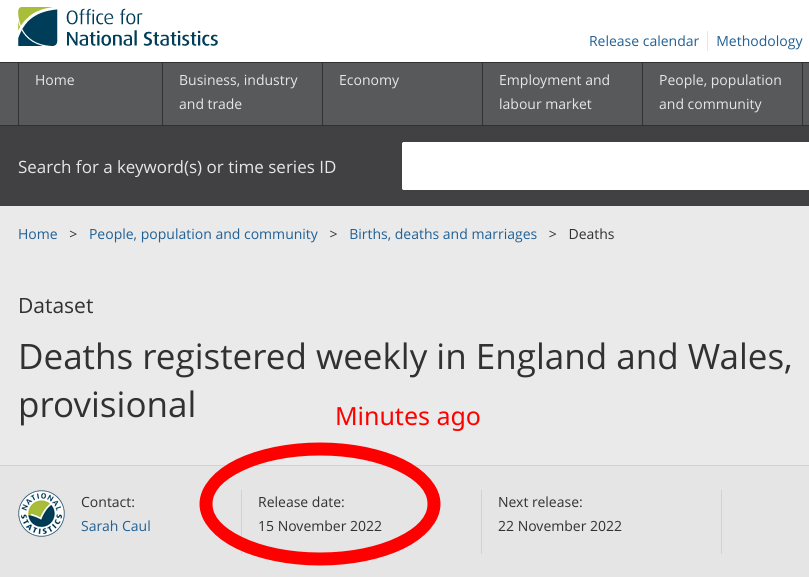
Minutes ago ONS released these new numbers, which I’ve been eager to see for days (also refreshed the page once in several minutes), having examined closely some troubling trends since the summer. Here’s the update:

Minutes ago ONS

We’ve made a local copy as OpenDocument Format (ODF).

For comparison’s sake, here are the latest numbers:

UK week 44 in 2022

Week 44 deaths in 2019:

Week 44 deaths in 2019

11795 (this year) – 9777 (pre-COVID 5-year average) = 2018 or 20.64%.

Monday, November 14th, 2022, 4:14 pm

Office for National Statistics Makes It Hard to Demonstrate Increase in Heart Failures

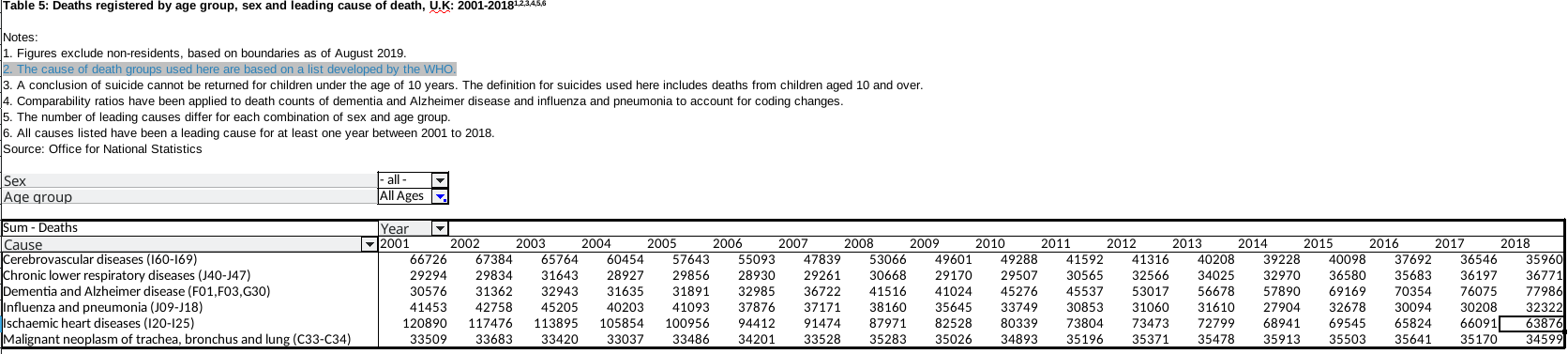
As per these pre-pandemic numbers, the causes of death across the UK look like this:

Disease death range of years

This should be self-explanatory. The data is here as ODF.

2022′s breakdown by causes is framed rather differently, which makes comparison difficult (maybe intentionally).

2022 cause of death

The corresponding Web page does not specify totals per cause. The hypothesis here is that there’s a correlation between the increases in heart attacks or other cardiac events. Some are fatal.

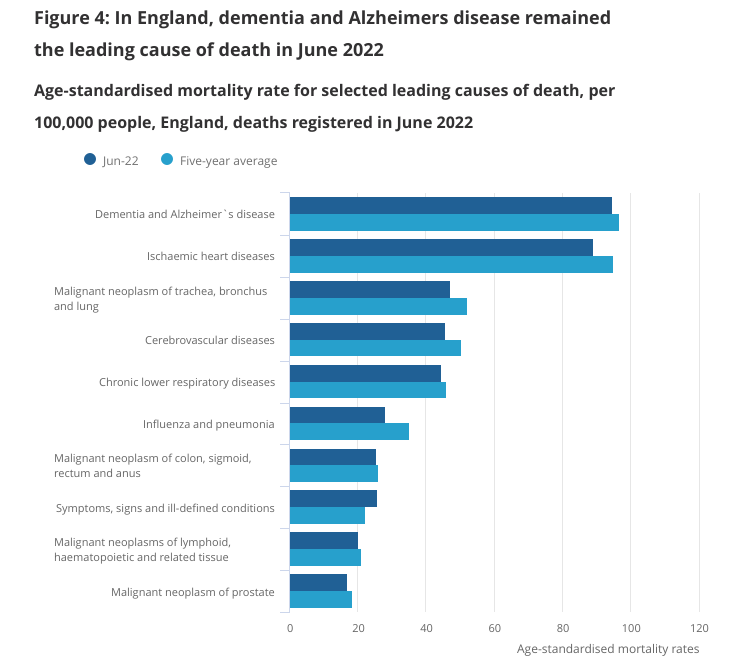
An earlier report said that “leading cause of death in England in June 2022 was dementia and Alzheimer’s disease (10.8% of all deaths); in Wales, the leading cause was ischaemic heart diseases (10.7% of all deaths).”

So there’s somewhere around 11%. This is for June:

Cause of death in June

To quote some more:

In the first six months (January to June) of 2022, the leading cause of death in England was dementia and Alzheimer’s disease (107.7 deaths per 100,000 people). In Wales, the year-to-date leading cause of death was ischaemic heart diseases (116.8 deaths per 100,000 people).

In England, the year-to-date COVID-19 mortality rate decreased to the fifth leading cause of death (46.7 deaths per 100,000 people) from the third in May 2022. This was statistically significantly lower than the top two leading causes of death (dementia and Alzheimer’s disease, and ischaemic heart diseases), and significantly lower than four of the other seven leading causes.

In Wales, deaths due to ischaemic heart diseases, and dementia and Alzheimer’s disease were also the top two leading causes of deaths. They were statistically significantly higher than any other cause of death. Deaths due to COVID-19 decreased to the sixth leading cause of death in the year-to-date (46.9 deaths per 100,000 people), from fourth in May 2022. This was significantly higher than all leading causes ranked lower.

So about 1.17 in 1,000 people died with “leading cause of death [being] ischaemic heart diseases” in the first 6 months.

The tendency to release in such inconsistent presentation forms (or presenting different kinds of data) makes one wonder if the motivation is to hide something. Why should it be so hard to figure out how many people died annually from heart failure before and during the pandemic?

Monday, November 14th, 2022, 3:43 pm

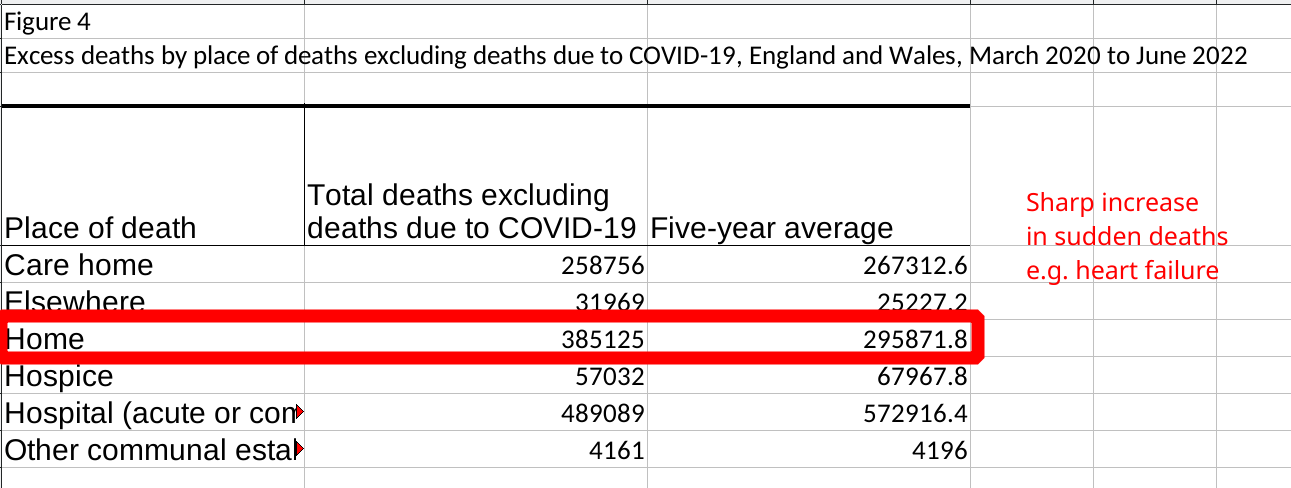
An Emergent Pandemic of Sudden Deaths in the UK (People Dying at Home)

Sharp increase in sudden deaths e.g. heart failure

ONS has released this data, but it left out pertinent numbers for the past 5 years so we cannot compare pre-COVID-19 and pre-vaccination numbers to this year’s huge figures.

Remember that the 5-year average includes 3 years of pandemic and only 2 years pre-pandemic. This can be misleading, giving a false sense of progress.

Monday, November 14th, 2022, 3:32 pm

Coronavirus (COVID-19) Deaths: Open Data as OpenDocument Format (ODF)

Coronavirus (COVID-19) latest insights: Deaths

It’s good that this data has been published, but the Office for National Statistics (ONS) foolishly or inadvertently (certain inadequately) favoured proprietary Microsoft formats instead of open standards. Here are the data sets in a free format:

  1. Deaths involving COVID-19 decreased in the UK
  2. The proportion of deaths involving COVID-19
  3. Mortality rates due to COVID-19
  4. Deaths by age
  5. Pre-existing health conditions
  6. And obesity as factor
  7. Excess deaths
  8. Private homes death location
  9. COVID-19 and flu deaths
  10. Evidence that average age of death is lower for COVID-19 than flu and pneumonia

Real-time Posts

Posts by @schestowitz

Retrieval statistics: 23 queries taking a total of 0.112 seconds • Please report low bandwidth using the feedback form
Original styles created by Ian Main (all acknowledgements) • PHP scripts and styles later modified by Roy Schestowitz • Help yourself to a GPL'd copy
|— Proudly powered by W o r d P r e s s — based on a heavily-hacked version 1.2.1 (Mingus) installation —|