Thursday, January 17th, 2013, 4:27 pm
Medivasc Ltd.
 Filed under:
 side project of mine, FXI/Medivasc, has a new Web site with some new layout that incorporates animation. I only used Free software to produce all the graphics.


|
|


Navigation |
side project of mine, FXI/Medivasc, has a new Web site with some new layout that incorporates animation. I only used Free software to produce all the graphics.
 he following show covers many of the key issues people must be aware of if they ever wish to know what caused the fiscal crisis, which is actually a passage of wealth from the poor and the middle class to those who cheat the system, and are typically already highly affluent. This audiocast is not a time waster.
Here is some background on William K. Black.
On interacting with various file servers or client servers as through they are local
 ometimes we may wish to allow users, logged in remotely (away from their main workstations) or wishing to connect to another host where essential files are located, to access those files. A convenient way to achieve this without proprietary protocols is SSH in SCP ‘mode’, meaning that OpenSSH is being used to gather information about remote filesystems and pass files across the network upon demand. There is a convenient ways to manage this in UNIXy file managers These are unified by the universal command-line syntax, but the front ends may vary and be based on Qt, GTK, etc. Here is a demonstration of how it is to be achieved in Dolphin (KDE) in order to remotely log in to an SSH-enabled (running
 sshd) host.
File managers typically have an address bar, which in simplified interfaces are not editable unless one clicks the universally-accepted CTRL+L (for location), which then replaces a breadcrumbs-styled interface with an editable line. Here is an example of Dolphin before and after.

Now, enter the address of the server with the syntax understood by the file manager, e.g. for KDE:
fish://[USER name]@[SERVER address]
One can add ":[DIRECTORY path]" to ascend/descend in the accessed server.
The syntax is the same for Konqueror and a few other file managers, with the exception of the “fish://” part, which is handled by kio. Here is what the password prompt/dialogue may look like.

Syntax may vary where the protocol, SSH in this case, is specified, but the port number if always the same and Nautilus can handle this too. Once the remote filesystem is shows like a local file system it can be dragged into the shortcuts pane, bookmarked, or whatever the file manager permits for fast access, including the facility for remembering the password/s (handled by kwallet in KDE).
I have installed Nautilus to document the process for Nautilus as well.
The process can be done with the GUI in Nautilus. This is to be achieved slightly differently and it take a little longer. Here are simple steps:
Step 1
Open Nautilus (installed under KDE in this instance, using Qt Curve in this case).

Step 2
Collapse the “File” menu.
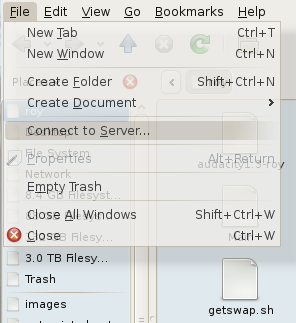
Click “Connect to Server…”
Step 3
Choose SSH, unless another protocol is desired in this case.

Step 4
Enter the server name (or IP address). Optionally enter the port number (if different from the standard port for this protocol), path (called “Folder”) and of course the username (“User Name”). Shortcuts can be created by using the options beneath.
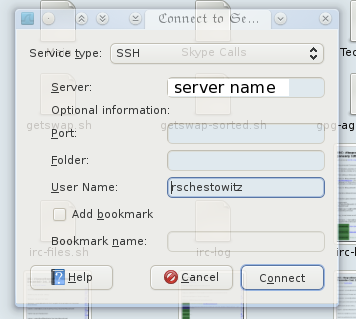
Step 5
Finally, enter the password and access is then granted.
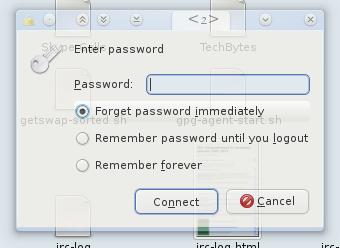
By keeping passwords in memory or disk one can more rapidly and transparently access the remote drive again, reaching files seamlessly.
This is where a lot of power can be derived from the above process. Using KIO slaves in KDE, for instance, files can be opened as though they are stored locally and when an application saves (applied changes) to those files, KIO will push the changed file into the remote file store (working in the background). This means that headless servers can be interacted with as though they are part of the machines that access them. No need for X Server, either. Since many machines out there are configured to be minimal (no graphical desktop), this sure proves handy.

new site I’ve launched, Maria Chain, uses a blogging software, WordPress, to act as a sort of photos gallery. This is the first time I set up such a Web site, presenting an artistic portfolio using WordPress.
Just uploaded. This site was down for longer than 12 hours last night (scheduled) while the server was being rebuilt.
Retrieval statistics: 23 queries taking a total of 0.091 seconds • Please report low bandwidth using the feedback form
Original styles created by Ian Main (all acknowledgements) • PHP scripts and styles later modified by Roy Schestowitz • Help yourself to a GPL'd copy
|— Proudly powered by W o r d P r e s s — based on a heavily-hacked version 1.2.1 (Mingus) installation —|

