Wednesday, January 18th, 2012, 8:09 pm
Increase in Number of Points in GMDS for Classification Purposes
 Filed under:
 GMDS for surface pairs comparison
 S natural succession to the previous experiments, I compromise speed and increase the number of points in GMDS from 10 to 50, hoping to see performance improved noticeably. So far, based on results that are coming out, no classification mistakes are being made, but more pairs need to be tested overnight before meaningful conclusions can be drawn.
As expected, increasing the number of points in GMDS helped improve performance, at the expense of speed of course.
They will now be increased even further to see how good an improvement can be made.
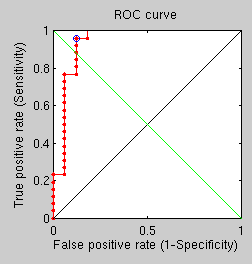
I have begun running GMDS-based recognition experiments with 300 points rather than the originally/already-tested 50. So far, based on 18 pairs, the classification is perfect (albeit the process is slow). It will be interesting to see how long it runs before the first error occurs. There was a talk back in December about a new server potentially arriving, with a lot more x86 cores in it.
Following the first mistake of the classifier, the ROC curve looks like this.

The next step doubles the density of the triangulation to see how major an improvement in performance it can entail (we never tried as many as 8,000+ vertices in such experiments).
With ~8,050 vertices the results are a bit baffling. Both computational servers got rebooted midway (memory upgrade), so there is not much data — to say the least — to base these results on.
By summing up all the GMDS stress (multiple iterations) we get iffy results.
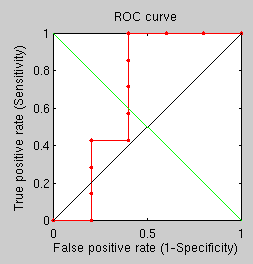
By taking the optimal fit (over all iterations) we get something better.

In summary, despite the small size of the sample, it does seem to suggest that using a triangulation too dense leads to poor results or does not lead to optimal performance. I’ll explore other route towards improvement; adding density just slows things down considerably.



 INYURL used to be one among few services that shortened long URLs for people (snipurl was another). These services would typically be used only when a URL was exceptionally (and perhaps irregularly) long — to the point of being incompatible with some mail/news readers. The landscape has changed somewhat and nowadays, with people becoming lazy and phone-tied, folks assume that original URLs don’t matter, even though they indicate their source, their date, and perhaps title as well, at least most of the time (if properly designed at CMS level). URLs are not merely barcodes, their visibility contributes a lot toward expectation and even the ability to recover broken URLs in the future (based on their source or title). Now that every John and Jane creates his or her own shortener, there is less incentive to keep those services up in the long run, especially once they drive a lot of ‘legacy’ traffic and do nothing for revenue (mere redirections). As the creator of the World Wide Web put it about a year ago, there is also the danger that authorities of TLDs will sooner or later be misusing their power to censor some popular shorteners and immediately break a whole lot of linkage, upon which much of the Web is based. In a sense, short URLs break the Web, but when there are limitations on the number of characters in services like Twitter, people are pressured to use them, even by default.
 OOGLE decided to hop on that whole “social” and “Web 2.0″ bandwagon by further destroying channel views in YouTube, replacing with arguably “simple” layout what people were already accustomed to. There is a parallel migration permitting people to stick to the old layout, but that won’t last for long. It’s merely a grace period, intended to calm down resentful users of YouTube.
 F YOU are not worried about what you search for and how you surf the Web,
  ordPress is a leading (probably “the” leading) blogging platform and it is also used extensively as a CMS, even in my business. I run about 10 WordPress sites and I take pleasure in the fact that it is GPL-licensed, community-supported, and managed by very cool and Free software-friendly people.