Executive summary: One has to be fortunate to get set up with an Internet Service Provider (ISP) within days, must prepare for dozens of agonising hours as average/worst case scenario
 wanted to have my Internet connection sorted out upon my arrival at the new apartment. I really did. Weeks before moving in I repeatedly asked everyone involved to leave the connection working and do the pass-over in the simplest way possible. It could not be so simple though. You see, the UK (and perhaps other countries too) has this funny procedural complexity which means that in addition to having to reassign accounts, e.g. closing one account, returning equipment, then opening another account and deploying similar equipment, there is a need to rent a line from BT. People here will attest to the experience of spending up to a month (if not more) trying to get an Internet connection running. If they feel unhappy with their current supplier — and some are said to be so atrocious that even weeks off-line is a worthwhile and acceptance exit barrier to cross — a switchover is likely to occur over and over again. Barking mad.
Here are bits of information that I found out for myself, not by reading anything on any other site (which may contain false/impartial testimonies).
O2
O2 are not so bad. In fact, most people I speak to (friends) share positive stories about O2 as an ISP and I have been using their decent mobile broadband (dongle), whereas others’ was a no-no. T-Mobile/Vodefone were too clueless, unlike O2 where few members of staff are knowledgeable enough to advise a GNU/Linux user. One member of staff in particular — a young man in a T-shirt unlike his buttoned-up colleagues — was extremely helpful; the others just gave a lot of grief, caused delays, and chose to argue rather than realise that the old saying, “the customer is always right”, probably means that the customer will eventually get his/her way anyway. So it’s a mixed bag there really.
What made O2 unacceptable as an ISP (yes, despite the good pricing) is that they started by lying about discounts for existing clients, conveniently calling the owner of a dongle a “customer” even though later on its turned out not to be the case. When a company overstates its special deals to the point of deceiving people, it is likely to disappoint through followup deceptions in the future, adding caveats, caps, and hidden fees. O2 also resorted to fairy tales about being connected within 24 hours (citing the extremely rare exception). The truth is, it often takes them weeks and there may be high charges for setup. ISPs in general compete over who is lying/spinning the most; they exaggerate setup time of their competitors (as Virgin did).
Virgin
Virgin and Sky are expensive, but maybe when cable TV is considered a necessary part of the bundle then they may turn out to be a decent deal. I visited Virgin’s shop a couple of times (and visited O2 about 5 times, for the sake of comparison), however it was not terribly helpful and the pricing for line plus broadband was not particularly appealing. Sky — like Virgin — just mailed me (unsolicited by post, i.e. snail mail) various brochures and other marketing material, but it stressed entertainment, not productivity.
TalkTalk
TalkTalk, despite all that they did to oppose the MAFIAA (although later they did some customer-hostile things well, e.g. DPI), are said to be absolutely atrocious in the sense that disconnections occur even minutes apart and their low prices can be justified/explained by their offshoring of support to poorly-paid Asian workers who merely read from the same list/script, trying to blame customers for TalkTalk’s known flaws. It is an attempt to exhaust the customer and not actually help. The bottom line is, even though I was enchanted by TalkTalk’s response to bad policies like the Digital Economy Act, TalkTalk appears to be the worst one can get. Several people said this to me, even today. Some are getting excited by the price (initially), only later realising why it is so cheap.
BT
Contacting BT is hard. Very hard, except on the phone (free calls, but hard when one’s line is not enabled, which is a sort of a recursive issue). They no longer have shops around, at least not here. They treat people like numbers and they do not keep track of customers’ problems. One agent says “do X” and then another agent knows nothing about it and says “do Y”. When one is asked to contact BT to give approval of an action, the next agent knows nothing about it (they are actually called “consultants”, which is a fancier name for people who absorb anger from customers all day long). The E-mails are almost robotic, the Web site-based forms are too. No replies to E-mails are possible. They fancy one-way communication, not in the sense of ignoring queries but in the sense that they make no queries even possible.
At BT, the gigantic size takes its toll. There are huge queues, too many members of staff who do not know what other staff said or did, and this morning I spent almost one hour just waiting in the queue to speak to a real person, which is actually not that bad after wasting dozens of hours with BT. Some lines and exchanges have better “waiting line” mechanisms/metaphors that give an estimated time until an agent becomes available. Actually, this whole fragmentation and separation into many departments is somewhat of a curse too as one hand does not work with another; for instance, BT made a mistake in the sense that one person says the contract is for 12 months, another one says 18, and it is not even possible to argue over this and point to what some other unnamed person said previously. It’s an endless battle when one speaks to a dozen different agents on a dozen different occasions about one single case of one single customer. Assignment would work a lot better (assigning an agent to a case for example). Otherwise, just as BT may record every call (to “improve the service” or something along those lines), the customer too should hold BT agents to their words by recording and playing it back later.
My story with BT is very long one and rather vexing; typically it seems better to just forget about it. But if it’s really that bad, why not share it to warn others? It might be tiring, but if others can be warned, there is a point in doing so.
To explain some basic things about the connection problems I have been having, additional background may help. I am using a machine at the computer science department at the moment, but I also temporarily use cellular-based Internet connection, which is expensive as O2 costs 7.5 pounds per gigabyte.
First of all, the reason BT is the ISP I went for is some hurried mention from a neighbour and other tenants. But BT is a monopoly, or at least a former monopoly pretending to play fair. Can it at least deliver a service to justify market leadership? They also handle the phone line, which means no messy line rentals/transferrals should be needed if one sticks with BT. Well, in theory at least! I have pressured them since the first day at the apartment (having pressured people who were there beforehand, in vain) and got an agreement with them after 2 days, over the phone. They arranged for my connection to be up 12 days from the time of the agreement (it usually takes 1-2 weeks for some unknown reason). Until now I have had no phone line or Internet at home; to make matters worse, after about 10 very long calls to them over the past two weeks it seems like my line is botched and they are sending out an engineer to fix it by Monday. The line worked fine until the day after I had made the agreement. How strange. Did they break it while trying to make modifications at some level (modifying phone numbers)?
To put this long story short, I have been very angry and disappointed with this time-consuming experience. I have never had to work so hard to get a wired, which means high-bandwidth, connection. Fortunately I have had fallbacks, but that does not justify anything (and a fallback may be hard to find, even when it’s critical for one’s job, as in my case). I hope my phone line and Internet will be up and running very soon, maybe Friday if I’m very lucky. I have not blogged or microblogged properly since the 6th of this month. Tomorrow I visit Sunderland and Newcastle, so no progress can be made on setting up the Internet at home (Royal Mail, for example, cannot come to deliver the hub).
The bottom line is, O2 seems like a reasonable option, but none is a great choice; nothing really stands out and the bottom line is, even if one is determined to get connected as soon as possible it is unlikely to be simple. Here we are in the 21st century and getting connected using 20th Ethernet seems a lot more complicated than using a dongle; likewise, buying a mobile phone seems simpler than setting up one’s landline. It’s like trying to give some old gramophone a kick, or playing VHS.


 Filed under:
 O REMOVE any misinterpretations or rumours, nothing has changed at Techrights. The reason there has been so little going on since the seventh of the month is that BT is so bloody awful. When the IRC logs get posted (hopefully this month) some of the details will be made visible, but until then there are these messy notes of mine and reassurance that when all wired connectivity is back to normal, everything in Techrights too will be back to normal. Until then I will carry on coding and complete my 50-page paper about this research project that has occupied a lot of my time. Here is an out-of-date screenshot (it looks a lot nicer by now):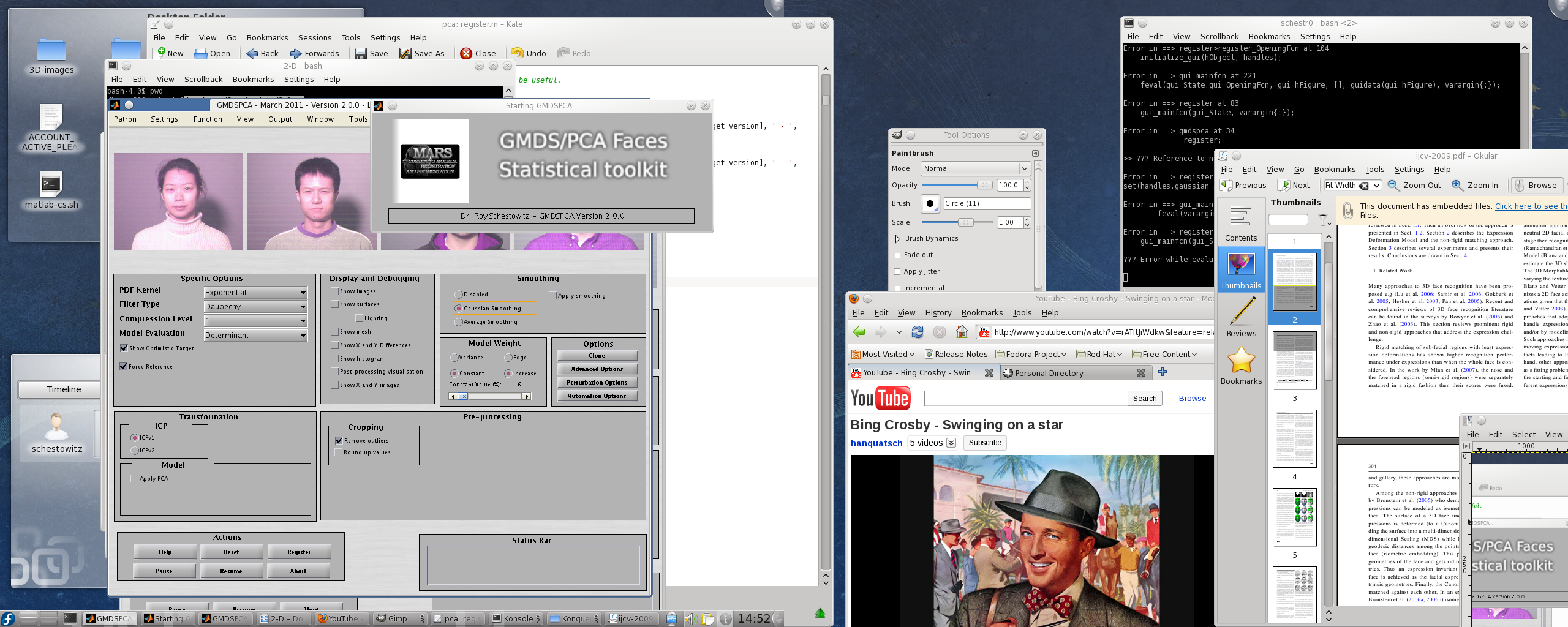



 The show ends with “Zombie Baby” and “Endsequence”. We hope you will join us for future shows and
 EDORA 11 is a fine distribution of GNU/Linux, but my session got stuck (frozen) today. Generally, scheduling on the desktop in this out-of-date operating system is somewhat deficient. Windows sometimes do not respond for a period of several seconds. The bug where a text selection cursor is made permanently visible and allows no real interaction with any applications kicked in… again… today. It happens quite rarely with other distributions and there’s an escape route out of it, e.g. if the terminate signal can be sent to the application causing it, assuming it can be identified. But not this time though. Bearing in mind that it’s not the very latest version of Fedora and having used the fourteenth release since it was made available (even installed it for others), it does seem fair to say that for a smooth experience on the desktop, one is still better off going with the Debian family. Mandriva (predominantly but not strictly RPM-based) has been very good too, probably a lot better than Fedora.
 nce a year I take a break from the Internet, usually for about a week. This need not mean being absent from the Net altogether, just a lot less omnipresent (if present at all). Last year I took my longest break ever (well, since the 90s) from the Internet, lasting about 5 days of zero access to the Net. It was an interesting experience. Usually I take these breaks in summer, but due to problems with the Internet connection (although I do work to have it restored in the new house as quickly as is feasible) this time it happens in spring. Anyway, for those who might be interested, here are my experiences when stepping offline after virtually ‘living’ on the grid on a daily basis for 51 weeks.