UTHORITIES seem to be cracking down quite blindly on P2P and bittorrent activities. This is fairly recent news. I use neither torrents nor P2P, but it’s worrisome nonetheless. While it may be true that copyright infringement thrives in such networks, shutting them down immediately (or throttling, aka “network shaping”, aka packet discrimination and tiered Web) is a case of throwing out the baby with the bathwater. There is a lot of legitimate and crucial data on those networks, such as Free software (e.g. GNU/Linux distributions).
There ought to be a better way to disseminate the vast amounts of art (music and video, for startes) that can be legally distributed. Consider various lenient licenses, public domain, Creative Commons, etc. Why not create a limited but huge catalog of music which can be shared legally and then only permit peers in the nwteork to exchange this trusted catalog? This would be perfectly legitimate. No need to hide anything, no need for warning letters from the RIAA, and so forth. Such a service/product would be the worst nightmare to a predatory media industry because no longer will people be required to buy new music the ol’ fashion way.
Many of us are willing to reuse and revive public domain material. We can listen to music that is no longer copyrighted. Why not share gigabytes of data that is perfectly legitimate music? At the moment it’s spreads in all sorts of places. It takes time to find it. But it’s there! There’s no point of centralisation and no peer exchange though, so the utility of the network’s potential remains low. It’s expansive to maintain from a single point. There’s not much choice or searching facilities, either. A service that is built as described here would be very valuable.
can’t believe I did this, but I’ve submitted (manually) over 20,000 stories to Propeller, formerly known as Netscape. I only began in August 2006. The counter stands at 20057 at the moment. I’m only second to Technology Expert, I suspect, in terms of submission volume. When it comes to site ranking — however meaningless it may be — I’m currently 6th, among 390,479 registered users.
ROKLAW’S founder, Pamela Jones (better known as “PJ”), has done an interview with me in Datamation. In the interview she explains her ambitions and drive in following the SCO case for several years. She also expands onto other areas and shed some light on the future direction of Groklaw. From the interview: “Obviously, patent cases are now stage front and center. But we also have an arrangement now where any lawyer can contact me and ask technical questions of our members.”
ALKING about Linux (or more broadly — about Free software) as a cheap alternative to Macintosh and Windows escapes the main point. This point is made more and more apparent as times goes by (and users lose more space). Linux is about freedom, not cost. The cost of an O/S is not as high as the worth of being allowed to control what your PC actually does. Consider DRM, WGA, spying, flexibility, migration, lock-in, bloat, and many other new factors that make alternatives to Linux repellent. Linux helps the user maintains basic rights and be treated decently.
While some people talk about price, it still encourages the misconception that Linux users are cheap or that Linux is good because it’s inexpensive. What if people spoke about the person actually owning his/her PCs, rather than renting a license to borrow some piece of software that takes over the PC, then restricts, punishes, requests money, and phones Mother Ship?
Another distinction needs to be made to separate what people call “open source” and what we know as “Free software”, which includes Linux. Watch the following new video.
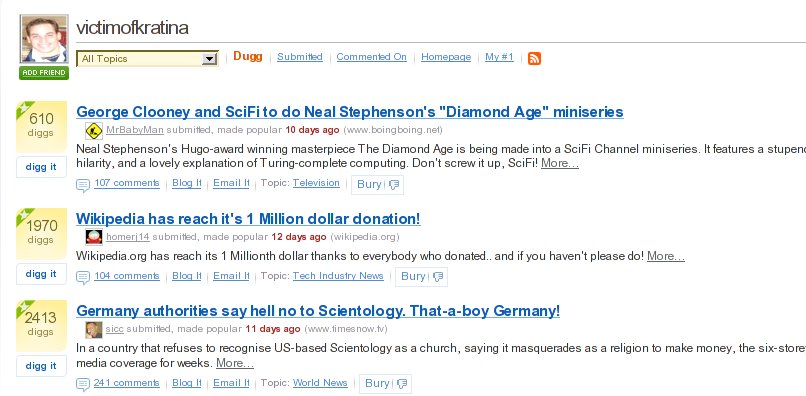
N recent days, attacks on my character have returned and they are reaching a peak. I mentioned this before on various occasions in this blog, but it is worth repeating. Some of the stuff that you find on the Web with my name attached to it is fake. You cannot assume anything which has my name as the poster (even with a valid E-mail address and homepage URL) is really from myself. Forgeries have gone quite far, even as far as Digg. Check out these fake accounts/images for example:
These are only a few examples among more from Digg and there are similar cases of forgery in several other places.
I digitally sign all my outgoing E-mail messages, but I don’t/cannot do this when posting in Web sites other than my own. Moreover, in USENET, it leads to unnecessary clutter. Digital signatures cannot be verified by people who are not IT-savvy, either. Most people are foreign to the very notion.
I don’t know if people are targeting me specifically and I prefer to think it is not the case. Bear in mind, however, that I insisted that those who attack me cannot be paid (or ‘compensated’ by companies that dislike my postings), but my friends are certain that they are, which has me frustrated. Maybe I’m being naive, but the attackers use open proxies (zombies) for anonymity, which speaks volumes.
Some of the abusive posters have done this for many years and death threats were made too. At the moment, others defend me so sometimes I don’t have to, with the exception of many cases where people pretend to be me and post to many forums lies such as “I cut off my [put whatever you like here]“. They also use e libel to try and portray me as a criminal. Some said I should contact Homeland Security.
The trolling has reached my own sites, but I use IP block lists to stop this. One of the abusers has been trying (compulsively) to enter the site almost every day for about a month (since s/he was blocked for flooding blog posts with very libelous things). In other sites, my comments get attacked, ranked poorly en masse (as a matter of principle for who I am, not the content being posted) with attacks on character in particular.
I know people who never let go their identity on the Web. They did the right thing by staying invisible. Anything you say or write can be used against you. I’ve had someone harass an artist to pressure me to take down an image and then there were hundreds of messages accusing me of being a ‘pirate’. They’ll use anything they can (and make stuff up!) to use against me. They repeat and repeat (Big Lie propaganda technique). Those who know me can ignore, but I don’t know outsiders might think. It’s frustrating, but it won’t stop me.
I was told that would be worthwhile to write about this in public, maybe just for future reference. I know someone who decided never to write or comment on another site, which cannot be controlled. I’m not ready to do this yet.
Forget about the Murdoch monopoly, which is essentially an information wall that keeps everyone narrow-minded and aligned with industrial interests. Welcome…
The Mickey Mouse monopoly
Mickey Mouse. Sounds very friendly, doesn’t it? Behind it, a wholly bogus entity of American Dreams and spendings culture lie. Have a look if you have the time.
Appended below (no particular order) are some bit of news I have been collecting. They should hopefully reveal Intel’s malicious and predatory behavior in the market. Some of the hyperlinks have expired, but the fragments of text are equally important.
South Korean media have reported the inquiry has centered on allegations Intel abused its market dominance by pressuring computer makers to avoid using chips made by Intel’s rivals.
It is not common for the Federal Trade Commission, which issued a second request for information to Intel last week, to ask for more information on such mergers.
The American Antitrust Institute (AAI), a Washington DC lobby group, has written an open letter to the Federal Trade Commission urging an investigation of Intel’s allegedly monopolistic business practices.
[...]
AAI say its insistence of an investigation is based on allegations by AMD in a private case and information obtained by the EC’s complaint, which have not been made public
AMD is an undisputed technology and innovation leader.
However, Intel’s abusive, illegal monopolistic behavior is preventing businesses and consumers alike from choosing freely between AMD and Intel products.
The third type of allegation, however, was new, and sounded like a variety of predatory pricing. “In the context of bids against AMD-based products for strategic customers in the server segment of the market,†the commission press release said, “Intel has offered CPUs on average below cost.â€
He is furious that Intel’s CEO Craig Barrett called the One Laptop a gadget. The Negroponte initiative is caught in the middle of a vicious fight between AMD and Intel, he said.
In 2005, after the Japan Fair Trade Commission found Intel guilty of offering illegal rebates to Japanese PC makers, AMD filed an anti-trust suit against its competitor in the U.S. District Court in Delaware. The case has not been decided.
In an unpublished statement to the U.S. District Court of Delaware, AMD alleges Intel allowed the destruction of evidence in pending antitrust litigation.
An investor lawsuit seeking class-action status accuses Dell Inc. of improper accounting in its relationship with chip giant Intel, according to a media report published Thursday evening.
[...]
The suit alleges that Dell received at times as much as $1 billion a year in “secret and likely illegal” kickbacks in the form of “e-Cap” or “exception to corporate average pricing” payments” from Intel to ensure that Dell used no other chip supplier, according to The Journal.
Chairman Craig Barrett, CEO Paul Otellini and sales chief Sean Maloney have appeared on a list of Intel employees thought to have deleted e-mails possibly relevant to AMD’s anti-trust lawsuit against its larger rival. The missing e-mails have thrust a livid state of mind onto AMD’s lawyers who have very serious problems with Intel’s rather lax document retention policy.
[...]
CEO Otellini appears to have been one of these troublesome employees.
Intel, the world’s biggest maker of computer chips, has been cited for anti-competitive behavior for allegedly offering large discounts to computer makers in exchange for their not using products from AMD, the paper said.
Those faulting Intel include regulators with the European Commission and Korea, the Times said. Japanese officials also made similar accusations in 2005, it said. Intel controls some 80 percent to 90 percent of the microchip market, it said.
South Korea began investigating Intel’s marketing and rebate practices for computer processors two years ago after similar probes by Japan and the European Union.
Although neither Intel nor the KFTC provided details on the findings, sources told the Korea Times said that the antitrust regulators did plan to impose penalties on the chipmaker. “The FTC gained some evidence backing up suspicions that Intel has offered discounts to computer makers in exchange for sealing exclusive deals, and coerced dealers not to buy products from rivals such as Advanced Micro Devices (AMD),” said one source.
I vow to keep my eye on Intel’s abuses because they make the world an uglier and imperialistic place. I say this despite the fact that my brother-in-law works for Intel, so there’s no prejudice here.
Retrieval statistics: 23 queries taking a total of 0.114 seconds • Please report low bandwidth using the feedback form
Original styles created by Ian Main (all acknowledgements) • PHP scripts and styles later modified by Roy Schestowitz • Help yourself to a GPL'd copy
|— Proudly powered by W o r d P r e s s — based on a heavily-hacked version 1.2.1 (Mingus) installation —|


 Filed under:
  UTHORITIES seem to be cracking down quite blindly on P2P and bittorrent activities. This is fairly recent news. I use neither torrents nor P2P, but it’s worrisome nonetheless. While it may be true that copyright infringement thrives in such networks, shutting them down immediately (or throttling, aka “network shaping”, aka packet discrimination and tiered Web) is a case of throwing out the baby with the bathwater. There is a lot of legitimate and crucial data on those networks, such as Free software (e.g. GNU/Linux distributions).


 can’t believe I did this, but I’ve submitted (manually) over 20,000 stories to Propeller, formerly known as Netscape. I only began in August 2006. The counter stands at 20057
  ROKLAW’S founder, Pamela Jones (better known as “PJ”), has done
  ALKING about Linux (or more broadly — about Free software) as a cheap alternative to Macintosh and Windows escapes the main point. This point is made more and more apparent as times goes by (and users lose more space). Linux is about freedom, not cost. The cost of an O/S is not as high as the worth of being allowed to control what your PC actually does. Consider DRM, WGA, spying, flexibility, migration, lock-in, bloat, and many other new factors that make alternatives to Linux repellent. Linux helps the user maintains basic rights and be treated decently.