Introduction About Site Map

XML
RSS 2 Feed RSS 2 Feed
Navigation

Main Page | Blog Index

Wednesday, August 9th, 2006, 5:08 am

XGL, Linux Beauty, and Usability

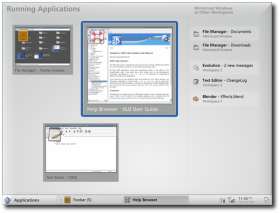
GNOME mockup

HERE is the latest find (a video) which illustrates how beautiful and powerful Linux has become. It is a showcase of dual-head with Compiz/XGL, all under a GNOME desktop. Some continue to argue, backed by myths, that GNOME and KDE are ugly and/or hard to use. I refuted both claims, I hope. Some would say that Fedora does not look so nice ‘out of the box’ (truly a matter of personal opinion). Nevertheless, just like any Linux distribution, it’s extensible and customisable. Here are two visual examples that I could quickly find on KDE-look.org:

  1. I Love My Fedora
  2. Metal Fedora

Related item: GNOME and XGL Showcases

Monday, August 7th, 2006, 3:07 am

Oracle + Linux = No Reciprocity

The powers and savour of GNU/Linux have taken the attention of Oracle’s taste buds. Anything that reduces margins seems to make the founder, Larry Ellison, feel elated. And he’s no exception these days. Some months ago I heard the following joke (paraphrased below):

Q: What is the difference between God and Larry Ellison?

A: God does not think he is Larry Ellison.

Oracle is no longer waiting for a days of free beer (let alone Freedom, as in Free and free UNIX). Oracle reaps the crops which others have previously sown, throughout the early days of Linux. Oracle programmers do not share much of their work, despite their new Open Source strategy. Meanwhile, OSDL is being snubbed too, according to a recent interview. So what gives? Will Sun Microsystems go down a similar route with Java?

I sometimes think that Oracle executive need to sober up their mind (preferably with some rum) and give something in return. Linux could truly benefit from budgets as large as Oracle’s — budgets that expand owing to the competitive advantage one gets with Linux. Seeing the abuse they currently direct at Red Hat leaves nobody with impeccably-neutral thoughts, sentiments and Oracle affinity. The ethical issues that are tied to forking of Red Hat Enterprise Desktop/Server, as well as the inability to snatch JBoss for middleware, has left Oracle bitter. But it’s more akin to snobbery, as well as neglect of the roots that got Oracle where it is today (Oracle was among the earliest large adopters of Linux).

Red hat
RedHat Linux

Will Oracle ever befriend Linux and actually prove that something can be given in return? At present, Oracle competes with and destroys some of the business that MySQL, Firebird, and PostgreSQL have conquered with Linux and pure Open Source software. This lack of moral values makes the mind boggle. Reciprocal benefit is just a belt-and-braces exercise given that Linux is out there begging for mere donations. What about assisting the giant whose shoulders you now stand on? Nobody can issue a cease-and-desist on the use of Linux and, in fact, with contributions to the kernel and even vocal appraisal alone, this can be seen as a form of advertising — a reciprocity.

I continue to perceive Oracle as somewhat of a Linux and Open Source parasite. Sometimes, more damage to reputation is done rather than the very contrary. Every once in a while somebody needs to crack that whip and knock some sense into those who only use Linux, accumulating enormous wealth and refuse to return anything, even when gently asked. Although there is no obligation (this is a clear point that frequently recurs in such discussions), there should be some sense of responsibility. You give and you get. FLOSS is community based, so the development of ‘lamer’ habits is dangerous. Let us all work together for the betterment of Linux.

Related item: Open Source and Paracites

From the press: Oracle #1 on Linux With More Than 80% Market Share

Oracle’s Linux commitment began in 1998 with the first commercial database on Linux. Today, only Oracle provides support for the complete software stack on Linux with applications, middleware, database and the operating system, including Red Hat, Novell/SUSE and Asianux. All Oracle products run on Linux, and Oracle Database on Linux meets the EAL4 Common Criteria…

Sunday, August 6th, 2006, 6:56 am

RSS Alternatives and Feeds Overload

RSSOwl Logo

FEEDS have improved the lives of everyone who wishes to be ‘on top of things’. But what tools should ideally be used? For syndication, I continue to use RSSOwl, as opposed to more bloated alternatives such as recent versions of Mozilla Thunderbird. I partly helped in the testing of RSSOwl (as a gensture of reciprocity), so I still feel as though I must ‘eat my own dog food’. And yet — recently had to check some other feed readers that are Web-based (or a carefully-crafted script that outputs (X)HTML). I was interested in better tools whose development is more active. The same applies to newsgroup readers. Some describe themselves as ‘application whores’ in such contexts.

Over the years I developed this banal habit of reading feeds. At present, I read the news three times a day (i.e. three passes), but other feeds — those which I once followed closely — I only go past or glance at about twice a week. Desire has been lost for full RSS coverage. Mailing lists and newsgroups likewise. Often I just quickly look through the titles/subject lines. It’s probably due to excessive subscription and burdensome load that I can no longer cope with. But there is no sense of obligation anymore. I suppose many people reach the state of feed overload, which is closely-related (if not an alias for) ‘information overload’. Such overloads take over innocent cyberspacers.

Side-anecdote: In hindsight, the last sentence if a bit of an overstatements or maybe a gross generalisation (projecting one’s problems onto others). But this generalisation is probably a benign one that acts merely as a warning sign. Unlike, for instance, calling someone a murder for taking antibiotics and killing germs…

Friday, August 4th, 2006, 4:47 pm

Microsoft Windows is Creating Jobs

  • For malware developers
  • For spammers
  • For extortionate botmasters
  • For spam filter developers
  • For firewall developers
  • For anti-virus developers

All of the above are nasties or software that defends against them. All of them exist and prosper owing to the fact that Windows was never built with security in mind. I can’t help feeling bitter as I am among the sufferers, despite the fact that I touch no Microsoft software. In a matter of just one week, a 30-megabyte mail account got clogged up by SPAM. The amount that comes in is so sheer that I cannot afford to even look at all the subject lines; rather, I go by patterns and highlighting-type filters. It is unbearable as I am skipping some genuine mail.

Windows botnets have brought the Internet to a dark age. Some people question themselevs as to whether conceding the use of E-mail altogether is the better way. And as for collaboration-based, Web 2.0-ish software, I have already been forced to disable much of its function (e.g. registrations, comments, and open Wikis). I also needed to block 2 IP address yesterday, due to continuous abuse involving heavy and continuous spidering of my main site. At least the abusers’ ISP‘s were alert and they quickly took action. These attacks came to their end yesterday. They were not the first though. It is a recurring pattern.

Several years ago I said that SPAM was a problem that did not affect me and I would rather just ignore it. But I am afraid that it is no longer possible. And if Microsoft does not protect its O/S (Vista was already proven to be hijackble) or loses a very significant market share, things will not improve any time soon. They will only get much, much worse.

Junk mail

Thursday, August 3rd, 2006, 3:28 am

The Imbalanced State of Digg.com

The Digg front page

DIGG.COM is a Web sites where more prominent news stories are voted for by a large pool of users. An informal blog post from ZDNet revealed some intersting ‘Digg facts’. It is of great interest to me as I have become a regular member and participants of the Digg community (I am currently ranked 17th).
Diggtrends.com aimed to find out answers to the following questions:

  1. What is the real contribution of top 100 users?
  2. Who took Jason’s (Netscape) Offer?
  3. How did the user statistics changed after July 18th (Jason’s Offer)?
  4. How many dig users are really contributing?

To the first question, they found:

  • top 10 users contributed 1792 of the frontpage stories – i.e 29.8%
  • top 100 contributed 3324 stories i.e 55.28%

Nearly 30% of frontpage stories contributed by just 10 people is a pretty amazing stat – talk about the A-List!

Addendum: here comes the more official analysis/announcement

Wednesday, August 2nd, 2006, 6:28 am

The Windows User’s Anti-Linux Mentality

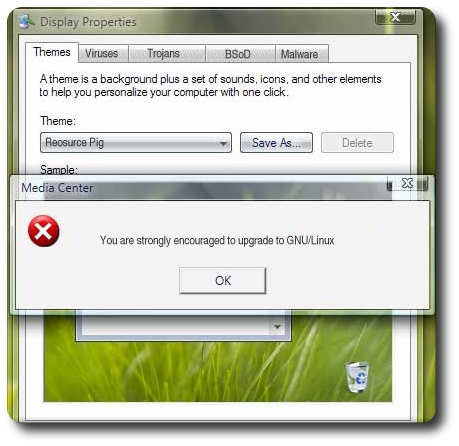
Vista error message

I learned to love the mockup that I had prepared with
the GNU Image Manipulation Program (GIMP) last month

STEREOTYPES are hard to fight, but logical inclinations are even harder to change. Everyone wishes to push away the enemy, whatever or whoever that enemy may be. First they ignore, then they ridicule and laugh at the enemy. Finally, they fight, before inevitably conceding and losing (attribution: Ghandi was among some people to use this 4-step breakdown, but he was not necessarily the first).
What point am I approaching here? Nobody likes foreseeing change. Change can leave one behind. Windows-defending ‘Internet trolls’ , and Windows advocates alike, fear becoming newbies so they will utter “Linux is terrible, hard, not ready for the desktop and so forth”. Maybe if they push it hard enough, they believe, one can win time for Microsoft to catch up, yet they most probably will not. This commotion has the adverse effect. The sooner people upgrade to Linux, the better. The world is heading towards open standards, Open Source, and one vocation that is opened by such migration — the Free Open Source: GNU/Linux.

As I said once in the past, I do not perceive myself as a typical, largely-ridiculed ‘Linux fanboy’. What I do appears to be constructive and beneficial for society’s computing infrastructure, as well as for quicker innovation in science and technology.

In recent months I have had the pleasure of sending Pamela Jones some news items on a daily basis. What a nice person she is! This morning I decided to learn a little more about her (non-personal) background and the following interview caught my mind (only a fragment appears beneath). I believe it supports the main point that I address above, as well as my previous post from yesterday.

(PJ:) They were always getting viruses and other malware, and eventually I learned why and how and what to do (not that they cooperated much), and one day I realized, “I really love this stuff.” When I discovered dual booting or a Knoppix CD meant you could see what went wrong on the Windows side, it changed my life. Eventually, I couldn’t enjoy Windows any more, partly because I saw finally there really was no way to secure a Windows 98 box no matter what you do, and partly because upgrading beyond Windows 2000 meant licenses to choke on, a lot because of privacy concerns, and also because I started resenting typing in numbers to prove I had paid for the software and feeling like I was being treated like I was criminally-inclined. The difference in how I felt using the two OSs was striking.

One day, I realized that this difference was “It”. Proprietary software and all the laws that back it up are designed to enforce restrictions on users. And that’s just what it felt like. For personal pleasure, I always turned to GNU/Linux, which felt like breathing clean air. No restrictions.

Tuesday, August 1st, 2006, 8:07 am

Why Linux?

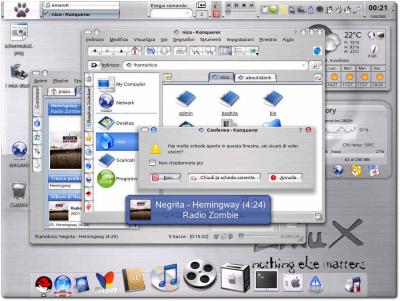
Tiger in KDE
Linux with KDE in its Baghira glory

Penguiniator expained this rather nicely in news:comp.os.linux.advocacy only days ago.

No anxiety over spyware in the form of “critical updates” that phones home to verify that your copy is legit. No danger that your software is tied to a company’s fortunes. No clandestine third party programs that disable your hardware when you “misuse” “their” music CD’s. No malware that turns your computer into an email zombie or that harvests contacts from your address book. No mysterious changes in your computer’s settings. No extra charges for bug fixes that are labelled as upgrades. No help files that are sprinkled liberally with marketting drivel. No need to reboot every time a new program is installed or updated. No artificial limitations placed on what you can do with your software, such as automating tasks, giving away your software, installing it on as many computers as you want, using it for commercial and non-commercial purposes. No need to relearn everything you knew about computers when your software vendor decides to replace the user interface with one that it promises will make you a more efficient user. No need to upgrade your applications just because you decide to upgrade your operating system. No need to upgrade your operating system just because you decide to upgrade your applications. And no need to look over your shoulder while you desperately try to stay ahead of rapidly approaching hardware obsolescence in the process.

When you learn a program, that knowledge remains valid for a very long time. File formats and communications protocols are open. Competition between developers is usually friendly and benefits everyone, especially end users. Availability of software is limited less by the financial resources of the user than with proprietary software. Users have direct access to developers and can influence the future development of their software. Technical support is more accessible and better organized than with proprietary counterparts via FAQ’s, how-to’s, Usenet, Web forums, wiki’s, IRC channels and email. Help files are more honest about a program’s shortcomings, listing known bugs and work-arounds for them. And it’s fun.

Real-time Posts

Posts by @schestowitz

Retrieval statistics: 23 queries taking a total of 0.168 seconds • Please report low bandwidth using the feedback form
Original styles created by Ian Main (all acknowledgements) • PHP scripts and styles later modified by Roy Schestowitz • Help yourself to a GPL'd copy
|— Proudly powered by W o r d P r e s s — based on a heavily-hacked version 1.2.1 (Mingus) installation —|