Monday, December 19th, 2005, 4:04 am

An example output image from the simple text-to-sign generator
Check out this on-line church sign generator. You need only enter some text to get an image generated ‘on the spot’. Notice the nice embedment of the letters in the sign. This page was brought to my attention by Dr. Scott Tobkes.
Image/text generation tools:
Sunday, December 18th, 2005, 11:49 am
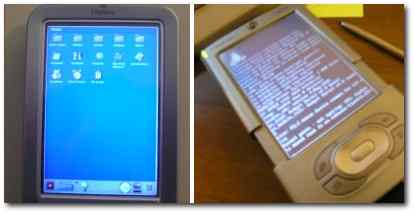
 ALM have intended, for quite some time in fact, to ditch Palm OS in favour of the Linux kernel.Then again, there are independent efforts by individuals to boot and run Linux on Palm devices, regardless of Palm’s mainstream initiatives.
Two new examples:
Related (older) items: Linux on the Tungsten E
Sunday, December 18th, 2005, 7:38 am
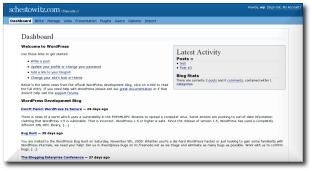
The WordPress dashboard in its ’2.0 gown’
 OR the past few weeks I have been working with the existing revision of WordPress 2.0 (RC2, soon Beta). It is currently on ‘feature freeze’, so it’s primarily a matter of cleaning up all imperfections and minor bugs. The nightly build of WordPress appears to be in a solid state and can definitely be described as “impressive”. My intention is to move this modified WordPress 1.2 blog (as well as another) into a newer and more robust section. There are various limitations to WordPress 1.2, the main one being its adaptability to scale and accommodation for functionality.
I have not made the new installation public yet, but the idea I have in mind is migrating the feeds to the new platform. I will be leaving the old 1.2 installation as-is to serve as a collection of legacy pages. The new installation will not contain older posts as to avoid duplicates. It can be perceived as a successor in a sense.
So what else should you know about WordPress 2.0? [Read on for details]
Read the rest of this entry »
Saturday, December 17th, 2005, 8:45 am
Wallpaper from Houghi (click image above
to enlarge; non-lossy PNG version)
Below is the summary of an article on user interface revolution. It has motivated me to post links to relevant items of mine.
Will we be stuck with flat rectangles on our desktop forever or will we finally live in a 3D desktop? This article discusses some alternatives and proposes a framework in which future interface designs may be evaluated.
On 3-D desktops, interaction, and display:
A few related ‘leftovers’:
Saturday, December 17th, 2005, 4:51 am
 Time and time again, Bill Gates is urging his engineers to push harder towards successful penetration into the Web. His main rival has been identified already and it has a name: Google. Now begins the fight to win over large corporations that can give an exposure boost and yet more marketing pipes. After talks and negotiations with both sides, AOL appear to be getting close to Google. In stake: communication, media, and more.
Under the deal, Google would pay $1bn (£565m) for a 5% stake in AOL, the Wall Street Journal website has reported. The two firms have declined to comment.
Here is an interesting quote comes from Blake Ross on the state-of-affairs between Google and Microsoft Windows. In particular, emphasis is put on the decline of the Windows brand.
As a user, how many times a day do I see “Windows” versus “Google”? My generation doesn’t know or care about “Windows,” and why should they? For all the talk about Google trying to “get onto the desktop,” you rarely hear about the incredible brand strengthening that takes place every time a user types “www.google.com”. Users go to Google and know it; Windows is a foam peanut that comes in the computer box. More than Google trying to get onto the desktop, Microsoft is trying to get onto the Web.
Friday, December 16th, 2005, 12:27 pm
 F I ever undertake a repetltive task that pertains to research, I wish to either automate it using existing (preferably free) tools, script it (e.g. bash, Perl or MATLAB which is by all means expenesive), or costomise the desktop environment to minimize the number of moves, clicks, etc. Productivity through convenience can be achieved using clipboard stacks, mouse focus policies and so forth.
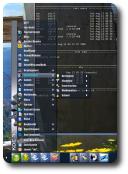 I find Linux to be a powerful tool in research. Windows, for instance, could not replace the multi-tasking capabiltities and expresiveness of Linux. Macs likewise, although they are most popular among designers, technical designers included. They are not, as far as I can tell, an optimal programming platform considering the price which they sell for. Singularity from Microsoft is intended to address the deficiencies related to Windows in the research sector. It is Singularity, as well as Monad, that ought to endow Microsoft with the platform that suits so-called “power users”. Monad is a command-line tool for Windows, that has been hacked a few months ago and will therefore be excluded from Windows Vista. In the mean time, KDE will remain my favourite desktop environment. Linus Torvalds could give a polite nod.
Desktop environement productivity tools and essays:
Friday, December 16th, 2005, 5:41 am
 HERE is a certain rumour, according to which Google are eyeing the acquisition of Opera. Opera is a powerful Web browser that has never attained its much-deserved popularity.
Google already financially support Mozilla Firefox and are sometimes even biased towards it. Evidently, Google cannot buy Mozilla or get directly involved in this splendid project. One wonders what powers Google would have gained if it adopted Mozilla Firefox more religiously. With the buzz about on-line operating systems and speculations over a so-called “Google O/S“ , one can speak of embracing the network boot, then using the browser for Web applications.
Opera was made free (yet it remains a commerical project) some months ago, shortly after its 10th birthday. It was only then that I decided to install it. I must admit that it looks very slick in this latest version, which is great improvement when compared against my memories of it. I first used Opera around 2002 under Red Hat Linux.
Opera is rich in terms of its features, but lacks that freelance developer involvement as it is not Open Source. Therefore, Opera does not have many plug-ins and is about as extensible as Internet Explorer, if not less. The base package, however, is featured and incorporates mouse gestures support and plenty of other goodies. If Google ever decided to gain ownership over this inter-operable browser, they would have a wonderful starting point and be able to use their reputation to spread it among the international community.
Addendum: Google are developing even more plug-ins for Mozilla Firefox.
Update (17/12/2005): Opera Dismisses Google Takeover Talk


 Filed under: