Introduction About Site Map

XML
RSS 2 Feed RSS 2 Feed
Navigation

Main Page | Blog Index

Monday, August 22nd, 2005, 4:22 pm

Google Desktop – Verging a Google Browser?

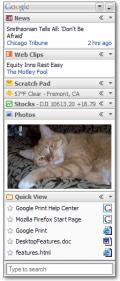
Google Desktop 2Only months after the release of Google Desktop, the much richer Google Desktop 2 has been announced. This native desktop software, as well as indexing and searching one’s hard-drive, incorporates a controversial sidebar. This sidebar contains RSS feeds, a virtual Gmail inbox, news headlines and more utilities and plug-ins like a scheduling toolset.

Will this truly provide the infrastructure to what might become a Google homebred Web browser? This kind of browser would make the Google-centric application everything that you will ever need. Would such strategy move all the users’ data on-line, namely mail, schedule and settings? Will this make our lives even more portable? Surely there is potential for this vision, which is not baseless. Google have strong ties with the Mozilla Foundation and they may have pondered the possibility of a Google browser in the past. Some sources claim they have.

Related items: Google OS – What if?, Towards On-Line Operating Systems

Monday, August 22nd, 2005, 6:16 am

PageRank and Traffic

Google’s PageRank mechanism refelects on popularity estimates in most engines and directories, which presently adopt similar ranking methods that are based on the notion of citations (links).

The average webmaster would fall victim to an illusion. It always appears as if the majority of other sites have higher ranks. A question then springs to mind: how come most pages being visited have PageRank 4 or higher, for example, if they are only a small minority? The matter of fact is that much of the Web, including one’s own site have much lower ranks. That remote part of the Web is often virtually invisible to the errant surfer.

Let us recognise the fact that Google, Yahoo and CNN, for example, receive far more traffic than other sites. Their traffic is many orders of magnitude higher than that of the average site. To visualise this, I drew two exponential curves. Some figures suggest that the curves I drew for illustrational purposes should be far steeper. Some would suggest that at any level of PageRank the number of sites may be 3 times smaller and the traffic 3 times greater than that of the previous PageRank level.

PageRank versus traffic
The number of sites with PageRank 10 is tiny when compared to the number of sites with PageRank 0. Conversely, traffic is largely centralised in sites with a high PR.

To give an idea of how vast the World Wide Web actually is, the number of sites is slowly approaching 100 million (all registered global domains, as well individual parts of the world). At present, PageRank 0 may fit 50 million sites (some are not identified, not listed, or parked), PageRank 2: 5 million sites, PageRank 4: 500,000 sites and so forth. Of course this rough guess does not lead to the true numbers, which end up at just dozens of sites with PageRank 10.

In conclusion, always remember that the vast majority of sites is on the left-hand-side of the figure above, whereas some of the far more popular pages are on the (comparably) tiny number of pages on the right, e.g. the Google’s search page, the BBC front page or the W3 consortium pages.

Sunday, August 21st, 2005, 7:00 am

Einstein Manuscript Archives

Einstein's manuscriptYou can now take a peek at one of Einstein’s last great breakthroughs. Be aware that the manuscript is written in German and Einstein’s handwriting is not very legible.

If it took the University 80 years to find his manuscript, one wonders about his privacy, which was in great jeopardy. This is yet another manuscript to be added to the pool of similar scans. It has been several years 1 since Einstein’s manuscripts were put in alberteinstein.info.

1 I can still remember the announcement from Reuters at the time.

Saturday, August 20th, 2005, 5:46 am

Fake Laughter

Roy as a baby smilingCertain ever-lasting trends in society worry me. While there is less smiling and degradation in terms of affectionate social patterns, anywhere you turn you see excessive compulsive laughter (often in public places over the telephone) as well as fake, polite laughs. [that's my genuine laugh on the right, circa 1984] Fake laughter has become a fundamental asset to girls who flirt. A man might say the darnest thing and some girls would still voluntarily giggle. Guys likewise, but as a straight man, I have no evidence. Either way, this fabricated temperament is becoming a norm.
It is also possible to see this wave of fake laughter in today’s sit-coms with a live studio audience. I don’t know about the old TV series , but the new batch of Hollywood Squares (with Whoopie), for example, bothered me quite a bit. Involved are 9 celebrities who memorise one-liners off paper, 2 contestants saying “true” or “false”, and an audience that hysterically laughs at jokes written by comedians prior to the show. In America, you would sometimes spot a guy with a large banner facing the audience and encouraging them to laugh or applaud. I used to watch such shows when there was nothing else on TV. Maturity has taught me the low educational value contained within them. We have to realise that if a joke is not forcibly laughed at, it does not imply that we have failed to understand it. One who does not laugh is not necessarily a boor.

To sum up, my bottom line would be that staged behaviour on TV hit our lives too. Most of us are living behind masks, hiding our real feelings and manipulating natural emotion to achieve our goals or adhere to norms. I am hoping for greater openness in society one day. Fake laughter is relatively benign, if not beneficial, commonplace behaviour. The new wave of utter disrespect, distance and cold, emotionless attitude is a far greater danger as manners and flattery are still the glue of society.

Friday, August 19th, 2005, 3:30 pm

Weather RSS Feeds

Man with binoculars

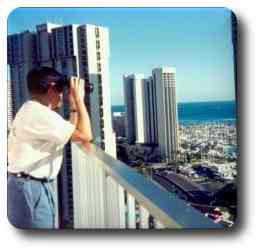
Methods exist for fetching weather forecasts as XML (RSS feeds). Weather Underground is the international giant, but its feeds are not sufficiently extensive. It reflects on current conditions in various places in the world, but provides no forecast. To subscribe to such feeds, go to Weather Underground, search for your town/city and identify the RSS2 button (presently at the top-right of the resulting page).
For more extensive and useful details, make use of the brand new XML’d information from the American National Weather Service:

The folks in the United Kingdom can enjoy the BBC Weather RSS feeds, which are in fact scraped from BBC Weather They are not quite legitimate, but they provide a concise yet detailed 5-day forecast.

Friday, August 19th, 2005, 3:46 am

40 GB per Platter

External hard driveIt’s coming! The perpendicular magnetic recording (PMR) hard-drive has been released by Toshiba for the first time. This 1.8 inch hard-drive takes us closer to the vision of huge capacity concentrated within a tiny space. As storage barriers are breached, not only laptops, but also handheld devices begin to challenge the desktop. This condensation of storage is particularly valuable for miniscule devices such as PDA‘s.
The disk stores 40GB in a single platter, and there are plans to release a 80GB version later this year

…

Toshiba is currently shipping the 40GB MK4007GAL to OEM and channel partners. The company plans to apply PMR technology to its 0.85-inch HDD in 2006, increasing capacity to 6GB-8GB per platter.

With many modern machines, the large numbers of platters relies on physical space being available. This enables manufacturers to sell hard-drive that reach hundreds of gigabytes (soon terabytes) in capacity. Expect PDA’s to contain a much greater amount of space soon, which is a pre-requisite to using them as hard-drives on full-sized PC‘s. Portable devices such as the Palm LifeDrive should be able to increase ten-fold in terms of capacity. This will probably happen some time in the near future when they equate to the capacity of the iPod (up to 60GB), for instance.

Cited by: PalmAddict

Thursday, August 18th, 2005, 11:29 pm

Elevator Express Mode

Elevator panel

A friend sent me this mischievous E-mail which explains how to avoid stopping at any intermediate floors when using an elevator.

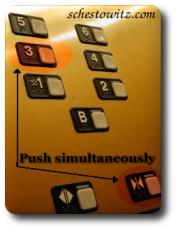
Many elevators include a hidden feature that puts them into “Express” mode, which will take the car to the floor of your choice without stopping at any other floors. When you enter the elevator, press the “door close” button and your floor button at the exact same time. For most elevators, this will automatically activate the “Express” mode. Some elevators require a key to activate the mode, and in some the option has been turned off by the elevator’s owners. But elevators the trick usually works on include:

  • Otis Elevators (Except those made in 1992)
  • Some Dover Elevators
  • Most Desert Elevators

Don’t tell too many people about this, as it will stop working for all of us.

I sure hope it does not trigger red lights somewhere as I have never tried it before. Spreading the word is something I could not resist doing. Just remember not to give me (or my friend) any credit for this; it is not something to take pride in. As a final clarification, I have never tried it, neither will I ever be tempted to. It is a nice trick to be aware of nonetheless.

Real-time Posts

Posts by @schestowitz

Retrieval statistics: 23 queries taking a total of 0.094 seconds • Please report low bandwidth using the feedback form
Original styles created by Ian Main (all acknowledgements) • PHP scripts and styles later modified by Roy Schestowitz • Help yourself to a GPL'd copy
|— Proudly powered by W o r d P r e s s — based on a heavily-hacked version 1.2.1 (Mingus) installation —|