Introduction About Site Map

XML
RSS 2 Feed RSS 2 Feed
Navigation

Main Page | Blog Index

Archive for the ‘Internet’ Category

Mail Readers Survey

As we approach the end of yet another year, some might ponder:

“what does each mail management method have in store?

I shall attempt to point out several facts and add my opinions, not necessarily in a most coherent manner. I chose to compose this item as streams of consciousness loosely glued together.

Local Mail

Outlook should not be considered the “gold standard”, i.e. one to compare most applications against. Thunderbird, a Mozilla Mail (Netscape) derivative, can be re-enforced by a powerful set of extensions among an endless ‘pool’. It can then becomes extremely powerful and versatile, much like Mozilla Firefox. It then becomes the most valid benchmark reference, which is rather hard to match.

Themes in Thunderbird are more visually appealing than most (I use an Aqua lookalike theme as shown below) and they are applied to the application as a whole, as broad as it may be in terms of functionality and widegets. Thunderbird is very stable and is — as always expected — cross-platform. Version 1.5 is now in beta and the inimitable Brent O’Connor gave it the thumbs up a couple of days ago.
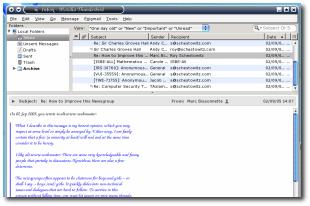
CrossOver
A shrunk-down screenshot of CrossOver-themed Thunderbird

Also see an older overview and comparison of mine which involved Outlook and Thunderbird.

Personal Remote Server

There is a true danger which lies in remote mail storage, i.e. mail that gets stored elsewhere, as opposed to the owner’s hard-drive. I once discussed the rudimentary choice between Web-based and locally stored mail.

If you opt for a rich on-line mail management tool, seek functionality and speed. I personally like the Zimbra interface a great deal. It requires some decent specifications as well as good bandwidth though. I recently recommended this tool in UseNet, having come across that fascinating Web application only days ago.

There are also free programs that can manage mail on one’s own domain. SquirrelMail is terrible from a productivity point-of-view and NeoMail is buggy. For remote mail and handling of several accounts in tandem I use the latest of Horde (formerly Imp) , which is fantastic. Filters, for example, are very powerful, as previously illustrated. The filters almost make Horde comparbale, efficiency-wise, with local mail clients.

Hosted E-mail Accounts

A few days ago I came across an article which criticised decisions made arrogantly by the GMail (Google Mail) team. Yahoo Mail was said to be superior. The article suggested: Yahoo E-mail delivers that desktop feel most users expect. MSN and Hotmail, on the contrary, no longer see the sun shine. The Microsoft on-line services have accumulated billions in losses despite being default placeholders (front page/home page) in Internet Explorer. Internet Explorer is bundled with Windows and cannot be uninstalled, one might wish to add.

Death of Privacy

Google Cookie

GROWING criticism becomes apparent as personal information on the Internet breaks new boundaries. This recently had CNET ignored by Google. CNET correspondent bluntly disclosed too much information about the personal life of Google CEO, Eric Schmidt. From that damaging article, which among another things, penerated a life of an individual:

“Your search history shows your associations, beliefs, perhaps your medical problems. The things you Google for define you,” Bankston (staff attorney at the Electronic Frontier Foundation) said.

The only way to avoid nasty information from ever being dispersed across the Internet is for everyone to recognise the danger of mentioning names. However, it is possibly too late already — too late to revert things, that is. The Web Archive, as controversial as it may seem, takes snapshots of the Internet periodically and makes these snapshots publicly available. Anything that was ever public remains public, perhaps under a few extra layers. Google cache introduces similar issues.

Recruitment agents or bosses can find out a lot about an individual nowadays. As a personalised instance, a search for my name (in Google) brings up approximately 70,000 results. Adding an extra term to query, ‘roy schestowitz microsoft’, for example, will draw a vivid picture of my mental views on the company. There are nearly 1,000 results for such a Web search.

Privacy is in jeopardy and is bound to be completely compromised as time carries on. Names do not have to be ‘contributed’ by will. Rather often these days, somebody else might mention one’s name, which will later be harvested and made available to anyone who ‘googles’ the name and binds it to some context. It was not too hard to discover a fair deal about families of famous IT founders. There needn’t be the will to disclose that information either. Sooner or later it will ‘leak’ and be made easily available due to. Search on the Web, as well as blogging, are a mixture that leads to dissemination and duplication. Take the embarrassing photo of Bill Gatesas a practical example.

On a different yet related topic, search engines slowly embrace spying, whether intentionally so or not, whether it is ethical or not. It is perhaps due to pressure from investors, who urge to do all that is necessary for increased profit. An IPO is never too helpful in that sense. There is a great deal of fuss revolving around the notorious Google cookie. Microsoft have been labelled “guilty” as well for MSN targetted advertising which involves spying, as well cross-site cookies exchange. Technologies advance and allow better monitoring than ever before, which is factor that raises even more concerns.

Has your privacy been broken apart? If not, it is probably just a matter of time.

Personal Computers as Relics

A repeated argument of mine gains strength and gets somewhat augmented as the president of Sun Microsystems speaks out. He recently predicted the diminish of the personal computer, which slowly gives way to on-line services.

The majority of the applications that will drive the next wave of innovation will be services, not applications that run on the desktop. The real innovation is occurring in the network and the network services.

In essence, the Personal computer becomes a host. Looking at an alternative direction, data itself, as well as an O/S and applications, can be accessed via the network (network boot) or even from a pocket-sized device. Whether that path will wind up catching on or not — this we are yet to discover.

Laptop and iPod
The little ‘object’ on the left has the most responsibility. The laptop may act as merely a relic, a host.

The idea of “Web-based everything” is not far-fetched. As we already see complex, JavaScript-based HTML Editors, maybe documents and spreadsheets will turn Web-based in the near future. Physical output can be printed from the browser, resulting in rich, high-quality layout as we approach Web 2.0 (some would argue 1.5) and CSS 2 (and higher). If you are inclined to think that the idea is preposterous, have a look at a complex Web-based mail client that relies heavily on several Web technologies which are available and are properly supported by all major platforms.

There are many more state-of-the-art examples, which embrace that approach of complex AJAX-reliant design, e.g.:

The Winner Takes All

Trophies

An article from CNET makes some interesting observations and is titled Microsoft’s nightmare inches closer to reality. From the article:

The nightmare is inching closer to reality and Microsoft execs are apparently paying attention to the decade-old alert. As part of a management shuffle, Microsoft said Tuesday it would make hosted services a more strategic part of the company and fold its MSN Web portal business into its platform product development group, where Windows is developed.

Another memo, called ‘Google–The Winner Takes All (And Not Just Search),’ is also making the rounds. This internal memo, written in 2005, argues that Google threatens Microsoft and the company’s crown jewel, Windows.

Rumours continue to circulate that Google, whose tight relationship with Linux is no longer a secret, may be ‘cooking’ an operating system. Some recent hirings of user interface experts, notable Dr. Kai-Fu Lee, only support this crazy speculation.

Related items:

Silencing Political Blogs

Torn American flagA BusinessWeek article relating to political blogs is rather difficult to ignore.

It appears as though a controversial move by the US government could make it more difficult for blogs to voice political tendencies. If censorship was ever forced, would that permit the existence of political comments, which may be contained within these blogs? We have already come to witness a lawsuit against a Webmaster due to contributory comments that were contained in his site. This should definitely make us all raise a brow.

Amid the explosion of political activity on the Internet, a federal court has instructed the six-member Federal Election Commission to draw up regulations that would extend the nation’s campaign finance and spending limits to the Web.

Google Goes Firefox-Only?

Firefox in the dock

UNTIL some time ago, the official Google Toolbar was only available for Internet Explorer. There were third-party substitutes, however, as I previously discussed in some depth.

One such third-party solution is the GoogleBar, which has an experimental feature exploiting Google Suggest. To those who do not know, Google Suggest involves a typical search box, with a drop-down list filled with suggestions for search term completion, where prevalance/saturation of results implies precedence. For example, if one was to type in “Star W”, a suggestion might be made for the term “Star World” or “Star Wars”.

The GoogleBar Google Suggest feature was buggy and never seemed to work reliably. As the Google Blog suggests this morning, the Google Toolbar now incorporates a new powerful feature. That feature does exactly what the GoogleBar aimed to achieve, namely provide a drop-down of suggestions in the toolbar, yet it does so reliably. More surprisingly, that feature from Google is only available to Firefox users.

The move surprises me as Google appeared to have favoured or catered for Microsoft’s products before complementing that with support for Mac, Linux, or various powerful browsers such as Mozilla Firefox and Opera. I went as far as contacting Google’s Code Manager a couple of weeks ago. He told me that kind support to platforms is yet to be seen, but software which is complete already should not be held back because of insufficient inter-operability.

In my humble opinion and perhaps for the first time, it seems as if Google put Firefox at a higher priority than Internet Explorer. This might mean something. Opera’s strategic move, which made their browser absolutely free, was possibly backed by revenue owing to Google.

Ending Comment Spam?

Stuffed mailboxes

WORDPRESS is finally most determinded to put a stop to comment spam. The introduction of rel='nofollow' never seemed to have done the trick. Yet, in then absence of this attribute, which was controversially introduced by Google (much like XML’d Site Maps), who knows what a jungle we would have lived in today.

The new spam prevention mechanism will be capable of serving all sites in principle (via API‘s), not only WordPress-powered sites. Meanwhile, I volunteered to be among the testers, but further details are not intended to be disclosed. I can only say that spam flagging is collaborative, much like Google Mail filtering (mentioned and recommended to the audience in my recent talk on security).

The spam protection plug-in presently has a test-bed on this domain. The following link will get things going, i.e. get spam to surge in:

http://www.schestowitz.com/Spam/

Prepare yourself to the end of comment spam!

Related items:

Retrieval statistics: 21 queries taking a total of 0.085 seconds • Please report low bandwidth using the feedback form
Original styles created by Ian Main (all acknowledgements) • PHP scripts and styles later modified by Roy Schestowitz • Help yourself to a GPL'd copy
|— Proudly powered by W o r d P r e s s — based on a heavily-hacked version 1.2.1 (Mingus) installation —|