Introduction About Site Map

XML
RSS 2 Feed RSS 2 Feed
Navigation

Main Page | Blog Index

Archive for the ‘Internet’ Category

Deer Park

Deer Park

Caution Firefox enthusiasts

There is an alpha version of Firefox, codenamed Deer Park, which is used to test future releases of the Mozilla browser. The following page explains a little further about the purpose of the package. My advice is to avoid the use of Deer Park as it interacts badly with your Firefox profile and can conflict with your current settings, extensions and themes in particular. The Deer Park page clearly states:

Deer Park Alpha 1 is intended for web application developers and our testing community. Current users of Mozilla Firefox 1.0.x should not use Deer Park Alpha 1.

Fixing the Bugs for Browser Developers

Internet Explorer

Modern browsers are among the more complex pieces of software in existence. Because browsers are expected to treat similar data (the World Wide Web) and behave consistently, there is plenty of room for bugs to crop up. Big trouble lies ahead if a browser is re-released infrequently or no updates are made available, apart from the critical. This is probably the main catalyst to the “Don’t click on the blue E” campaign.

Web developers spend extra time trying to compensate for Internet Explorer bugs. In css-discuss, for example, almost half of all questions (if not more) concern browser compatibility, fixes and hacks. Internet Explorer is often the culprit. Rather than fixing/hacking around IE bugs, perhaps we should all upgrade to a browser that is actively maintained and released to the public. There is no doubt as to how fed up development communities have become with IE, which for most users ships by default.

Firefox Toolbars

ZDNet report that Google will release an official Google toolbar for Firefox.

Google is poised to release a version of its toolbar for the Firefox browser, according to information sent to developers of an open source toolbar alternative.

…

It has pretty much the same features as the latest IE toolbar except of course for things like the popup blocker

Various other bars (using the same API) have indicated erratic PageRank recently and PageRank was sometimes greyed out for no known reason (see below). About a month ago it was greyed out globally for 2 or 3 days straight.

PageRank

Until google release their own homebred bar for Firefox, the GoogleBar project will serve as a primary alternative. However, PRGoogleBar (formerly the PageRank bar) is much more powerful as it experimentally makes use of Google Suggest for search phrase completion. It also incorporates extra shortcuts and the ability to customise SERPs behaviour. This bar is definitely better than the equivalent from Google.

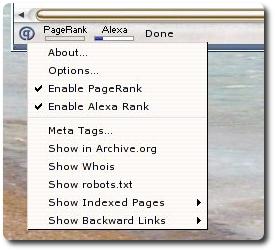
Another excellent search-related bar is SearchStatus, which additionally provides Alexa ranks and does not occupy much screen space (see below).

AlexRank
SearchStatus in action

Finally, also worth mentioning is Yahoo’s search bar which has been kind to Firefox for quite some time.

Playlist Similarity

Vinyl record

How does one identify music which has potential of being liked? Music, unlike textbooks, does not contain text or keywords. Its tags are not always valuable either. An interesting paper from Trinity College Dublin describes a method by which music adapts to the preferences of listeners (PDF). However, can this be done purely based on prior data? Data that is provided in advance unlike in real-time? A List of records maybe? Playlists perhaps? We seem to be coming closer to realisation of this idea.

Image similarity measures are one focus point of my research; also sparks to mind is Google’s notion of ‘Similar Pages’. Why not apply similar principles to music? I now collect big daily dumps of music that I listen to (output to files using the following technique ). Bound to each entry is the time when a track started. From this, one can infer which tracks are being skipped. Alternatively, full, raw playlists can be of use and might, in fact, be more manageable as well. By exploiting a large collection of playlists, the nature of the genres can be better understood.

Given all of this data, it can potentially be used for collabortive playlist sharing, somewhat like del.icio.us (see previous reference to del.icio.us with a gentle introduction). Users can then discover other songs they might like based on other people’s playlists. The more data, the more accurate statistics will be. Getting large lumps of input (playlists) is effortless too. Just imagine yourself the scenario:

You can automatically find playlists most similar to yours and recognise the most-played tracks on that playlist. Social software has seen great success recently, so exchange of music preferences and recommendations is probably the way to proceed.

Treating Online Addicts

Laptop

Audra Ang, an Associated Press writer, reports about a Beijing clinic that treats online addicts.

All the children here have left school because they are playing games or in chat rooms everyday,” says the clinic’s director, Dr. Tao Ran. “They are suffering from depression, nervousness, fear and unwillingness to interact with others, panic and agitation. They also have sleep disorders, the shakes and numbness in their hands.

The descriptions sound a little freaky, but I have known people whose entire life was dependent on their computer.

Hmmm… 5 AM… time for lunch…

CSS Zen Garden Gallery

CSS Zen Garden

CSS Zen Garden is a site illustrating the power of design using cascading style sheets (CSS). It accepts submissions from professional designers and allows visitors of the site to browse, participate, and appreciate a variety of different styles. Navigation among the styles and heavy page loads are rather slow, so why not use the following screenshot gallery of styles from CSS Zen Garden?

Firefox 1.1 Release is Near

Firefox icon

Judging by the official Firefox Roadmap, the release of Firefox 1.1 is near.

Quoting the site:

We are planning for a Firefox 2.0, but will divide the planned work over (at this point) three major Milestones, 1.1 (July 2005), 1.5 (unscheduled) and 2.0 (unscheduled). All major development work will be done on the Mozilla trunk, and these releases will coincide with Gecko version revs.

If you have free time in your hands, you can use Burning Edge to keep track of the Firefox changelog.

Retrieval statistics: 21 queries taking a total of 0.089 seconds • Please report low bandwidth using the feedback form
Original styles created by Ian Main (all acknowledgements) • PHP scripts and styles later modified by Roy Schestowitz • Help yourself to a GPL'd copy
|— Proudly powered by W o r d P r e s s — based on a heavily-hacked version 1.2.1 (Mingus) installation —|