Introduction About Site Map

XML
RSS 2 Feed RSS 2 Feed
Navigation

Main Page | Blog Index

Archive for the ‘Opinion’ Category

Linux Desktop Enviroments and Window Managers

KDE transparency

An Example screenshot from my KDE 3.1 environment. There is
also one from KDE 3.4 (local copy of screenshot)

ADMITTEDLY, I am a huge fan of KDE. That said, many other alternatives (choices) do exist and they scale better with older hardware, levels of proficiency, the nature of the work, and taste. This morning I came across a site which provides a succinct overview of merely any desktop environment and window manager. To quote the introductory paragraph:

Welcome to my guide to window managers and desktop environments for The X Window System, as used mainly by Linux and UNIX operating systems. Here you will find descriptions, screenshots and configuration files for all popular window managers, along with related resources, including a news and discussion area.

Site Advertising for a Lifetime?

Ad BlockingEver wondered if running a recreational Web site can become a full-time occupation? Ever wondered if bloggers can be paid a wage to blog in favour of a particular company? That it, using the audience as a tool for income? It is a rarity, yet a reality, which more and more people strive to attain.

I pretty much know what ambitious Webmaster are trying to accomplish with advertisements, but if it is income for life, I would warn them in advance. There are very few Webmasters who, at the moment, can actually boast getting a wage out of advertisements (WebMasterWorld is just one example). However, there is a difference between making ends meet and sustaining an income for life. As with all businesses, the terrain changes and one must change and adopt to to this perpetual change. This change is not intervention(time)-free.

The Web, for instance, is changing all the time and all sites need to evolve. Advertising channels and income sources are running dry even for journalists, in part due to online content, bloggers, and Web 2.0 sites, which are far more fascinating (interactive) than ‘old school’ news sites. And by the way, all my sites combined do not generate more than $30 dollars a month. This is not even enough to cover the hosting bills.

To elaborate on the issue of evolving to facilitate trends, 6 years ago I was using nothing but Windows. I thought my skills were well-invested and bound to endure. Nowadays, I never even lay my hands on Windows and, while I consider this change a tremendous improvement, I just know I would never have managed to do the same things as effectively had I stuck with where I was (a monoculture).

Why I Love KDE

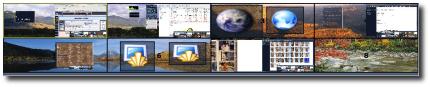
Pager in KDE
A KDE pager containing eight virtual desktops

KDE is a powerful and versatile desktop environment, which I have raved about for as long ago as I had known it (read GNOME vs. KDE, for example). Apart from its augmented support for virtual desktops, it boasts an almost infinite number of features that make it highly extensible. Here are some examples of things that any user is able to achieve with KDE.

  • Open a particular program, let us say the Web browser, consistently in desktop 8, always in shaded mode with opacity level 80% (20% translucent). These per-program features were added around version 3.4 of KDE.
  • Without any extensions, KDE enables the user to download fresh wallpapers off the Internet (primarily through kde-look.org), all with a single click. Then, the user is given the choice to select multiple wallpapers from the collection, revolve them (as in a slideshow) every number of minutes, with separate wallpapers assigned to different virtual desktops, at different changing intervals, and with effects like hue shifts applied to them ‘on the fly’.
  • Move and resize windows without reaching for their edges and corners, simply using the mouse pointer and the keyboard. Moreover, window focus policies, as well as new window placement, is highly customisable.
  • KDE supports XGL (or conversely so, as well GNOME, of course). XGL is hardware-accelerated nice ‘eye candy’, which does not necessarily enhance the pace and productivity of work.

So where is the competition? KDE appears to be best bar none, in terms of function. Many consider it user friendly since its look-and-feel is assimilated to that of Microsoft Windows.

Related items:

Thesis Composition and Apprehensive Thoughts

THE potential AUT strike is keeping everyone occupied, so I have embarked on final persistent push to write and complete my thesis. This began on the 2nd of the month and it primarily involve piecing together some past publications, elaborating where suitable, and glueing them sensibly.

Book shelfWhen I first joined this scene of academic research, I was somewhat surprised to reveal that genuine and original content (as opposed to gross re-use) is not only perceived as acceptable; it is sometimes encouraged, as a matter of fact. I was truly disappointed to come to grips with this mentality, wherein peers say that good text should better remain unchanged and in most cases evolve or have some fine, cosmethic changes applied. If further progress is made, it can be appended to the existing text. This robs many people out of artistic integrity, in my humble opinion. It also leads to duplication and repeatability, which can make us feel like parrots.

Service to Centralise Plagiarism Awareness

Book scanning

WHEN Webmasters discover that someone stole their content, they often report this to Google. Blog plagiarism has truly become a plague, but stolen content, spam, site scraping, and copyrights infringements ought to be reported to all search engines, which is why I set up this one particular Web page. It enables any Webmaster or user to report content misuse to three search engines at once (or in parallel at the least).

What was the motivator for this little handy frameset? I noticed that many people report undesirable content to just a single copany called Google. But what about the others? Shouldn’t all be infomed at once? I believe there should be an impartial, not-for-profit body that watches over content theft. somehat like the DMCA, I suppose. Such a body (or site-accessible service with interfaces) could centralise knowledge regarding Web offenders and prevent various companies from doing this independently, merely reinventing the wheel to achieve the same (search) results.

Think big(ger). Let’s get the Web more organised, better structure, and immune to fraud. Never delegate this responsibility to companies, which are slowly making our Web more commercialised and semi-privately owned.

The Signs of a Company Under Collapse

The Digg front page
Web services and Open Source force a plunge (click for full-sized image)

THE Picture above speaks for itself. Microsoft’s stock (MSFT) continues to lose its value even after that 11% one-day drop. There are plenty of factors going against it at the moment. Word on the street it: George Soros is dropping that stock progressively.

Analysts will one day return to looking at the day when this prominent downward movement began — notably the end of the first quarter of 2006 when Office, Windows Server, and Windows Vista failed to be released on time, let alone offer what was initially planned. It is a sad story, but I cry not.

Who still wants to work at Microsoft? See: Microsoft Job Offer Refusal, My Sister and Microsoft

The Rise of Linux, SOA, Mobile Devices

Season of the playful penguins
Season of the playful penguins from Oyonale

SEVERAL years ago I foresaw the demise of Windows, especially when I was first introduced to Linux. Years later to find myself sought after by companies like Google, whereas giants like Microsoft only seem to offshore their job market as to cut margins and sustain stable figures.

As some recent large declines in the MSFT stock indicate, the trend looks unpromising, for Microsoft. If I was to predict the events of the next couple of years, I would argue strongly in defence of SOA and mobile computing, predominently run on Linux.

Concurrently, as an article in the CNN suggests, mobile devised will gnaw at usage of the personal computer. The evidence is there to be seen as Google liaise with Nokia on their Linux-based Internet tablet. Moreover, Motorola have just become friends of Open Source.

Retrieval statistics: 21 queries taking a total of 0.117 seconds • Please report low bandwidth using the feedback form
Original styles created by Ian Main (all acknowledgements) • PHP scripts and styles later modified by Roy Schestowitz • Help yourself to a GPL'd copy
|— Proudly powered by W o r d P r e s s — based on a heavily-hacked version 1.2.1 (Mingus) installation —|