Introduction About Site Map

XML
RSS 2 Feed RSS 2 Feed
Navigation

Main Page | Blog Index

Archive for the ‘Rant’ Category

Outlook Discourages E-mail Correspondence

CrossOver
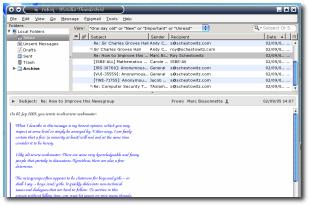
Upgrade to Thunderbird. It’s Open Source and it honours standards/netiquette.

MICROSOFT Outlook is a terrible mail application, despite some common beliefs (and expectations due to cost, or bloat). I cannot comment on its abilities as a calendaring software as I have only seen others using these peripherals features. However, at least one Outlook user whom I exchange E-mails with is breaking every rule in the book regularly (if not always). Outlook does not prevent him from doing this. As a matter of fact, it encourages this and a dissatisfied recipient is of course less likely to reply.

Here is a short description of the problems inherent in these messages that I receive from Outlook (and sometimes Outlook Express too):

  • HTML-formatted
  • Non-standard ‘HTML’ (Microsoft Office inclination, MSIE-centric)
  • Roughly 38 kilobyte even for a one-liner (an enormous non-standards compliant ‘style sheet’ is prepended)
  • 10-line signature (Outlook does not warn or deter)
  • No signature delimiter (breaking all RFC standards)
  • Always top-posted, not trimmed and lacking context (Outlook is definitely not helping by creating new lines and putting the cursor at the top)
  • In quotes, re-wrapping is broken and irregular symbols get inserted sporadically

There is no gentle way to approach the issue, but one such person learned to at least stick to plain-text (owing to a kind request). The top posting habits remain though. Outlook Express requires QuoteFix, which is addon software/hack, just to stop this default behaviour and make bottom posting practical. So there is no subtle way to suggesting others to improve their posting habits, unfortunately. To them, the Windows/Microsoft way is the right way. Acceptable standards lose their value when a desktop monopoly simply ignores them.

Some time ago I wrote some notes on how to begin loving E-mail again , which reminds me of an old favourite that is titled the UseNet improvement project.

A Train Which Requires a Reboot

System error

I was travelling to London the other day and something out of the ordinary happened on the journey back to Manchester. This has me think of the possibility of a subsequent rant, which is something that I can never help doing.

So, we were all prepared to leave Euston Rail Station, but the train got stuck. Once it was time for it to depart, the brakes could not be operated. They didn’t permit the train to move. The manager soon said that the local engineers were called in and later added that the train needs a reboot. All the lights went out and the train was virtually disabled for several minutes. Then, even after the reboot, the breaks did not work. Delays have begun to accumulate as the train remained in the station for almost half an hour longer than it should have.

Eventually, the problem was fixed and we rode to Manchester faster than usual, still to no avail (it was late). I slept the entire time fortunately, so not all was bad. The occupancy of the train was low. I couldn’t help but wonder: are these new-ish Virgin trains driven by anything from Microsoft? Windows in particular as a possibility? Or is it specialised UNIX? This reminded me of a very recent deal involving Microsoft and all the Formula 1 teams. I asked somebody who might know the answer, but he could only suggest the following:

“I’d kind of doubt that they’d have windows, but it is just possible. I’d suggest you contact virgin to find out. If it’s true, it could well be a serious safety hazard which should be highlighted anyway.

Personally, I’ve truly no idea…”

Eventually, I decided to contact the company and find out. I doubt Virgin would even reply to any such as enquiry. If they use Windows, they’ll probably deny it. Nobody wants their train systems hijacked, using the flaw du jour, right?

BBC Confuses Hacker and Cracker, Again

Laptop

The bad reputation that the press is giving the term “hacker” is getting. Too. Much. To bear. From this morning’s news.

Supporters of Gary McKinnon have condemned the decision to let the former hacker be extradited to the US.

[...]

“The US Government is scapegoating Gary McKinnon to cover up their ownshortcomings as systems administrators,” he told the BBC News website. “Who breaks a butterfly on a wheel?”

For the record, the system administrators did not change the default password, so McKinnon had a look at some files and changed the desktop’s wallpaper. This is based on something that I read in a fairly reliable source last year. It seems as though the current American regime is becoming irrational and suppressive.

Stuff That Bothers Me

Here is an arbitrary list of items which contribute to hassle and even distress:

  • Monolithic content management systems such as PHP-Nuke (and its derivatives or siblings) still attract spam. My forum section has begun eating spam on a daily basis and it is very time consuming. I restore from backup every couple of days, merely reverting to an older database state.
  • The blog’s CAPTCHA filter has been cracked, so I must cope with over 100 spam per day.
  • Some people post incoherent comments which are not only characterised by poor grammar and typos. It makes one wonder if click-and-point sobriety tests should replace CAPTCHA-based filters.
  • With the increase in the number of Windows zombies on the Web, the amount of junk mail that I receive doubled within a few months. I am not alone in this, so I at least find some sympathy.

Speaking of which, the following showed up in the news last night:

Spam zombies give UK ISPs the fear

A massive 96 per cent of 50 ISP respondents cited the proliferation of botnets – networks of virus-infected PCs under the control of hackers – as a key business issue.

According to industry analyst firm Gartner, seven in 10 items of spam originate from infected PCs.

Let us take a moment to thank out friends at Microsoft. Owing to their so-easy-to-hijack operating system, we all choke on spam.

  • Lawsuit against Google over PageRank got bloggers humming. It was a mastery of incompetence. One such lawsuit was apparently successful, so algorithms that discriminate (not deliberately so) can lead their operator to paying fines.
  • Judging by one of the OSDL mailing lists, to which I have been subscribed for while, the OSDL mailing lists (much like xmms-dev) mainly attract spam, kooks, and posers.
  • Outlook Express or Outlook (same codebase; same rubbish; one word less) are a bit of a handful. I am tired of receiving E-mail where responses, are top-posted (‘jeopardy-style’ composition, i.e. answer comes first, then the question).
  • Making your software exclusively available for Windows is like selling and displaying your merchandise at a garbage site just because most prospective customers reside.
  • Digg version 3 does not discourage dupes as effectively as it used to. It makes it somewhat inferior to its predecessor. But I digress…

Coping With the Loss of Personal Data

AS recently as January this year, I proudly spoke about data resilience in Palm PDA‘s. Now, on the other hand, I am slightly more hesitant in making such bold statements, having screwed up big time. Allow me to elaborate in a stream-of-rage fashion (this won’t be too eloquent).

Palm TungstenWhile my general opinion (and confidence in Palm) has not changed much, this morning I was a victim of data loss. This cost me about 3 hours, a loss of data that I cannot truly recover, and a huge headache (metaphorically-speaking, through distress). To describe the ordeal in brevity, I woke up to discover that my Palm’s battery was empty. I thought the unit was dead until I had it charged and could reset it. I could soon come to grips with the fact that my main, volatile memory was void (not ROM). I then realised that the batteries got emptied without any prior notification. I left the handheld in my trousers’ packet overnight, rather than dock it on the cradle as I usually do.

The drainage took my by surprise. The last HotSync operation took place 24 hours earlier, but backup files were no good under KPilot, which can be odd and inconsistent at times, despite my praises. To make matters worse, it was the past 24 hours when I made the most changes, some of which were crucial and spanned a period of months. But it gets worse…

I attempted recovery in vain. I fortunately had one backup which was one week old in my peripheral SD card. I could recover with the loss of one week. To avoid this considerable time gap, this afternoon I bought a USB card reader. I thought it would enable me to modify the backup on the SD card using Red Feline Backup — that which I mentioned a long time ago. I wanted this backup to be be overriden by newer data which resides on the desktop. However, files were corrupt and led to a mess time after time. So no luck there, either.

SD Card

All in all, I ended up losing data, some of which I could restore from short-term memory and timely backups on the desktop. It is very laborious and time-consuming though. While the loss was rather small if put in proportion (nothing on par with data loss “disasters”), this occupied a lot of my time as I was somewhat negligent (I was caught off guard due to complacency — an indication of resilience in its own right). I suspect the unit might betray me again, so I will begin backing up more frequently. The paranoid’s approach will perhaps be embraced, but what else do I have to rely on? I never want this to happen again. Ever!

I Do Not Look Forward to Vista

Bill Gates

IF you listen closely, you can already some squeaks of anguish. Indeed, these are coming from Mr. Ballmer as oinks his way into a nearby office to break a chair. The prospective departure of Bill Gates has been made public, so the future of the company his jointly founded does not look bright.

Despite the many problems that Microsoft is facing, many are eager to stay with Windows and accept the Microsoft waiver (EULA). More recently, privacy of users, as well as rights, have been compromised. It’s high time people took a closer look at the truth behind licensing. Deplorable executives whose misuse of the law has reached new peaks are now beginning to depart. This includes Jim Allchin with a Vista status report that can make anyone gasp. Windows Vista is the result of just 6 months in development.

When Windows Vista finally comes out, Steve Ballmer will no longer be dancing like a ballerina. It is no longer the 90′s (alluding to the in/famous “monkey dance” scene). More likely than that, he will toss a chair with sheer fury, repulsed by the outcome, which is completely unacceptable.

So, what it is that can keep Windows in the game for a few more years? To name a few factors: (1) dependence on a vendor, which leads to exacerbating standards, or (2) unilateral deployment of new proprietary ones. Fortunately, Adobe resist the latter, as well as the former. Moreover, OpenDocument has recently become the one and only ISO standard.

There is yet another snag that will act as a barrier to Windows’ acceptance. Microsoft OneCare’s marketing campaign will have to bash Windows security in order to be sold. It is a necessary ‘component’ that fixes another already-broken product, which ironically enough, comes from the very same vendor.

But not all hope is lost. On the other hand, Linux is gaining steam on a daily basis. I no longer blog as often as I used to simply because I report Linux advocacy items elsewhere. Apart from more obvious advantages that are stability, Freedom, and security, Linux always leaves me wanting more as I know the options for extensibility are there. They just need to be understood and embraced. The Linux kernel is better wrought, yet Microsoft propaganda, trolls and marketing puppets deny it. Yes, for income.

Google’s Take on Operating Systems

Google Earth
Click to enlarge the image

GOOGLE Earth has been released for Linux (see my SUSE screenshot for proof), following the Mac OS X version and preceded by the Windows version.

Let us look further. Google Talk is another example of a similar ‘porting channel’. It began with Windows support, just like most desktop applications from Google. Then, there is Picasa, which was ported to Linux using the Wine layer, with several features disabled. There is a whole variety of applications that began as native Windows programs. This appears to be the trend rather than a mere coincidence. A few days ago, SketchUp from Google was ported to the Mac. No Linux version, as yet.

This simple observation leaves you wondering if Google, a company that is heavily dependent on Open Source software, even owing its success to Linux, perceives Windows (with a userbase majority) as a top priority. Only then come the Mac users, Linux being at the bottom (or top rather) of the pyramid. Considering the fact that Linux is more prevalent than Mac OS X (based on several surveys), it would seem as though Google unfairly favours Mac users while neglecting the loyal Linux users, whose number is underestimated. It is worth emphasising that even Google engineers use Linux (Goobuntu) on their desktops. Don’t they have a say?

Retrieval statistics: 21 queries taking a total of 0.115 seconds • Please report low bandwidth using the feedback form
Original styles created by Ian Main (all acknowledgements) • PHP scripts and styles later modified by Roy Schestowitz • Help yourself to a GPL'd copy
|— Proudly powered by W o r d P r e s s — based on a heavily-hacked version 1.2.1 (Mingus) installation —|